The author observes that while the desire for conquest is natural, it must be matched by sufficient power; attempting to acquire territory through flawed alliances is a mark of folly.
← Back to The Prince1 / 2 in chapter
CHAPTER IV. WHY THE KINGDOM OF DARIUS, CONQUERED BY ALEXANDER, DID NOT REBEL AGAINST THE SUCCESSORS OF ALEXANDER AT HIS DEATH
7 of 8 in CHAPTER III. CONCERNING MIXED PRINCIPALITIES13 of 99 in work
Acquisition's Natural Limit
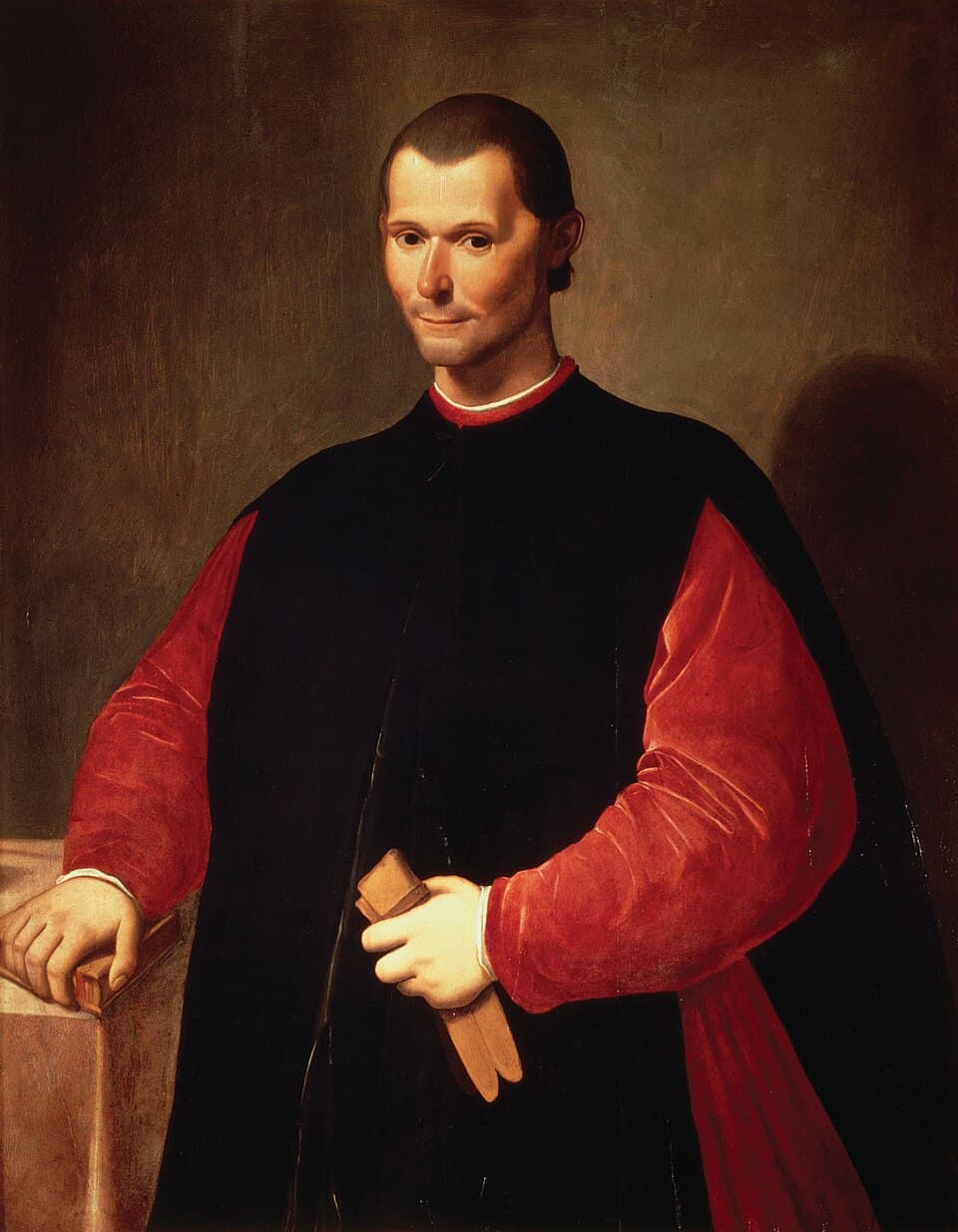
Niccolo Machiavelli
The Prince...And as if it were not enough to have aggrandized the Church, and deprived himself of friends, he, wishing to have the kingdom of Naples, divided it with the King of Spain, and where he was the prime arbiter in Italy he takes an associate, so that the ambitious of that country and the malcontents of his own should have somewhere to shelter; and whereas he could have left in the kingdom his own pensioner as king, he drove him out, to put one there who was able to drive him, Louis, out in turn.
The wish to acquire is in truth very natural and common, and men always do so when they can, and for this they will be praised not blamed; but when they cannot do so, yet wish to do so by any means, then there is folly and blame. Therefore, if France could have attacked Naples with her own forces she ought to have done so; if she could not, then she ought not to have divided it.
And if the partition which she made with the Venetians in Lombardy was justified by the excuse that by it she got a foothold in Italy, this other partition merited blame, for it had not the excuse of that necessity. Therefore Louis made these five errors: he destroyed the minor powers, he increased the strength of one of the greater powers in Italy, he brought in a foreign power, he did not settle in the country, he did not send colonies. Which errors, had he lived, were not enough to injure h...
6
8 of 8 in CHAPTER III. CONCERNING MIXED PRINCIPALITIES14 of 99 in work
⚖The War Deferral Trap

Niccolo Machiavelli
The PrinceThe author argues that making concessions to avoid conflict is a strategic error, as war cannot be avoided but is merely delayed to the benefit of the enemy.
...it would have been very reasonable and necessary to humble them; but having first taken these steps, he ought never to have consented to their ruin, for they, being powerful, would always have kept off others from designs on Lombardy, to which the Venetians would never have consented except to become masters themselves there; also because the others would not wish to take Lombardy from France in order to give it to the Venetians, and to run counter to both they would not have had the courage.
And if any one should say: “King Louis yielded the Romagna to Alexander and the kingdom to Spain to avoid war,” I answer for the reasons given above that a blunder ought never to be perpetrated to avoid war, because it is not to be avoided, but is only deferred to your disadvantage.
And if another should allege the pledge which the king had given to the Pope that he would assist him in the enterprise, in exchange for the dissolution of his marriage[5] and for the cap to Rouen,[6] to that I reply what I shall write later on concerning the faith of princes, and how it ought to be kept. [5] Louis XII divorced his wife, Jeanne, daughter of Louis XI, and married in 1499 Anne of Brittany, widow of Charles VIII, in order to retain the Duchy of Brittany for the crown. [6] Th...
2
1 of 2 in CHAPTER IV. WHY THE KINGDOM OF DARIUS, CO...15 of 99 in work
Now entering CHAPTER IV. WHY THE KINGDOM OF DARIUS, CO...
⚖The Two Governments

Niccolo Machiavelli
The PrinceA thesis explaining that states are governed either through a centralized bureaucracy of ministers or a decentralized system of hereditary barons, which dictates how easily a territory can be held after conquest.
...h and of Spain in Italy has been caused by France, and her ruin may be attributed to them. From this a general rule is drawn which never or rarely fails: that he who is the cause of another becoming powerful is ruined; because that predominancy has been brought about either by astuteness or else by force, and both are distrusted by him who has been raised to power. CHAPTER IV. WHY THE KINGDOM OF DARIUS, CONQUERED BY ALEXANDER, DID NOT REBEL AGAINST THE SUCCESSORS OF ALEXANDER AT HIS DEATH
Considering the difficulties which men have had to hold to a newly acquired state, some might wonder how, seeing that Alexander the Great became the master of Asia in a few years, and died whilst it was scarcely settled (whence it might appear reasonable that the whole empire would have rebelled), nevertheless his successors maintained themselves, and had to meet no other difficulty than that which arose among themselves from their own ambitions. I answer that the principalities of which one has record are found to be governed in two different ways; either by a prince, with a body of servants, who assist him to govern the kingdom as ministers…
Those states that are governed by a prince and his servants hold their prince in more consideration, because in all the country there is no one who is recognized as superior to him, and if they yield obedience to another they do it as to a minister and official, and they do not bear him any particular affection. The examples of these two governments in our time are the Turk and the King of France. The entire monarchy of the Turk is governed by one lord, the others are his servants; and, dividi...
Continue reading →
5
2 of 2 in CHAPTER IV. WHY THE KINGDOM OF DARIUS, CO...16 of 99 in work
⚖The United Kingdom

Niccolo Machiavelli
The PrinceA thesis comparing different types of states, arguing that a highly centralized autocracy like the Ottoman Empire is difficult to conquer but very easy to maintain once the ruling family is extinguished.
...hese two governments in our time are the Turk and the King of France. The entire monarchy of the Turk is governed by one lord, the others are his servants; and, dividing his kingdom into sanjaks, he sends there different administrators, and shifts and changes them as he chooses. But the King of France is placed in the midst of an ancient body of lords, acknowledged by their own subjects, and beloved by them; they have their own prerogatives, nor can the king take these away except at his peril.
Therefore, he who considers both of these states will recognize great difficulties in seizing the state of the Turk, but, once it is conquered, great ease in holding it. The causes of the difficulties in seizing the kingdom of the Turk are that the usurper cannot be called in by the princes of the kingdom, nor can he hope to be assisted in his designs by the revolt of those whom the lord has around him. This arises from the reasons given above; for his ministers, being all slaves and bondmen, can only be corrupted with great difficulty, and one can expect little advantage from them when they have been corrupted, as they cannot carry the…
but, if once the Turk has been conquered, and routed in the field in such a way that he cannot replace his armies, there is nothing to fear but the family of this prince, and, this being exterminated, there remains no one to fear, the others having no credit with the people; and as the conqueror did not rely on them before his victory, so he ought not to fear them after it. The contrary happens in kingdoms governed like that of France, because one can easily enter there by gaining over some ba...
Continue reading →
2
1 of 2 in CHAPTER V. CONCERNING THE WAY TO GOVERN C...17 of 99 in work
Now entering CHAPTER V. CONCERNING THE WAY TO GOVERN C...
⚖The Three Conquest Strategies

Niccolo Machiavelli
The PrinceThe author outlines three strategies for holding a formerly free city: destroying it, living in it, or allowing it to keep its laws under a loyal puppet government.
...he Romans were acknowledged. When these things are remembered no one will marvel at the ease with which Alexander held the Empire of Asia, or at the difficulties which others have had to keep an acquisition, such as Pyrrhus and many more; this is not occasioned by the little or abundance of ability in the conqueror, but by the want of uniformity in the subject state. CHAPTER V. CONCERNING THE WAY TO GOVERN CITIES OR PRINCIPALITIES WHICH LIVED UNDER THEIR OWN LAWS BEFORE THEY WERE ANNEXED
Whenever those states which have been acquired as stated have been accustomed to live under their own laws and in freedom, there are three courses for those who wish to hold them: the first is to ruin them, the next is to reside there in person, the third is to permit them to live under their own laws, drawing a tribute, and establishing within it an oligarchy which will keep it friendly to you. Because such a government, being created by the prince, knows that it cannot stand without his friendship and interest, and does its utmost to support him; and therefore he who would keep a city accustomed to freedom will hold it more easily by the…
There are, for example, the Spartans and the Romans. The Spartans held Athens and Thebes, establishing there an oligarchy: nevertheless they lost them. The Romans, in order to hold Capua, Carthage, and Numantia, dismantled them, and did not lose them. They wished to hold Greece as the Spartans held it, making it free and permitting its laws, and did not succeed. So to hold it they were compelled to dismantle many cities in the country, for in truth there is no safe way to retain them otherwise...
Continue reading →
2