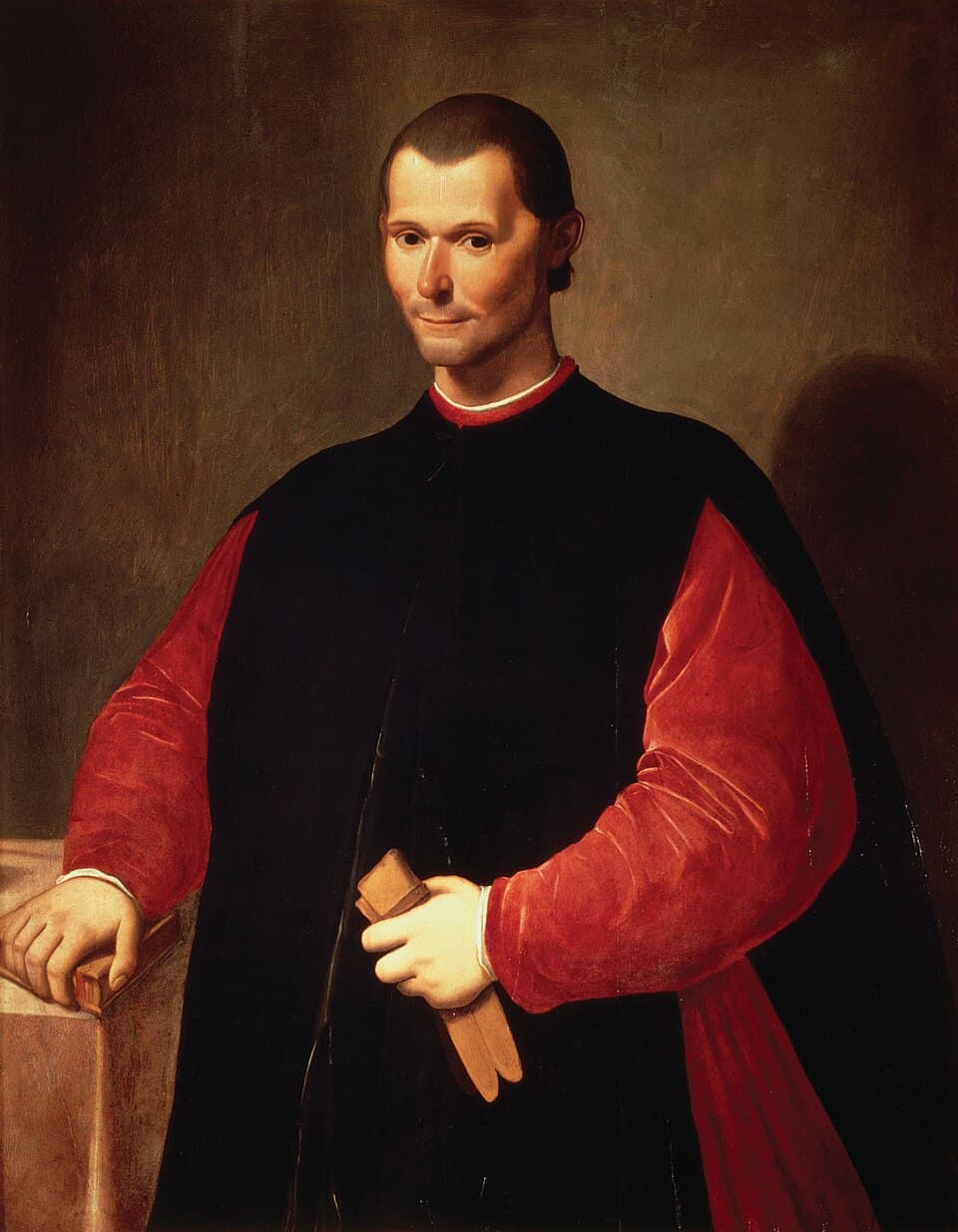
The author argues that auxiliary troops are inherently dangerous for a prince; if they lose, the prince is defeated, and if they win, the prince becomes their prisoner.
← Back to The Prince3 / 4 in chapter
CHAPTER XIII. CONCERNING AUXILIARIES, MIXED SOLDIERY, AND ONE’S OWN
1 of 4 in CHAPTER XIII. CONCERNING AUXILIARIES, MIX...47 of 99 in work
Now entering CHAPTER XIII. CONCERNING AUXILIARIES, MIX...
The Auxiliary Trap
Niccolo Machiavelli
The Prince...tockade or ditch, nor did they campaign in the winter. All these things were permitted by their military rules, and devised by them to avoid, as I have said, both fatigue and dangers; thus they have brought Italy to slavery and contempt. [8] Alberigo da Conio. Alberico da Barbiano, Count of Cunio in Romagna. He was the leader of the famous “Company of St George,” composed entirely of Italian soldiers. He died in 1409. CHAPTER XIII. CONCERNING AUXILIARIES, MIXED SOLDIERY, AND ONE’S OWN
Auxiliaries, which are the other useless arm, are employed when a prince is called in with his forces to aid and defend, as was done by Pope Julius in the most recent times; for he, having, in the enterprise against Ferrara, had poor proof of his mercenaries, turned to auxiliaries, and stipulated with Ferdinand, King of Spain, for his assistance with men and arms. These arms may be useful and good in themselves, but for him who calls them in they are always disadvantageous; for losing, one is undone, and winning, one is their captive.
[1] Ferdinand V (F. II of Aragon and Sicily, F. III of Naples), surnamed “The Catholic,” born 1452, died 1516. And although ancient histories may be full of examples, I do not wish to leave this recent one of Pope Julius the Second, the peril of which cannot fail to be perceived; for he, wishing to get Ferrara, threw himself entirely into the hands of the foreigner. But his good fortune brought about a third event, so that he did not reap the fruit of his rash choice; because, having his au...
2
2 of 4 in CHAPTER XIII. CONCERNING AUXILIARIES, MIX...48 of 99 in work
⚖Mercenaries vs Auxiliaries

Niccolo Machiavelli
The PrinceA prescription warning against the use of auxiliary and mercenary troops, arguing that their inherent qualities make them more dangerous to the prince than to the enemy.
...o his auxiliaries, he having conquered by other arms than theirs. The Florentines, being entirely without arms, sent ten thousand Frenchmen to take Pisa, whereby they ran more danger than at any other time of their troubles. The Emperor of Constantinople,[2] to oppose his neighbours, sent ten thousand Turks into Greece, who, on the war being finished, were not willing to quit; this was the beginning of the servitude of Greece to the infidels. [2] Joannes Cantacuzenus, born 1300, died 1383.
Therefore, let him who has no desire to conquer make use of these arms, for they are much more hazardous than mercenaries, because with them the ruin is ready made; they are all united, all yield obedience to others; but with mercenaries, when they have conquered, more time and better opportunities are needed to injure you; they are not all of one community, they are found and paid by you, and a third party, which you have made their head, is not able all at once to assume enough authority to injure you. In conclusion, in mercenaries dastardy is most dangerous; in auxiliaries, valour.
The wise prince, therefore, has always avoided these arms and turned to his own; and has been willing rather to lose with them than to conquer with the others, not deeming that a real victory which is gained with the arms of others. I shall never hesitate to cite Cesare Borgia and his actions. This duke entered the Romagna with auxiliaries, taking there only French soldiers, and with them he captured Imola and Forli; but afterwards, such forces not appearing to him reliable, he turned to merce...
2
3 of 4 in CHAPTER XIII. CONCERNING AUXILIARIES, MIX...49 of 99 in work
⚖Victory with Own Arms

Niccolo Machiavelli
The PrinceThe author advises that a wise ruler should rely exclusively on their own troops, suggesting that a victory achieved through the help of others is not a true victory.
...re hazardous than mercenaries, because with them the ruin is ready made; they are all united, all yield obedience to others; but with mercenaries, when they have conquered, more time and better opportunities are needed to injure you; they are not all of one community, they are found and paid by you, and a third party, which you have made their head, is not able all at once to assume enough authority to injure you. In conclusion, in mercenaries dastardy is most dangerous; in auxiliaries, valour.
The wise prince, therefore, has always avoided these arms and turned to his own; and has been willing rather to lose with them than to conquer with the others, not deeming that a real victory which is gained with the arms of others.
I shall never hesitate to cite Cesare Borgia and his actions. This duke entered the Romagna with auxiliaries, taking there only French soldiers, and with them he captured Imola and Forli; but afterwards, such forces not appearing to him reliable, he turned to mercenaries, discerning less danger in them, and enlisted the Orsini and Vitelli; whom presently, on handling and finding them doubtful, unfaithful, and dangerous, he destroyed and turned to his own men. And the difference between one and...
2
4 of 4 in CHAPTER XIII. CONCERNING AUXILIARIES, MIX...50 of 99 in work
⚖The Foundation of Power

Niccolo Machiavelli
The PrinceThe author asserts that true political stability is impossible without a military force comprised of one's own citizens, as reliance on mercenaries is inherently fragile.
...at this was ‘wholly unhistorical.’ He might well have added that the Roman power was at its zenith when every citizen acknowledged his liability to fight for the State, but that it began to decline as soon as this obligation was no longer recognised.”—Pall Mall Gazette, 15th May 1906. I conclude, therefore, that no principality is secure without having its own forces; on the contrary, it is entirely dependent on good fortune, not having the valour which in adversity would defend it. And
It has always been the opinion and judgment of wise men that nothing can be so uncertain or unstable as fame or power not founded on its own strength. And one’s own forces are those which are composed either of subjects, citizens, or dependents; all others are mercenaries or auxiliaries.
And the way to make ready one’s own forces will be easily found if the rules suggested by me shall be reflected upon, and if one will consider how Philip, the father of Alexander the Great, and many republics and princes have armed and organized themselves, to which rules I entirely commit myself. CHAPTER XIV. THAT WHICH CONCERNS A PRINCE ON THE SUBJECT OF THE ART OF WAR A prince ought to have no other aim or thought, nor select anything else for his study, than war and its rules and disc...
6
1 of 2 in CHAPTER XIV. THAT WHICH CONCERNS A PRINCE...51 of 99 in work
Now entering CHAPTER XIV. THAT WHICH CONCERNS A PRINCE...
⚖The Art of War

Niccolo Machiavelli
The PrinceA prescription stating that a ruler's primary and sole focus should be the art of war, as military proficiency is the foundation of both acquiring and retaining political power.
...es are those which are composed either of subjects, citizens, or dependents; all others are mercenaries or auxiliaries. And the way to make ready one’s own forces will be easily found if the rules suggested by me shall be reflected upon, and if one will consider how Philip, the father of Alexander the Great, and many republics and princes have armed and organized themselves, to which rules I entirely commit myself. CHAPTER XIV. THAT WHICH CONCERNS A PRINCE ON THE SUBJECT OF THE ART OF WAR
A prince ought to have no other aim or thought, nor select anything else for his study, than war and its rules and discipline; for this is the sole art that belongs to him who rules, and it is of such force that it not only upholds those who are born princes, but it often enables men to rise from a private station to that rank. And, on the contrary, it is seen that when princes have thought more of ease than of arms they have lost their states. And the first cause of your losing it is to neglect this art; and what enables you to acquire a state is to be master of the art. Francesco Sforza, through being martial, from a private person became…
Because there is nothing proportionate between the armed and the unarmed; and it is not reasonable that he who is armed should yield obedience willingly to him who is unarmed, or that the unarmed man should be secure among armed servants. Because, there being in the one disdain and in the other suspicion, it is not possible for them to work well together. And therefore a prince who does not understand the art of war, over and above the other misfortunes already mentioned, cannot be respected by...
Continue reading →
2