The author defends his credentials as a political advisor, citing fifteen years of diligent study and his own poverty as proof of his loyalty, honesty, and hard-won experience.
2 of 2 in Introduction2 of 99 in work
Experience's Earned Voice
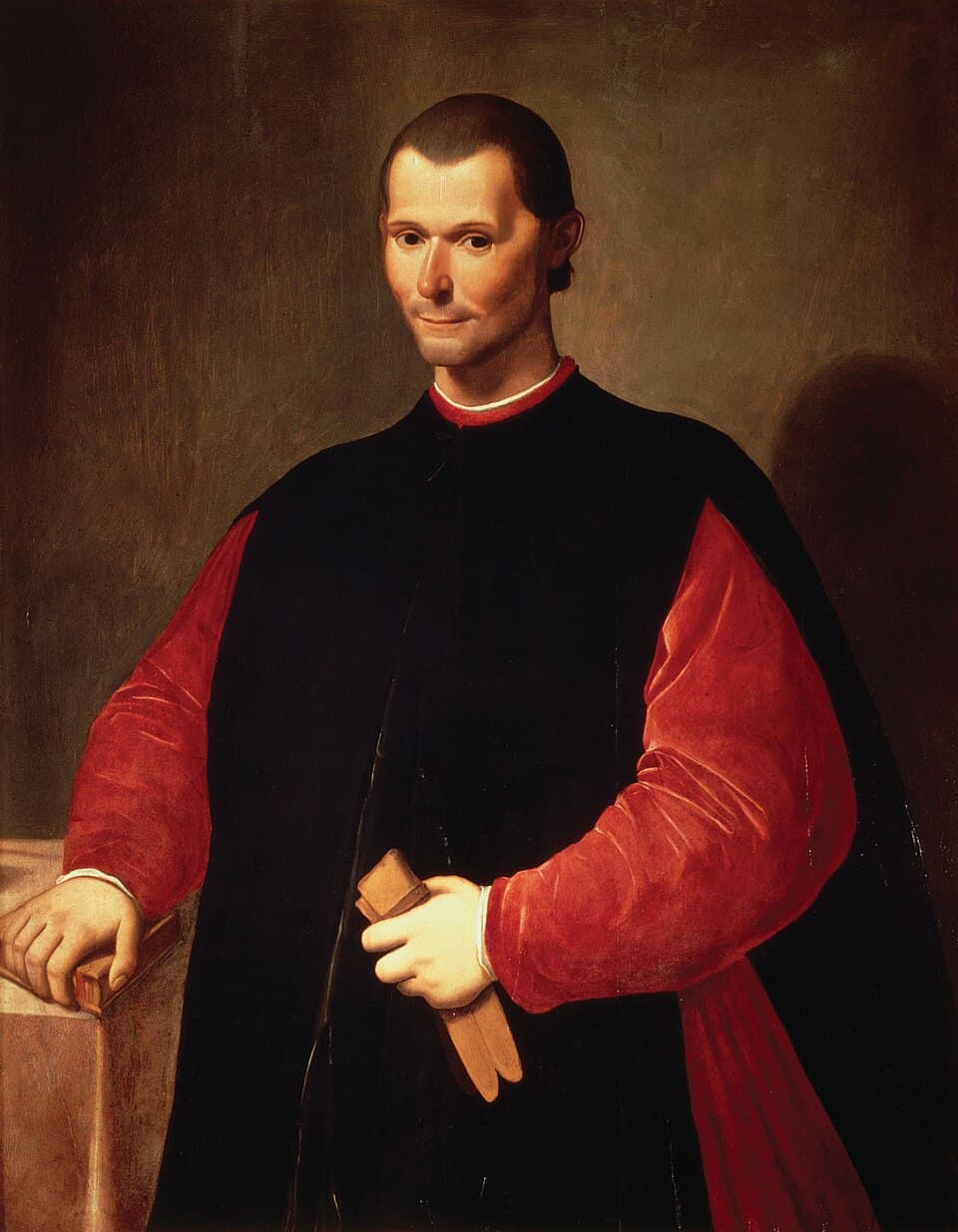
Niccolo Machiavelli
The Prince...changed; and for some unknown reason it was finally dedicated to Lorenzo de’ Medici. Although Machiavelli discussed with Casavecchio whether it should be sent or presented in person to the patron, there is no evidence that Lorenzo ever received or even read it: he certainly never gave Machiavelli any employment. Although it was plagiarized during Machiavelli’s lifetime, The Prince was never published by him, and its text is still disputable. Machiavelli concludes his letter to Vettori thus:
“And as to this little thing [his book], when it has been read it will be seen that during the fifteen years I have given to the study of statecraft I have neither slept nor idled; and men ought ever to desire to be served by one who has reaped experience at the expense of others. And of my loyalty none could doubt, because having always kept faith I could not now learn how to break it; for he who has been faithful and honest, as I have, cannot change his nature; and my poverty is a witness to my honesty.”
Before Machiavelli had got The Prince off his hands he commenced his “Discourse on the First Decade of Titus Livius,” which should be read concurrently with The Prince. These and several minor works occupied him until the year 1518, when he accepted a small commission to look after the affairs of some Florentine merchants at Genoa. In 1519 the Medicean rulers of Florence granted a few political concessions to her citizens, and Machiavelli with others was consulted upon a new constitution...
2
1 of 2 in DEDICATION3 of 99 in work
Now entering DEDICATION
⚖Knowledge as Precious Gift

Niccolo Machiavelli
The PrinceIn this dedicatory note, the author offers his most precious possession—his distilled knowledge of the actions of great men—as a gift to a prince.
...1813; Silvestri, 9 vols., 1820-2; Passerini, Fanfani, Milanesi, 6 vols. only published, 1873-7. Minor works. Ed. F. L. Polidori, 1852; Lettere familiari, ed. E. Alvisi, 1883, 2 editions, one with excisions; Credited Writings, ed. G. Canestrini, 1857; Letters to F. Vettori, see A. Ridolfi, Pensieri intorno allo scopo di N. Machiavelli nel libro Il Principe, etc.; D. Ferrara, The Private Correspondence of Nicolo Machiavelli, 1929. DEDICATION To the Magnificent Lorenzo Di Piero De’ Medici
Those who strive to obtain the good graces of a prince are accustomed to come before him with such things as they hold most precious, or in which they see him take most delight; whence one often sees horses, arms, cloth of gold, precious stones, and similar ornaments presented to princes, worthy of their greatness. Desiring therefore to present myself to your Magnificence with some testimony of my devotion towards you, I have not found among my possessions anything which I hold more dear than, or value so much as, the knowledge of the actions of great men, acquired by long experience in contemporary affairs, and a continual study of…
And although I may consider this work unworthy of your countenance, nevertheless I trust much to your benignity that it may be acceptable, seeing that it is not possible for me to make a better gift than to offer you the opportunity of understanding in the shortest time all that I have learnt in so many years, and with so many troubles and dangers; which work I have not embellished with swelling or magnificent words, nor stuffed with rounded periods, nor with any extrinsic allurements or adorn...
Continue reading →
2
2 of 2 in DEDICATION4 of 99 in work
⚖The Observer's Shift

Niccolo Machiavelli
The PrinceMachiavelli justifies his right to analyze the behavior of princes by arguing that one must be a commoner to truly understand the nature of a ruler, just as one must be a prince to understand the people.
...y of understanding in the shortest time all that I have learnt in so many years, and with so many troubles and dangers; which work I have not embellished with swelling or magnificent words, nor stuffed with rounded periods, nor with any extrinsic allurements or adornments whatever, with which so many are accustomed to embellish their works; for I have wished either that no honour should be given it, or else that the truth of the matter and the weightiness of the theme shall make it acceptable.
Nor do I hold with those who regard it as a presumption if a man of low and humble condition dare to discuss and settle the concerns of princes; because, just as those who draw landscapes place themselves below in the plain to contemplate the nature of the mountains and of lofty places, and in order to contemplate the plains place themselves upon high mountains, even so to understand the nature of the people it needs to be a prince, and to understand that of princes it needs to be of the people.
Take then, your Magnificence, this little gift in the spirit in which I send it; wherein, if it be diligently read and considered by you, you will learn my extreme desire that you should attain that greatness which fortune and your other attributes promise. And if your Magnificence from the summit of your greatness will sometimes turn your eyes to these lower regions, you will see how unmeritedly I suffer a great and continued malignity of fortune. THE PRINCE CHAPTER I. HOW MANY KINDS...
2
1 of 1 in CHAPTER I. HOW MANY KINDS OF PRINCIPALITI...5 of 99 in work
Now entering CHAPTER I. HOW MANY KINDS OF PRINCIPALITI...
⚖States' Two Forms

Niccolo Machiavelli
The PrinceA foundational classification of political structures, defining all states as either republics or principalities, with the latter being either hereditary or newly acquired.
...hich I send it; wherein, if it be diligently read and considered by you, you will learn my extreme desire that you should attain that greatness which fortune and your other attributes promise. And if your Magnificence from the summit of your greatness will sometimes turn your eyes to these lower regions, you will see how unmeritedly I suffer a great and continued malignity of fortune. THE PRINCE CHAPTER I. HOW MANY KINDS OF PRINCIPALITIES THERE ARE, AND BY WHAT MEANS THEY ARE ACQUIRED
All states, all powers, that have held and hold rule over men have been and are either republics or principalities. Principalities are either hereditary, in which the family has been long established; or they are new. The new are either entirely new, as was Milan to Francesco Sforza, or they are, as it were, members annexed to the hereditary state of the prince who has acquired them, as was the kingdom of Naples to that of the King of Spain.
Such dominions thus acquired are either accustomed to live under a prince, or to live in freedom; and are acquired either by the arms of the prince himself, or of others, or else by fortune or by ability. CHAPTER II. CONCERNING HEREDITARY PRINCIPALITIES I will leave out all discussion on republics, inasmuch as in another place I have written of them at length, and will address myself only to principalities. In doing so I will keep to the order indicated above, and discuss how such princi...
3
1 of 1 in CHAPTER II. CONCERNING HEREDITARY PRINCIP...6 of 99 in work
Now entering CHAPTER II. CONCERNING HEREDITARY PRINCIP...
⚖Hereditary Rule's Stability

Niccolo Machiavelli
The PrinceThe author explains that hereditary rulers have an easier time maintaining power because their long-standing authority feels natural to subjects, reducing the need for disruptive innovations.
...deal prudently with circumstances as they arise, for a prince of average powers to maintain himself in his state, unless he be deprived of it by some extraordinary and excessive force; and if he should be so deprived of it, whenever anything sinister happens to the usurper, he will regain it. We have in Italy, for example, the Duke of Ferrara, who could not have withstood the attacks of the Venetians in ’84, nor those of Pope Julius in ’10, unless he had been long established in his dominions.
For the hereditary prince has less cause and less necessity to offend; hence it happens that he will be more loved; and unless extraordinary vices cause him to be hated, it is reasonable to expect that his subjects will be naturally well disposed towards him; and in the antiquity and duration of his rule the memories and motives that make for change are lost, for one change always leaves the toothing for another.
CHAPTER III. CONCERNING MIXED PRINCIPALITIES But the difficulties occur in a new principality. And firstly, if it be not entirely new, but is, as it were, a member of a state which, taken collectively, may be called composite, the changes arise chiefly from an inherent difficulty which there is in all new principalities; for men change their rulers willingly, hoping to better themselves, and this hope induces them to take up arms against him who rules: wherein they are deceived, because t...
4