The author argues that vice destroys the perception of moral principles, necessitating practical wisdom to maintain a focus on the 'final cause' of human good.
2 of 2 in Book VI, Chapter V145 of 276 in work
Vice's Blinding Effect
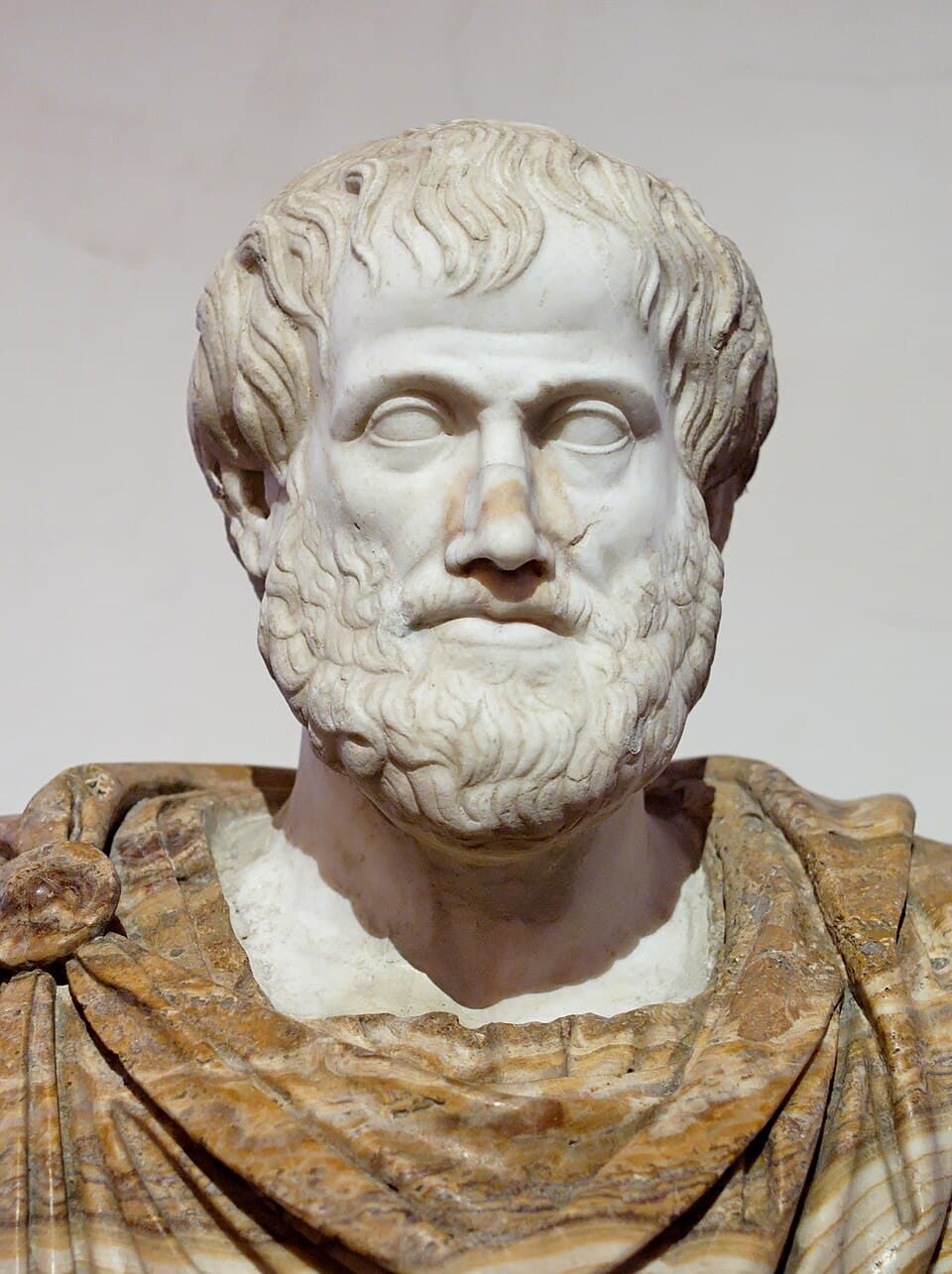
Aristotle
Nicomachean Ethics...the reason why we call the habit of perfected self-mastery by the name which in Greek it bears, etymologically signifying “that which preserves the Practical Wisdom:” for what it does preserve is the Notion I have mentioned, i.e. of one’s own true interest.[18] For it is not every kind of Notion which the pleasant and the painful corrupt and pervert, as, for instance, that “the three angles of every rectilineal triangle are equal to two right angles,” but only those bearing on moral action.
For the Principles of the matters of moral action are the final cause of them: now to the man who has been corrupted by reason of pleasure or pain the Principle immediately becomes obscured, nor does he see that it is his duty to choose and act in each instance with a view to this final cause and by reason of it: for viciousness has a tendency to destroy the moral Principle: and so Practical Wisdom must be “a state conjoined with reason, true, having human good for its object, and apt to do.”
Then again Art admits of degrees of excellence, but Practical Wisdom does not:[20] and in Art he who goes wrong purposely is preferable to him who does so unwittingly,[21] but not so in respect of Practical Wisdom or the other Virtues. It plainly is then an Excellence of a certain kind, and not an Art. Now as there are two parts of the Soul which have Reason, it must be the Excellence of the Opinionative [which we called before calculative or deliberative], because both Opinion and Practical...
3
1 of 1 in Book VI, Chapter VII146 of 276 in work
Now entering Book VI, Chapter VII
⚖Science's Intuitive Foundation

Aristotle
Nicomachean EthicsThe author defines science as the most accurate form of knowledge, requiring both an understanding of first principles and an intuition of the most precious objects in the universe.
...ighest accuracy;[22] Phidias, for instance, we call a Scientific or cunning sculptor; Polycleitus a Scientific or cunning statuary; meaning, in this instance, nothing else by Science than an excellence of art: in the other sense, we think some to be Scientific in a general way, not in any particular line or in any particular thing, just as Homer says of a man in his Margites; “Him the Gods made neither a digger of the ground, nor ploughman, nor in any other way Scientific.” So it is plain that
Science must mean the most accurate of all Knowledge; but if so, then the Scientific man must not merely know the deductions from the First Principles but be in possession of truth respecting the First Principles. So that Science must be equivalent to Intuition and Knowledge; it is, so to speak, Knowledge of the most precious objects, with a head on. I say of the most precious things, because it is absurd to suppose πολιτικὴ, or Practical Wisdom, to be the highest, unless it can be shown that Man is the most excellent of all that exists in the Universe.
Now if “healthy” and “good” are relative terms, differing when applied to men or to fish, but “white” and “straight” are the same always, men must allow that the Scientific is the same always, but the Practically Wise varies: for whatever provides all things well for itself, to this they would apply the term Practically Wise, and commit these matters to it; which is the reason, by the way, that they call some brutes Practically Wise, such that is as plainly have a faculty of forethought respect...
5
1 of 3 in Book VI, Chapter VIII147 of 276 in work
Now entering Book VI, Chapter VIII
⚖The Good in Counsel

Aristotle
Nicomachean EthicsThe author defines Practical Wisdom as the capacity to deliberate about things that can be changed to achieve the best possible practical goods for humanity.
...union of Knowledge and Intuition, and has for its objects those things which are most precious in their nature. Accordingly, Anexagoras, Thales, and men of that stamp, people call Scientific, but not Practically Wise because they see them ignorant of what concerns themselves; and they say that what they know is quite out of the common run certainly, and wonderful, and hard, and very fine no doubt, but still useless because they do not seek after what is good for them as men. Chapter VIII. But
Practical Wisdom is employed upon human matters, and such as are objects of deliberation (for we say, that to deliberate well is most peculiarly the work of the man who possesses this Wisdom), and no man deliberates about things which cannot be otherwise than they are, nor about any save those that have some definite End and this End good resulting from Moral Action; and the man to whom we should give the name of Good in Counsel, simply and without modification, is he who in the way of calculation has a capacity for attaining that of practical goods which is the best for Man.
Nor again does Practical Wisdom consist in a knowledge of general principles only, but it is necessary that one should know also the particular details, because it is apt to act, and action is concerned with details: for which reason sometimes men who have not much knowledge are more practical than others who have; among others, they who derive all they know from actual experience: suppose a man to know, for instance, that light meats are easy of digestion and wholesome, but not what kinds of...
3
2 of 3 in Book VI, Chapter VIII148 of 276 in work
⚖Practical Wisdom's Details

Aristotle
Nicomachean EthicsThe author explains that practical wisdom requires knowledge of specific details rather than just general principles, as action is always concerned with particulars.
...tion (for we say, that to deliberate well is most peculiarly the work of the man who possesses this Wisdom), and no man deliberates about things which cannot be otherwise than they are, nor about any save those that have some definite End and this End good resulting from Moral Action; and the man to whom we should give the name of Good in Counsel, simply and without modification, is he who in the way of calculation has a capacity for attaining that of practical goods which is the best for Man.
Nor again does Practical Wisdom consist in a knowledge of general principles only, but it is necessary that one should know also the particular details, because it is apt to act, and action is concerned with details: for which reason sometimes men who have not much knowledge are more practical than others who have; among others, they who derive all they know from actual experience: suppose a man to know, for instance, that light meats are easy of digestion and wholesome, but not what kinds of meat are light, he will not produce a healthy state; that man will have a much better chance of doing so, who knows that the flesh of birds is light and wholesome.
Since then Practical Wisdom is apt to act, one ought to have both kinds of knowledge, or, if only one, the knowledge of details rather than of Principles. So there will be in respect of Practical Wisdom the distinction of supreme and subordinate.[26] Further: πολιτικὴ and Practical Wisdom are the same mental state, but the point of view is not the same. Of Practical Wisdom exerted upon a community that which I would call the Supreme is the faculty of Legislation; the subordinate, which is con...
3
3 of 3 in Book VI, Chapter VIII149 of 276 in work
⚖Experience's Practical Wisdom

Aristotle
Nicomachean EthicsThe text explains why young people can master abstract subjects like mathematics but lack practical wisdom, which requires the specific knowledge gained only through long-term experience.
...enerality of mankind seek their own good and hold that this is their proper business. It is then from this opinion that the notion has arisen that such men are the Practically-Wise. And yet it is just possible that the good of the individual cannot be secured independently of connection with a family or a community. And again, how a man should manage his own affairs is sometimes not quite plain, and must be made a matter of enquiry.[29] A corroboration of what I have said is[30] the fact, that
The young come to be geometricians, and mathematicians, and Scientific in such matters, but it is not thought that a young man can come to be possessed of Practical Wisdom: now the reason is, that this Wisdom has for its object particular facts, which come to be known from experience, which a young man has not because it is produced only by length of time. By the way, a person might also enquire, why a boy may be made a mathematician but not Scientific or a natural philosopher. Is not this the reason? that mathematics are taken in by the process of abstraction, but the principles of Science and natural philosophy must be gained by experiment;…
Again, in matter of practice, error attaches either to the general rule, in the process of deliberation, or to the particular fact: for instance, this would be a general rule, “All water of a certain gravity is bad;” the particular fact, “this water is of that gravity.” And that Practical Wisdom is not Knowledge is plain, for it has to do with the ultimate issue,[33] as has been said, because every object of action is of this nature. To Intuition it is opposed, for this takes in those princi...
Continue reading →
6