Aristotle analyzes mixed actions, concluding they are essentially voluntary because the internal origin of the physical movement allows the individual the power to act or refrain.
1 of 2 in Book III, Chapter I52 of 276 in work
Now entering Book III, Chapter I
The Voluntary Moment
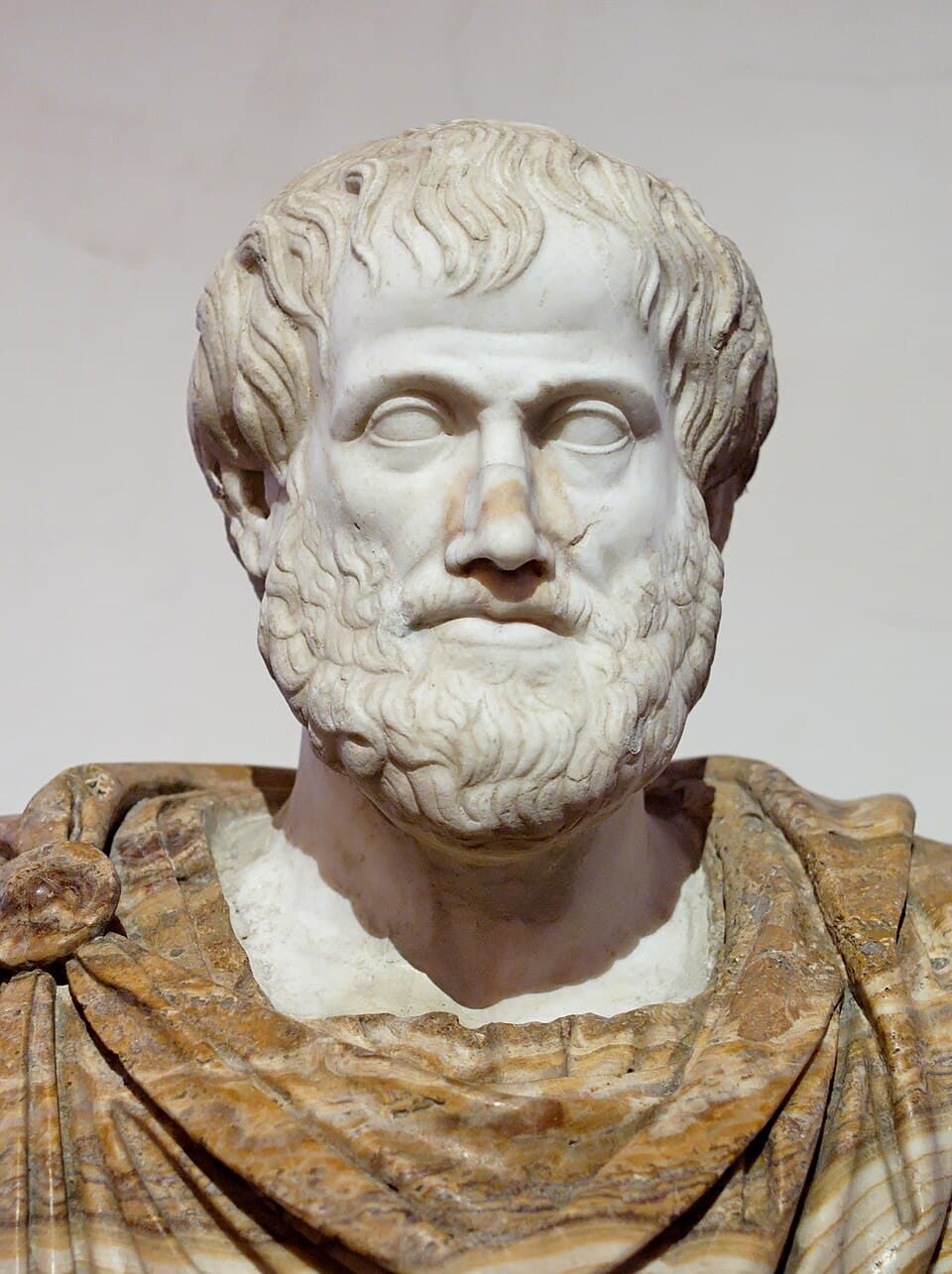
Aristotle
Nicomachean Ethics...f you were ordered to commit some base act by a despot who had your parents or children in his power, and they were to be saved upon your compliance or die upon your refusal, in such cases there is room for a question whether the actions are voluntary or involuntary. A similar question arises with respect to cases of throwing goods overboard in a storm: abstractedly no man throws away his property willingly, but with a view to his own and his shipmates’ safety any one would who had any sense.
The truth is, such actions are of a mixed kind, but are most like voluntary actions; for they are choice-worthy at the time when they are being done, and the end or object of the action must be taken with reference to the actual occasion. Further, we must denominate an action voluntary or involuntary at the time of doing it: now in the given case the man acts voluntarily, because the originating of the motion of his limbs in such actions rests with himself; and where the origination is in himself it rests with himself to do or not to do.
Such actions then are voluntary, though in the abstract perhaps involuntary because no one would choose any of such things in and by itself. But for such actions men sometimes are even praised, as when they endure any disgrace or pain to secure great and honourable equivalents; if vice versâ, then they are blamed, because it shows a base mind to endure things very disgraceful for no honourable object, or for a trifling one. For some again no praise is given, but allowance is made; as where...
6
2 of 2 in Book III, Chapter I53 of 276 in work
⚖External Attribution's Absurdity

Aristotle
Nicomachean EthicsThe author argues that individuals are responsible for their susceptibility to external influences and defines compulsion as an external force where the agent contributes nothing.
...one ought to choose instead of what, it is not easy to settle, for there are many differences in particular instances. But suppose a person should say, things pleasant and honourable exert a compulsive force (for that they are external and do compel); at that rate every action is on compulsion, because these are universal motives of action. Again, they who act on compulsion and against their will do so with pain; but they who act by reason of what is pleasant or honourable act with pleasure.
It is truly absurd for a man to attribute his actions to external things instead of to his own capacity for being easily caught by them; or, again, to ascribe the honourable to himself, and the base ones to pleasure. So then that seems to be compulsory “whose origination is from without, the party compelled contributing nothing.”
Chapter II. Now every action of which ignorance is the cause is not-voluntary, but that only is involuntary which is attended with pain and remorse; for clearly the man who has done anything by reason of ignorance, but is not annoyed at his own action, cannot be said to have done it with his will because he did not know he was doing it, nor again against his will because he is not sorry for it. So then of the class “acting by reason of ignorance,” he who feels regret afterwards is thoug...
6
1 of 2 in Book III, Chapter II54 of 276 in work
Now entering Book III, Chapter II
⚖Remorse Defines Involuntary

Aristotle
Nicomachean EthicsThe author defines 'involuntary' actions specifically as those caused by ignorance that result in subsequent pain and remorse.
..., they who act on compulsion and against their will do so with pain; but they who act by reason of what is pleasant or honourable act with pleasure. It is truly absurd for a man to attribute his actions to external things instead of to his own capacity for being easily caught by them;[1] or, again, to ascribe the honourable to himself, and the base ones to pleasure. So then that seems to be compulsory “whose origination is from without, the party compelled contributing nothing.” Chapter II.
Now every action of which ignorance is the cause is not-voluntary, but that only is involuntary which is attended with pain and remorse; for clearly the man who has done anything by reason of ignorance, but is not annoyed at his own action, cannot be said to have done it with his will because he did not know he was doing it, nor again against his will because he is not sorry for it.
So then of the class “acting by reason of ignorance,” he who feels regret afterwards is thought to be an involuntary agent, and him that has no such feeling, since he certainly is different from the other, we will call a not-voluntary agent; for as there is a real difference it is better to have a proper name. Again, there seems to be a difference between acting because of ignorance and acting with ignorance: for instance, we do not usually assign ignorance as the cause of the actions of...
6
2 of 2 in Book III, Chapter II55 of 276 in work
⚖Ignorance of Details

Aristotle
Nicomachean EthicsThe author distinguishes between ignorance of general principles, which is blameworthy, and ignorance of specific details, which renders an act involuntary.
...s a real difference it is better to have a proper name. Again, there seems to be a difference between acting because of ignorance and acting with ignorance: for instance, we do not usually assign ignorance as the cause of the actions of the drunken or angry man, but either the drunkenness or the anger, yet they act not knowingly but with ignorance. Again, every bad man is ignorant what he ought to do and what to leave undone, and by reason of such error men become unjust and wholly evil.
Again, we do not usually apply the term involuntary when a man is ignorant of his own true interest; because ignorance which affects moral choice constitutes depravity but not involuntariness: nor does any ignorance of principle (because for this men are blamed) but ignorance in particular details, wherein consists the action and wherewith it is concerned, for in these there is both compassion and allowance, because he who acts in ignorance of any of them acts in a proper sense involuntarily.
It may be as well, therefore, to define these particular details; what they are, and how many; viz. who acts, what he is doing, with respect to what or in what, sometimes with what, as with what instrument, and with what result;[4] as that of preservation, for instance, and how, as whether softly or violently. All these particulars, in one and the same case, no man in his senses could be ignorant of; plainly not of the agent, being himself. But what he is doing a man may be ignorant, as men i...
6
1 of 1 in Book III, Chapter III56 of 276 in work
Now entering Book III, Chapter III
⚖Voluntary Action's Origin

Aristotle
Nicomachean EthicsThe author defines voluntary action as originating within an agent who is aware of the specific details of their conduct.
...ince ignorance is possible in respect to all these details in which the action consists, he that acted in ignorance of any of them is thought to have acted involuntarily, and he most so who was in ignorance as regards the most important, which are thought to be those in which the action consists, and the result. Further, not only must the ignorance be of this kind, to constitute an action involuntary, but it must be also understood that the action is followed by pain and regret. Chapter III.
Now since all involuntary action is either upon compulsion or by reason of ignorance, Voluntary Action would seem to be “that whose origination is in the agent, he being aware of the particular details in which the action consists.” For, it may be, men are not justified by calling those actions involuntary, which are done by reason of Anger or Lust.
Because, in the first place, if this be so no other animal but man, and not even children, can be said to act voluntarily. Next, is it meant that we never act voluntarily when we act from Lust or Anger, or that we act voluntarily in doing what is right and involuntarily in doing what is discreditable? The latter supposition is absurd, since the cause is one and the same. Then as to the former, it is a strange thing to maintain actions to be involuntary which we are bound to grasp at: now there...
6