The author establishes a functional definition of virtue as the state that enables a thing to be in a good condition and to perform its specific work well.
1 of 4 in Book II, Chapter V41 of 276 in work
Now entering Book II, Chapter V
Excellence as Function
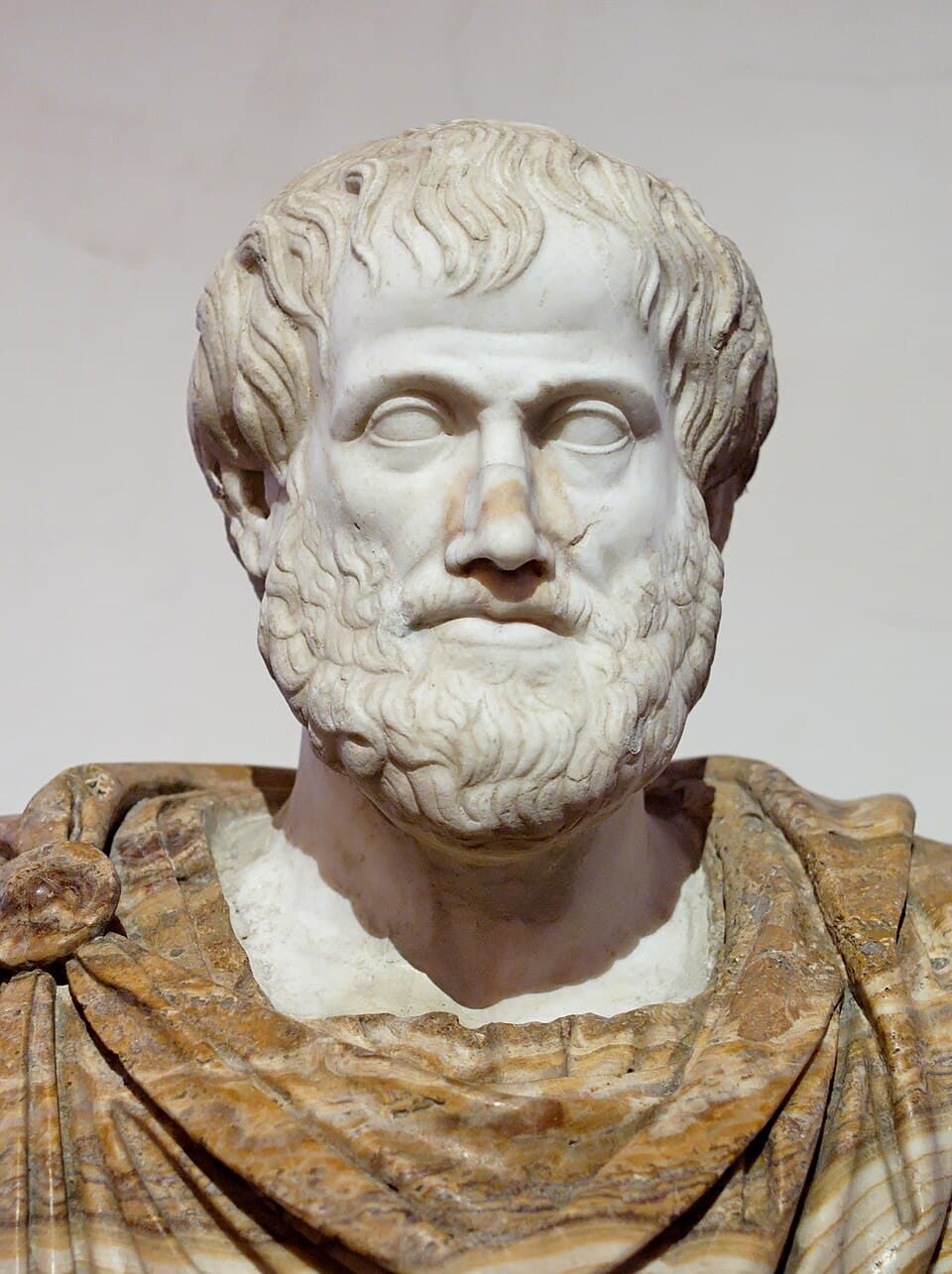
Aristotle
Nicomachean Ethics...they are not Capacities, for we are not called good or bad merely because we are able to feel, nor are we praised or blamed. And again, Capacities we have by nature, but we do not come to be good or bad by nature, as we have said before. Since then the virtues are neither Feelings nor Capacities, it remains that they must be States. Chapter V. Now what the genus of Virtue is has been said; but we must not merely speak of it thus, that it is a state but say also what kind of a state it is.
We must observe then that all excellence makes that whereof it is the excellence both to be itself in a good state and to perform its work well. The excellence of the eye, for instance, makes both the eye good and its work also: for by the excellence of the eye we see well. So too the excellence of the horse makes a horse good, and good in speed, and in carrying his rider, and standing up against the enemy. If then this is universally the case, the excellence of Man, i.e. Virtue, must be a state whereby Man comes to be good and whereby he will perform well his proper work.
Now how this shall be it is true we have said already, but still perhaps it may throw light on the subject to see what is its characteristic nature. In all quantity then, whether continuous or discrete,[11] one may take the greater part, the less, or the exactly equal, and these either with reference to the thing itself, or relatively to us: and the exactly equal is a mean between excess and defect. Now by the mean of the thing, i.e. absolute mean, I denote that which is equidistant from eit...
4
2 of 4 in Book II, Chapter V42 of 276 in work
⚖Relative vs Absolute Mean

Aristotle
Nicomachean EthicsThe author differentiates between an absolute mathematical mean and a relative mean that is tailored to the specific needs and capacities of an individual.
...must be a state whereby Man comes to be good and whereby he will perform well his proper work. Now how this shall be it is true we have said already, but still perhaps it may throw light on the subject to see what is its characteristic nature. In all quantity then, whether continuous or discrete,[11] one may take the greater part, the less, or the exactly equal, and these either with reference to the thing itself, or relatively to us: and the exactly equal is a mean between excess and defect.
Now by the mean of the thing, i.e. absolute mean, I denote that which is equidistant from either extreme (which of course is one and the same to all), and by the mean relatively to ourselves, that which is neither too much nor too little for the particular individual. This of course is not one nor the same to all: for instance, suppose ten is too much and two too little, people take six for the absolute mean; because it exceeds the smaller sum by exactly as much as it is itself exceeded by the larger, and this mean is according to arithmetical proportion. But the mean relatively to ourselves must not be so found ; for it does not follow,…
So then it seems every one possessed of skill avoids excess and defect, but seeks for and chooses the mean, not the absolute but the relative. Now if all skill thus accomplishes well its work by keeping an eye on the mean, and bringing the works to this point (whence it is common enough to say of such works as are in a good state, “one cannot add to or take ought from them,” under the notion of excess or defect destroying goodness but the mean state preserving it), and good artisans, as we sa...
Continue reading →
5
3 of 4 in Book II, Chapter V43 of 276 in work
⚖The Virtuous Mean

Aristotle
Nicomachean EthicsThe author defines virtue as the ability to find the 'mean' in feelings and actions, avoiding excess and defect by acting at the right time and for the right reasons.
...ill thus accomplishes well its work by keeping an eye on the mean, and bringing the works to this point (whence it is common enough to say of such works as are in a good state, “one cannot add to or take ought from them,” under the notion of excess or defect destroying goodness but the mean state preserving it), and good artisans, as we say, work with their eye on this, and excellence, like nature, is more exact and better than any art in the world, it must have an aptitude to aim at the mean.
It is moral excellence, i.e. Virtue, of course which I mean, because this it is which is concerned with feelings and actions, and in these there can be excess and defect and the mean: it is possible, for instance, to feel the emotions of fear, confidence, lust, anger, compassion, and pleasure and pain generally, too much or too little, and in either case wrongly; but to feel them when we ought, on what occasions, towards whom, why, and as, we should do, is the mean, or in other words the best state, and this is the property of Virtue. In like manner too with respect to the actions, there may be excess and defect and the mean.
Now Virtue is concerned with feelings and actions, in which the excess is wrong and the defect is blamed but the mean is praised and goes right; and both these circumstances belong to Virtue. Virtue then is in a sense a mean state, since it certainly has an aptitude for aiming at the mean. Again, one may go wrong in many different ways (because, as the Pythagoreans expressed it, evil is of the class of the infinite, good of the finite), but right only in one; and so the former is easy, the lat...
3
4 of 4 in Book II, Chapter V44 of 276 in work
⚖Virtue as Mean

Aristotle
Nicomachean EthicsThe author posits that virtue is a 'mean state' between the extremes of excess and deficiency, noting that while there are many ways to fail, there is only one way to be right.
...ese there can be excess and defect and the mean: it is possible, for instance, to feel the emotions of fear, confidence, lust, anger, compassion, and pleasure and pain generally, too much or too little, and in either case wrongly; but to feel them when we ought, on what occasions, towards whom, why, and as, we should do, is the mean, or in other words the best state, and this is the property of Virtue. In like manner too with respect to the actions, there may be excess and defect and the mean.
Now Virtue is concerned with feelings and actions, in which the excess is wrong and the defect is blamed but the mean is praised and goes right; and both these circumstances belong to Virtue. Virtue then is in a sense a mean state, since it certainly has an aptitude for aiming at the mean. Again, one may go wrong in many different ways (because, as the Pythagoreans expressed it, evil is of the class of the infinite, good of the finite), but right only in one; and so the former is easy, the latter difficult; easy to miss the mark, but hard to hit it: and for these reasons, therefore, both the excess and defect belong to Vice, and the mean…
Chapter VI. Virtue then is “a state apt to exercise deliberate choice, being in the relative mean, determined by reason, and[14] as the man of practical wisdom would determine.” It is a middle state between too faulty ones, in the way of excess on one side and of defect on the other: and it is so moreover, because the faulty states on one side fall short of, and those on the other exceed, what is right, both in the case of the feelings and the actions; but Virtue finds, and when found adopt...
Continue reading →
4
1 of 2 in Book II, Chapter VI45 of 276 in work
Now entering Book II, Chapter VI
⚖Virtue as the Mean

Aristotle
Nicomachean EthicsThe author provides a formal definition of virtue as a deliberate choice of the mean between excess and defect, as determined by practical wisdom.
...aptitude for aiming at the mean. Again, one may go wrong in many different ways (because, as the Pythagoreans expressed it, evil is of the class of the infinite, good of the finite), but right only in one; and so the former is easy, the latter difficult; easy to miss the mark, but hard to hit it: and for these reasons, therefore, both the excess and defect belong to Vice, and the mean state to Virtue; for, as the poet has it, “Men may be bad in many ways, But good in one alone.” Chapter VI.
Virtue then is “a state apt to exercise deliberate choice, being in the relative mean, determined by reason, and as the man of practical wisdom would determine.” It is a middle state between too faulty ones, in the way of excess on one side and of defect on the other: and it is so moreover, because the faulty states on one side fall short of, and those on the other exceed, what is right, both in the case of the feelings and the actions; but Virtue finds, and when found adopts, the mean. And so, viewing it in respect of its essence and definition, Virtue is a mean state; but in reference to the chief good and to excellence it is the highest…
But it must not be supposed that every action or every feeling is capable of subsisting in this mean state, because some there are which are so named as immediately to convey the notion of badness, as malevolence, shamelessness, envy; or, to instance in actions, adultery, theft, homicide; for all these and suchlike are blamed because they are in themselves bad, not the having too much or too little of them. In these then you never can go right, but must always be wrong: nor in such does the r...
Continue reading →
4