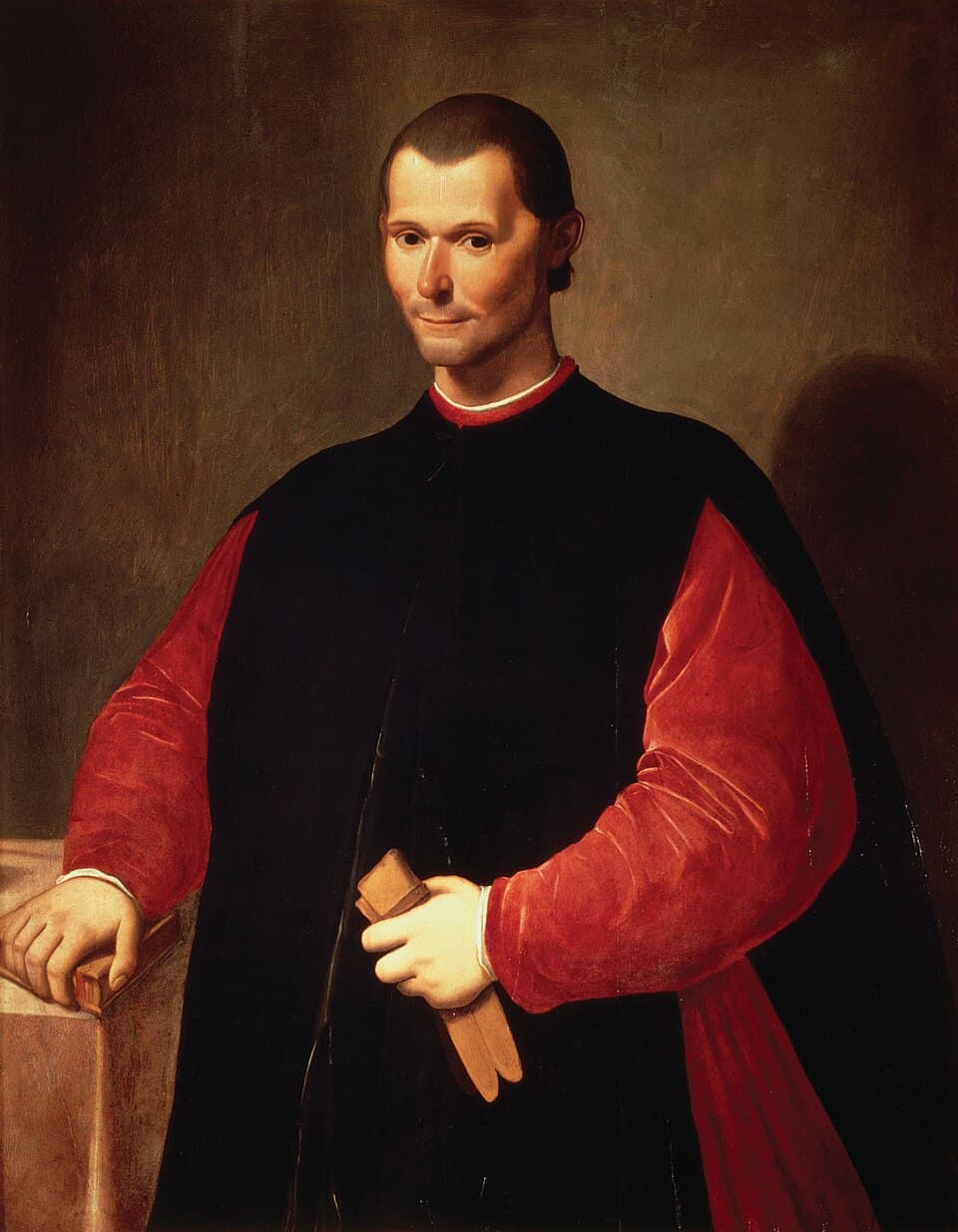
The Fox and Lion
Niccolo Machiavelli
The Prince

The author prescribes that a prince must master both deception and force, using the 'fox' to recognize traps and the 'lion' to drive away predators.

...t is necessary for a prince to understand how to avail himself of the beast and the man. This has been figuratively taught to princes by ancient writers, who describe how Achilles and many other princes of old were given to the Centaur Chiron to nurse, who brought them up in his discipline; which means solely that, as they had for a teacher one who was half beast and half man, so it is necessary for a prince to know how to make use of both natures, and that one without the other is not durable.
A prince, therefore, being compelled knowingly to adopt the beast, ought to choose the fox and the lion; because the lion cannot defend himself against snares and the fox cannot defend himself against wolves. Therefore, it is necessary to be a fox to discover the snares and a lion to terrify the wolves. Those who rely simply on the lion do not understand what they are about.
Therefore a wise lord cannot, nor ought he to, keep faith when such observance may be turned against him, and when the reasons that caused him to pledge it exist no longer. If men were entirely good this precept would not hold, but because they are bad, and will not keep faith with you, you too are not bound to observe it with them. Nor will there ever be wanting to a prince legitimate reasons to excuse this non-observance. Of this endless modern examples could be given, showing how many treati...
2

Niccolo Machiavelli

The Prince

The Prince's Paradox

Machiavelli explains that because the lawful method is frequently insufficient, a prince must be prepared to use force and craft. This grounds the parent's advice in the practical necessity of adapting to an imperfect world.

...feared or loved, I come to the conclusion that, men loving according to their own will and fearing according to that of the prince, a wise prince should establish himself on that which is in his own control and not in that of others; he must endeavour only to avoid hatred, as is noted. CHAPTER XVIII.[1] CONCERNING THE WAY IN WHICH PRINCES SHOULD KEEP FAITH [1] “The present chapter has given greater offence than any other portion of Machiavelli’s writings.” Burd, “Il Principe,” p. 297.
Every one admits how praiseworthy it is in a prince to keep faith, and to live with integrity and not with craft. Nevertheless our experience has been that those princes who have done great things have held good faith of little account, and have known how to circumvent the intellect of men by craft, and in the end have overcome those who have relied on their word. You must know there are two ways of contesting, the one by the law, the other by force; the first method is proper to men, the second to beasts; but because the first is frequently not sufficient, it is necessary to have recourse to...
Therefore it is necessary for a prince to understand how to avail himself of the beast and the man. This has been figuratively taught to princes by ancient writers, who describe how Achilles and many other princes of old were given to the Centaur Chiron to nurse, who brought them up in his discipline; which means solely that, as they had for a teacher one who was half beast and half man, so it is necessary for a prince to know how to make use of both natures, and that one without the other is n...

Niccolo Machiavelli

The Prince

The Virtue Facade

This excerpt offers a concrete method: a prince should cultivate the appearance of virtue while maintaining the flexibility to act contrary to it when compelled by circumstance. This directly enacts the fox's cunning (deception) and the lion's readiness to use force.

...nd he always found victims; for there never was a man who had greater power in asserting, or who with greater oaths would affirm a thing, yet would observe it less; nevertheless his deceits always succeeded according to his wishes,[3] because he well understood this side of mankind. [3] “Nondimanco sempre gli succederono gli inganni (ad votum).” The words “ad votum” are omitted in the Testina addition, 1550. Alexander never did what he said, Cesare never said what he did. Italian Proverb.
Therefore it is unnecessary for a prince to have all the good qualities I have enumerated, but it is very necessary to appear to have them. And I shall dare to say this also, that to have them and always to observe them is injurious, and that to appear to have them is useful; to appear merciful, faithful, humane, religious, upright, and to be so, but with a mind so framed that should you require not to be so, you may be able and know how to change to the opposite. And you have to understand this, that a prince, especially a new one, cannot observe all those things for which men are esteemed, b...
[4] “Contrary to fidelity” or “faith,” “contro alla fede,” and “tutto fede,” “altogether faithful,” in the next paragraph. It is noteworthy that these two phrases, “contro alla fede” and “tutto fede,” were omitted in the Testina edition, which was published with the sanction of the papal authorities. It may be that the meaning attached to the word “fede” was “the faith,” i.e. the Catholic creed, and not as rendered here “fidelity” and “faithful.” Observe that the word “religione” was...