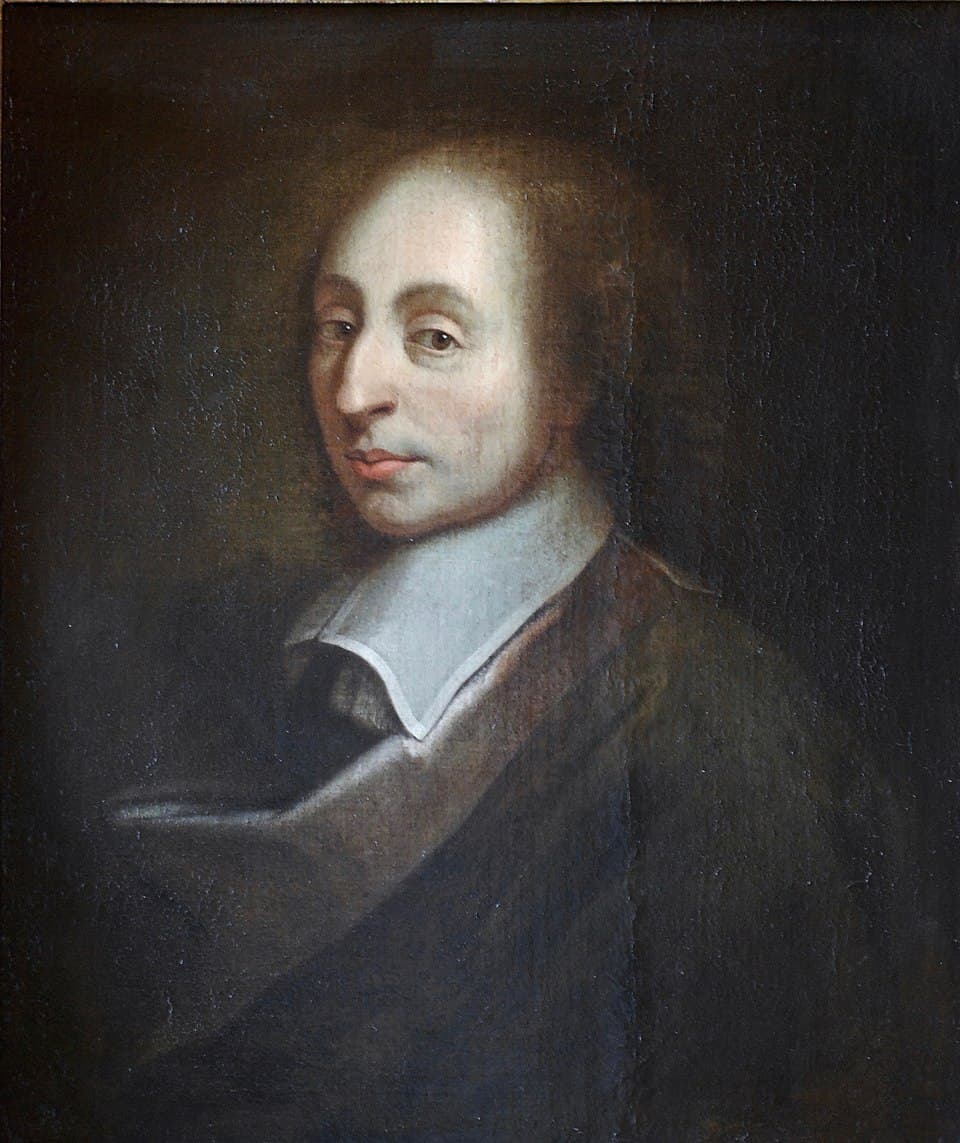
Custom's Power
Blaise Pascal
Pensees

Pascal argues that custom is the most powerful force of persuasion, shaping our deepest beliefs and daily certainties more effectively than logical demonstration or reason.

...and internals. It raises the common people to the internal, and humbles the proud to the external; it is not perfect without the two, for the people must understand the spirit of the letter, and the learned must submit their spirit to the letter. 252 For we must not misunderstand ourselves; we are as much automatic as intellectual; and hence it comes that the instrument by which conviction is attained is not demonstrated alone. How few things are demonstrated? Proofs only convince the mind.
Custom is the source of our strongest and most believed proofs. It bends the automaton, which persuades the mind without its thinking about the matter. Who has demonstrated that there will be a to-morrow, and that we shall die? And what is more believed? It is, then, custom which persuades us of it; it is custom that makes so many men Christians; custom that makes them Turks, heathens, artisans, soldiers, etc.
(Faith in baptism is more received among Christians than among Turks.) Finally, we must have recourse to it when once the mind has seen where the truth is, in order to quench our thirst, and steep ourselves in that belief, which escapes us at every hour; for always to have proofs ready is too much trouble. We must get an easier belief, which is that of custom, which, without violence, without art, without argument, makes us believe things, and inclines all our powers to this belief, so that out...
5

Blaise Pascal

Pensees

Custom as Nature

This excerpt extends Pascal's claim by stating that 'Custom is our nature,' directly agreeing that habitual exposure shapes our deepest beliefs, such as faith or fear of authority, thus reinforcing the parent text's argument.

...ugas dixerit.[54] Quasi quidquam infelicius sit homini cui sua figmenta dominantur._[55] (Plin.) 88 Children who are frightened at the face they have blackened are but children. But how shall one who is so weak in his childhood become really strong when he grows older? We only change our fancies. All that is made perfect by progress perishes also by progress. All that has been weak can never become absolutely strong. We say in vain, "He has grown, he has changed"; he is also the same. 89
Custom is our nature. He who is accustomed to the faith believes in it, can no longer fear hell, and believes in nothing else. He who is accustomed to believe that the king is terrible ... etc. Who doubts then that our soul, being accustomed to see number, space, motion, believes that and nothing else?
90 Quod crebro videt non miratur, etiamsi cur fiat nescit; quod ante non viderit, id si evenerit, ostentum esse censet.[56] (Cic. 583.) 91 Spongia solis.[57]--When we see the same effect always recur, we infer a natural necessity in it, as that there will be a to-morrow, etc. But nature often deceives us, and does not subject herself to her own rules. 92 What are our natural principles but principles of custom? In children they are those which they have received from the habits of...

David Hume

An Enquiry Concerning Human Understanding

Custom's Ultimate Principle

Hume explains the underlying mechanism of custom: repeated actions or experiences create a propensity to renew them without reasoning, which is exactly the process by which custom 'bends the automaton' as described by Pascal.

...erience, acquired any idea or knowledge of the secret power by which the one object produces the other; nor is it, by any process of reasoning, he is engaged to draw this inference. But still he finds himself determined to draw it: And though he should be convinced that his understanding has no part in the operation, he would nevertheless continue in the same course of thinking. There is some other principle which determines him to form such a conclusion. 36. This principle is Custom or Habit.
For wherever the repetition of any particular act or operation produces a propensity to renew the same act or operation, without being impelled by any reasoning or process of the understanding, we always say, that this propensity is the effect of Custom. By employing that word, we pretend not to have given the ultimate reason of such a propensity. We only point out a principle of human nature, which is universally acknowledged, and which is well known by its effects. Perhaps we can push our enquiries no farther, or pretend to give the cause of this cause; but must rest contented with it as t...
And it is certain we here advance a very intelligible proposition at least, if not a true one, when we assert that, after the constant conjunction of two objects--heat and flame, for instance, weight and solidity--we are determined by custom alone to expect the one from the appearance of the other. This hypothesis seems even the only one which explains the difficulty, why we draw, from a thousand instances, an inference which we are not able to draw from one instance, that is, in no respect, di...

John Stewart Mill

Utilitarianism

Custom's Moral Halo

Mill reframes the discussion from custom as the source of belief to the principle of general happiness as the true foundation of moral obligation, suggesting that customary morality is often mistaken for inherent obligation when the real standard is utility.

...is the source of its obligation? whence does it derive its binding force? It is a necessary part of moral philosophy to provide the answer to this question; which, though frequently assuming the shape of an objection to the utilitarian morality, as if it had some special applicability to that above others, really arises in regard to all standards. It arises, in fact, whenever a person is called on to adopt a standard or refer morality to any basis on which he has not been accustomed to rest it.
For the customary morality, that which education and opinion have consecrated, is the only one which presents itself to the mind with the feeling of being in itself obligatory; and when a person is asked to believe that this morality derives its obligation from some general principle round which custom has not thrown the same halo, the assertion is to him a paradox; the supposed corollaries seem to have a more binding force than the original theorem; the superstructure seems to stand better without, than with, what is represented as its foundation. He says to himself, I feel that I am boun...
If the view adopted by the utilitarian philosophy of the nature of the moral sense be correct, this difficulty will always present itself, until the influences which form moral character have taken the same hold of the principle which they have taken of some of the consequences--until, by the improvement of education, the feeling of unity with our fellow creatures shall be (what it cannot be doubted that Christ intended it to be) as deeply rooted in our character, and to our own consciousness...

David Hume

An Enquiry Concerning Human Understanding

The Circular Proof

Hume raises a meta-level doubt about justifying the uniformity of nature, showing that any attempt to prove that the future will resemble the past is circular, thus questioning our ability to ground the beliefs that custom produces.

...and can never be proved false by any demonstrative argument or abstract reasoning à priori. If we be, therefore, engaged by arguments to put trust in past experience, and make it the standard of our future judgement, these arguments must be probable only, or such as regard matter of fact and real existence, according to the division above mentioned. But that there is no argument of this kind, must appear, if our explication of that species of reasoning be admitted as solid and satisfactory.
We have said that all arguments concerning existence are founded on the relation of cause and effect; that our knowledge of that relation is derived entirely from experience; and that all our experimental conclusions proceed upon the supposition that the future will be conformable to the past. To endeavour, therefore, the proof of this last supposition by probable arguments, or arguments regarding existence, must be evidently going in a circle, and taking that for granted, which is the very point in question.
31. In reality, all arguments from experience are founded on the similarity which we discover among natural objects, and by which we are induced to expect effects similar to those which we have found to follow from such objects. And though none but a fool or madman will ever pretend to dispute the authority of experience, or to reject that great guide of human life, it may surely be allowed a philosopher to have so much curiosity at least as to examine the principle of human nature, which give...

Blaise Pascal

Pensees

Belief Through Custom

This excerpt gives practical guidance: after seeing the truth with the mind, one should 'steep' oneself in belief through custom to make it easier and more stable, directly answering 'what should I do?' in light of custom's power.

...ince the mind. Custom is the source of our strongest and most believed proofs. It bends the automaton, which persuades the mind without its thinking about the matter. Who has demonstrated that there will be a to-morrow, and that we shall die? And what is more believed? It is, then, custom which persuades us of it; it is custom that makes so many men Christians; custom that makes them Turks, heathens, artisans, soldiers, etc. (Faith in baptism is more received among Christians than among Turks.)
Finally, we must have recourse to it when once the mind has seen where the truth is, in order to quench our thirst, and steep ourselves in that belief, which escapes us at every hour; for always to have proofs ready is too much trouble. We must get an easier belief, which is that of custom, which, without violence, without art, without argument, makes us believe things, and inclines all our powers to this belief, so that out soul falls naturally into it. It is not enough to believe only by force of conviction, when the automaton is inclined to believe the contrary.
Both our parts must be made to believe, the mind by reasons which it is sufficient to have seen once in a lifetime, and the automaton by custom, and by not allowing it to incline to the contrary. Inclina cor meum, Deus.[100] The reason acts slowly, with so many examinations, and on so many principles, which must be always present, that at every hour it falls asleep, or wanders, through want of having all its principles present. Feeling does not act thus; it acts in a moment, and is always re...