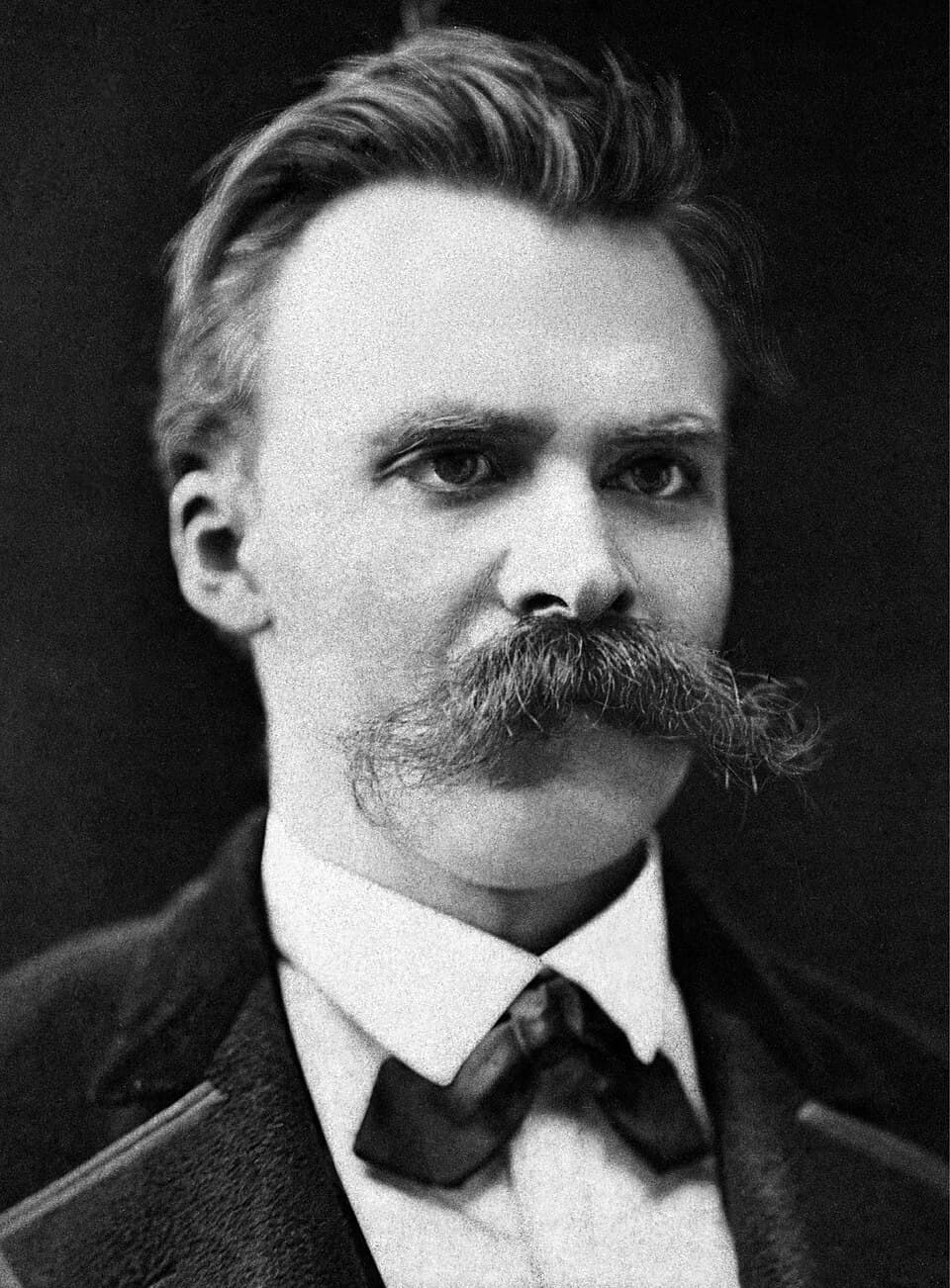
Body's Big Sagacity
Friedrich Nietzsche
Thus Spake Zarathustra

The author posits that the body is the primary intelligence, while the 'spirit' or 'ego' is merely a small tool or plaything of the body's greater sagacity.

...it speaketh of the meaning of the earth.— Thus spake Zarathustra. IV. THE DESPISERS OF THE BODY. To the despisers of the body will I speak my word. I wish them neither to learn afresh, nor teach anew, but only to bid farewell to their own bodies,—and thus be dumb. “Body am I, and soul”—so saith the child. And why should one not speak like children? But the awakened one, the knowing one, saith: “Body am I entirely, and nothing more; and soul is only the name of something in the body.”
The body is a big sagacity, a plurality with one sense, a war and a peace, a flock and a shepherd. An instrument of thy body is also thy little sagacity, my brother, which thou callest “spirit”—a little instrument and plaything of thy big sagacity. “Ego,” sayest thou, and art proud of that word. But the greater thing—in which thou art unwilling to believe—is thy body with its big sagacity; it saith not “ego,” but doeth it.
What the sense feeleth, what the spirit discerneth, hath never its end in itself. But sense and spirit would fain persuade thee that they are the end of all things: so vain are they. Instruments and playthings are sense and spirit: behind them there is still the Self. The Self seeketh with the eyes of the senses, it hearkeneth also with the ears of the spirit. Ever hearkeneth the Self, and seeketh; it compareth, mastereth, conquereth, and destroyeth. It ruleth, and is also the ego’s ruler....
6

Friedrich Nietzsche

Thus Spake Zarathustra

The Body's Hidden Sage

This excerpt extends the parent's idea by explicitly identifying the 'Self' with the body and describing the ego as its subordinate, laughing at its pretensions.

...What the sense feeleth, what the spirit discerneth, hath never its end in itself. But sense and spirit would fain persuade thee that they are the end of all things: so vain are they. Instruments and playthings are sense and spirit: behind them there is still the Self. The Self seeketh with the eyes of the senses, it hearkeneth also with the ears of the spirit. Ever hearkeneth the Self, and seeketh; it compareth, mastereth, conquereth, and destroyeth. It ruleth, and is also the ego’s ruler.
Behind thy thoughts and feelings, my brother, there is a mighty lord, an unknown sage—it is called Self; it dwelleth in thy body, it is thy body. There is more sagacity in thy body than in thy best wisdom. And who then knoweth why thy body requireth just thy best wisdom? Thy Self laugheth at thine ego, and its proud prancings. “What are these prancings and flights of thought unto me?” it saith to itself. “A by-way to my purpose. I am the leading-string of the ego, and the prompter of its notions.”
The Self saith unto the ego: “Feel pain!” And thereupon it suffereth, and thinketh how it may put an end thereto—and for that very purpose it IS MEANT to think. The Self saith unto the ego: “Feel pleasure!” Thereupon it rejoiceth, and thinketh how it may ofttimes rejoice—and for that very purpose it IS MEANT to think. To the despisers of the body will I speak a word. That they despise is caused by their esteem. What is it that created esteeming and despising and worth and will? The creatin...

Marcus Aurelius

Meditations

The Threefold Self

This excerpt challenges the parent's elevation of the body by asserting that the true ruling part of a human is reason, and one should think little of the flesh.

...and of the same divine particle; How can I either be hurt by any of those, since it is not in their power to make me incur anything that is truly reproachful? or angry, and ill affected towards him, who by nature is so near unto me? for we are all born to be fellow-workers, as the feet, the hands, and the eyelids; as the rows of the upper and under teeth: for such therefore to be in opposition, is against nature; and what is it to chafe at, and to be averse from, but to be in opposition? XVI.
Whatsoever I am, is either flesh, or life, or that which we commonly call the mistress and overruling part of man; reason. Away with thy books, suffer not thy mind any more to be distracted, and carried to and fro; for it will not be; but as even now ready to die, think little of thy flesh: blood, bones, and a skin; a pretty piece of knit and twisted work, consisting of nerves, veins and arteries; think no more of it, than so. And as for thy life, consider what it is; a wind; not one constant wind neither, but every moment of an hour let out, and sucked in again. The third, is thy ruling part;...
XVII. Whatsoever proceeds from the gods immediately, that any man will grant totally depends from their divine providence. As for those things that are commonly said to happen by fortune, even those must be conceived to have dependence from nature, or from that first and general connection, and concatenation of all those things, which more apparently by the divine providence are administered and brought to pass. All things flow from thence: and whatsoever it is that is, is both necessary, and...

Friedrich Nietzsche

Thus Spake Zarathustra

The Creating Self

This excerpt provides a causal explanation for the parent's claim by stating that the creating body fashioned the spirit as an instrument to serve its will.

...s. “What are these prancings and flights of thought unto me?” it saith to itself. “A by-way to my purpose. I am the leading-string of the ego, and the prompter of its notions.” The Self saith unto the ego: “Feel pain!” And thereupon it suffereth, and thinketh how it may put an end thereto—and for that very purpose it IS MEANT to think. The Self saith unto the ego: “Feel pleasure!” Thereupon it rejoiceth, and thinketh how it may ofttimes rejoice—and for that very purpose it IS MEANT to think.
To the despisers of the body will I speak a word. That they despise is caused by their esteem. What is it that created esteeming and despising and worth and will? The creating Self created for itself esteeming and despising, it created for itself joy and woe. The creating body created for itself spirit, as a hand to its will.
Even in your folly and despising ye each serve your Self, ye despisers of the body. I tell you, your very Self wanteth to die, and turneth away from life. No longer can your Self do that which it desireth most:—create beyond itself. That is what it desireth most; that is all its fervour. But it is now too late to do so:—so your Self wisheth to succumb, ye despisers of the body. To succumb—so wisheth your Self; and therefore have ye become despisers of the body. For ye can no longer create b...

Blaise Pascal

Pensees

Mind-Body Paradox

This excerpt reframes the issue from a debate about primacy to the fundamental mystery of how mind and body are united, which we least understand.

...y from destruction, that they fear the void, that they have inclinations, sympathies, antipathies, all of which attributes pertain only to mind. And in speaking of minds, they consider them as in a place, and attribute to them movement from one place to another; and these are qualities which belong only to bodies. Instead of receiving the ideas of these things in their purity, we colour them with our own qualities, and stamp with our composite being all the simple things which we contemplate.
Who would not think, seeing us compose all things of mind and body, but that this mixture would be quite intelligible to us? Yet it is the very thing we least understand. Man is to himself the most wonderful object in nature; for he cannot conceive what the body is, still less what the mind is, and least of all how a body should be united to a mind. This is the consummation of his difficulties, and yet it is his very being.
Modus quo corporibus adhærent spiritus comprehendi ab hominibus non potest, et hoc tamen homo est.[35] Finally, to complete the proof of our weakness, I shall conclude with these two considerations.... 73 [But perhaps this subject goes beyond the capacity of reason. Let us therefore examine her solutions to problems within her powers. If there be anything to which her own interest must have made her apply herself most seriously, it is the inquiry into her own sovereign good. Let us see, th...

Blaise Pascal

Pensees

Man's Paradoxical Nature

This excerpt questions our ability to settle questions about human nature by reason alone, presenting man as a paradoxical being who transcends himself.

...he is being pinched, or whether he is being burned? Shall he doubt whether he doubts? Shall he doubt whether he exists? We cannot go so far as that; and I lay it down as a fact that there never has been a real complete sceptic. Nature sustains our feeble reason, and prevents it raving to this extent. Shall he then say, on the contrary, that he certainly possesses truth--he who, when pressed ever so little, can show no title to it, and is forced to let go his hold? What a chimera then is man!
What a novelty! What a monster, what a chaos, what a contradiction, what a prodigy! Judge of all things, imbecile worm of the earth; depositary of truth, a sink of uncertainty and error; the pride and refuse of the universe! Who will unravel this tangle? Nature confutes the sceptics, and reason confutes the dogmatists. What then will you become, O men! who try to find out by your natural reason what is your true condition? You cannot avoid one of these sects, nor adhere to one of them. Know then, proud man, what a paradox you are to yourself. Humble yourself, weak reason; be silent, foolish na...
Hear God. For in fact, if man had never been corrupt, he would enjoy in his innocence both truth and happiness with assurance; and if man had always been corrupt, he would have no idea of truth or bliss. But, wretched as we are, and more so than if there were no greatness in our condition, we have an idea of happiness, and cannot reach it. We perceive an image of truth, and possess only a lie. Incapable of absolute ignorance and of certain knowledge, we have thus been manifestly in a degree of...

Marcus Aurelius

Meditations

Our Tiny Portion

This excerpt offers practical guidance to focus on doing what one's own nature requires and conforming to the common nature of the world.

...ive soul; or of the appetitive faculty? or wouldst thou grow, and then decrease again? Wouldst thou long be able to talk, to think and reason with thyself? Which of all these seems unto thee a worthy object of thy desire? Now if of all these thou doest find that they be but little worth in themselves, proceed on unto the last, which is, in all things to follow God and reason. But for a man to grieve that by death he shall be deprived of any of these things, is both against God and reason. XXV.
What a small portion of vast and infinite eternity it is, that is allowed unto every one of us, and how soon it vanisheth into the general age of the world: of the common substance, and of the common soul also what a small portion is allotted unto us: and in what a little clod of the whole earth (as it were) it is that thou doest crawl. After thou shalt rightly have considered these things with thyself; fancy not anything else in the world any more to be of any weight and moment but this, to do that only which thine own nature doth require; and to conform thyself to that which the common natur...
XXVI. What is the present estate of my understanding? For herein lieth all indeed. As for all other things, they are without the compass of mine own will: and if without the compass of my will, then are they as dead things unto me, and as it were mere smoke. XXVII. To stir up a man to the contempt of death this among other things, is of good power and efficacy, that even they who esteemed pleasure to be happiness, and pain misery, did nevertheless many of them contemn death as much as any. An...