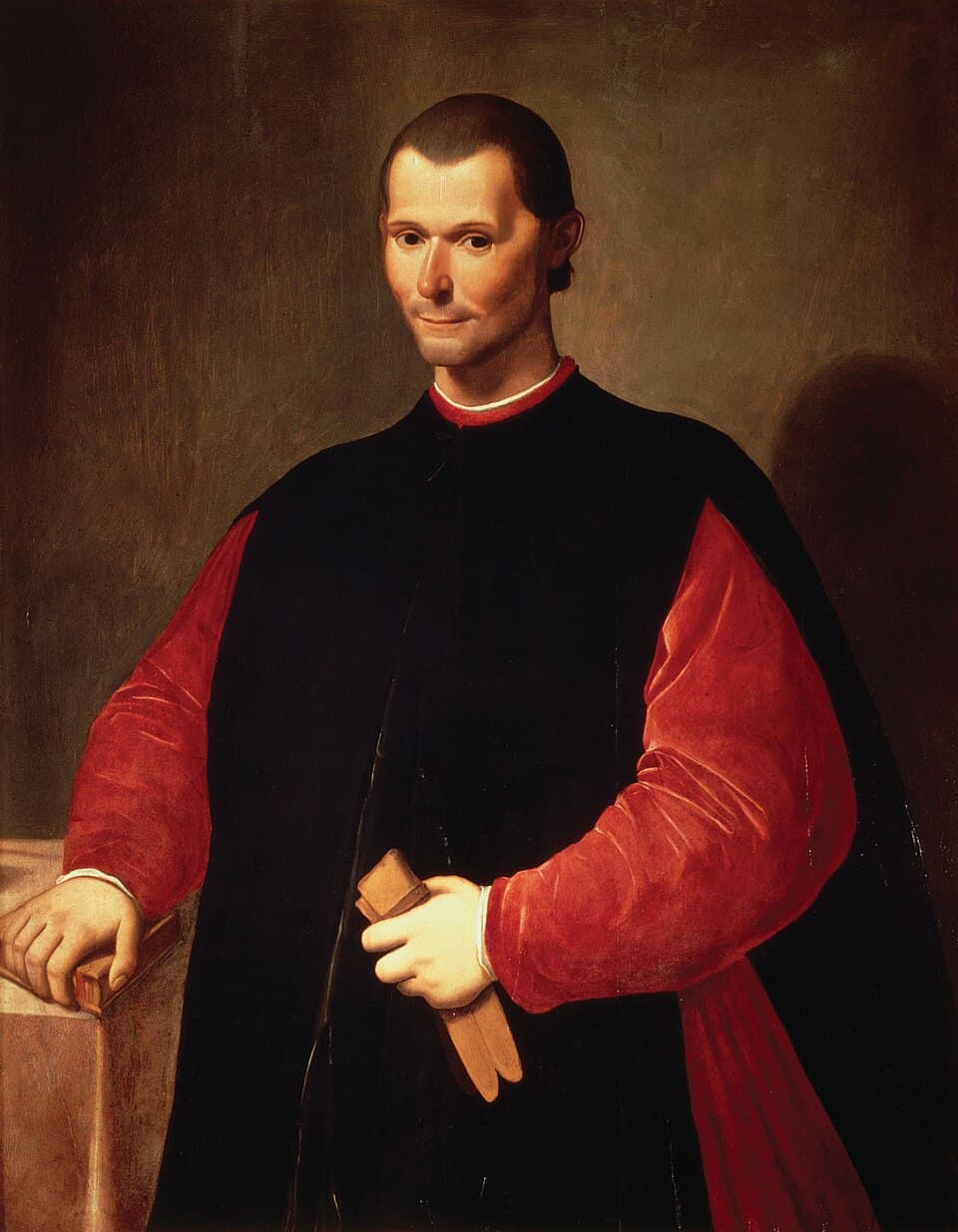
The Lesser Evil
Niccolo Machiavelli
The Prince

The author argues that political decisions always involve risk, and true prudence lies in the ability to identify and choose the least harmful course of action.

...pels him, as is said above; because if he conquers you are at his discretion, and princes ought to avoid as much as possible being at the discretion of any one. The Venetians joined with France against the Duke of Milan, and this alliance, which caused their ruin, could have been avoided. But when it cannot be avoided, as happened to the Florentines when the Pope and Spain sent armies to attack Lombardy, then in such a case, for the above reasons, the prince ought to favour one of the parties.
Never let any Government imagine that it can choose perfectly safe courses; rather let it expect to have to take very doubtful ones, because it is found in ordinary affairs that one never seeks to avoid one trouble without running into another; but prudence consists in knowing how to distinguish the character of troubles, and for choice to take the lesser evil.
A prince ought also to show himself a patron of ability, and to honour the proficient in every art. At the same time he should encourage his citizens to practise their callings peaceably, both in commerce and agriculture, and in every other following, so that the one should not be deterred from improving his possessions for fear lest they be taken away from him or another from opening up trade for fear of taxes; but the prince ought to offer rewards to whoever wishes to do these things and des...
4

Aristotle

Nicomachean Ethics

Moral Action's Unfixedness

Aristotle explains that matters of moral action and expediency lack fixedness, much like matters of health. This inherent uncertainty in human affairs is the deeper reason why governments cannot choose perfectly safe courses and must instead rely on prudence to distinguish between troubles and choose the lesser evil.

...would have been useless), we must consider as to the particular actions how we are to do them, because, as we have just said, the quality of the habits that shall be formed depends on these. Now, that we are to act in accordance with Right Reason is a general maxim, and may for the present be taken for granted: we will speak of it hereafter, and say both what Right Reason is, and what are its relations to the other virtues.[4] But let this point be first thoroughly understood between us, that
All which can be said on moral action must be said in outline, as it were, and not exactly: for as we remarked at the commencement, such reasoning only must be required as the nature of the subject-matter admits of, and matters of moral action and expediency have no fixedness any more than matters of health. And if the subject in its general maxims is such, still less in its application to particular cases is exactness attainable: because these fall not under any art or system of rules, but it must be left in each instance to the individual agents to look to the exigencies of the particular ca...
Still, though the present subject is confessedly such, we must try and do what we can for it. First then this must be noted, that it is the nature of such things to be spoiled by defect and excess; as we see in the case of health and strength (since for the illustration of things which cannot be seen we must use those that can), for excessive training impairs the strength as well as deficient: meat and drink, in like manner, in too great or too small quantities, impair the health: while in due...

Francois de La Rochefoucauld

Maxims

Bear Present Ills

La Rochefoucauld suggests that it is better to accustom ourselves to bear existing ills than to speculate on future ones. This directly counters Machiavelli's prescription that one must actively choose between evils to avoid trouble, implying that such speculation and intervention may lead to worse outcomes and that stoic endurance is preferable.

It is far better to accustom our mind to bear the ills we have than to speculate on those which may befall us.

Marcus Aurelius

Meditations

The Two Rules

Marcus Aurelius offers an alternative rule: act only according to reason for the benefit of men, and be always ready to change your mind based on grounds of justice or public good. This opposes Machiavelli's consequentialist 'lesser evil' approach with a deontological focus on virtuous action and correction.

...were by way of equal distribution, according to the true worth of everything. Continue then to take notice of it, as thou hast begun, and whatsoever thou dost, do it not without this proviso, that it be a thing of that nature that a good man (as the word good is properly taken) may do it. This observe carefully in every action. IX. Conceit no such things, as he that wrongeth thee conceiveth, or would have thee to conceive, but look into the matter itself, and see what it is in very truth. X.
These two rules, thou must have always in a readiness. First, do nothing at all, but what reason proceeding from that regal and supreme part, shall for the good and benefit of men, suggest unto thee. And secondly, if any man that is present shall be able to rectify thee or to turn thee from some erroneous persuasion, that thou be always ready to change thy mind, and this change to proceed, not from any respect of any pleasure or credit thereon depending, but always from some probable apparent ground of justice, or of some public good thereby to be furthered; or from some other such inducement.
XI. Hast thou reason? I have. Why then makest thou not use of it? For if thy reason do her part, what more canst thou require? XII. As a part hitherto thou hast had a particular subsistence: and now shalt thou vanish away into the common substance of Him, who first begot thee, or rather thou shalt be resumed again into that original rational substance, out of which all others have issued, and are propagated. Many small pieces of frankincense are set upon the same altar, one drops first and is...

Niccolo Machiavelli

The Prince

Preventative Action

Machiavelli provides a concrete method: prudent rulers must not only address present troubles but also foresee future ones and prepare for them energetically. By anticipating problems while they are still easy to remedy, a ruler can avoid the incurable maladies that arise from neglect, thus enacting the prescription to choose the lesser evil through proactive distinction of troubles.

...wers to gain authority. Greece appears to me sufficient for an example. The Achaeans and Ætolians were kept friendly by them, the kingdom of Macedonia was humbled, Antiochus was driven out; yet the merits of the Achaeans and Ætolians never secured for them permission to increase their power, nor did the persuasions of Philip ever induce the Romans to be his friends without first humbling him, nor did the influence of Antiochus make them agree that he should retain any lordship over the country.
Because the Romans did in these instances what all prudent princes ought to do, who have to regard not only present troubles, but also future ones, for which they must prepare with every energy, because, when foreseen, it is easy to remedy them; but if you wait until they approach, the medicine is no longer in time because the malady has become incurable; for it happens in this, as the physicians say it happens in hectic fever, that in the beginning of the malady it is easy to cure but difficult to detect, but in the course of time, not having been either detected or treated in the beginning,...
Thus it happens in affairs of state, for when the evils that arise have been foreseen (which it is only given to a wise man to see), they can be quickly redressed, but when, through not having been foreseen, they have been permitted to grow in a way that every one can see them, there is no longer a remedy. Therefore, the Romans, foreseeing troubles, dealt with them at once, and, even to avoid a war, would not let them come to a head, for they knew that war is not to be avoided, but is only to b...