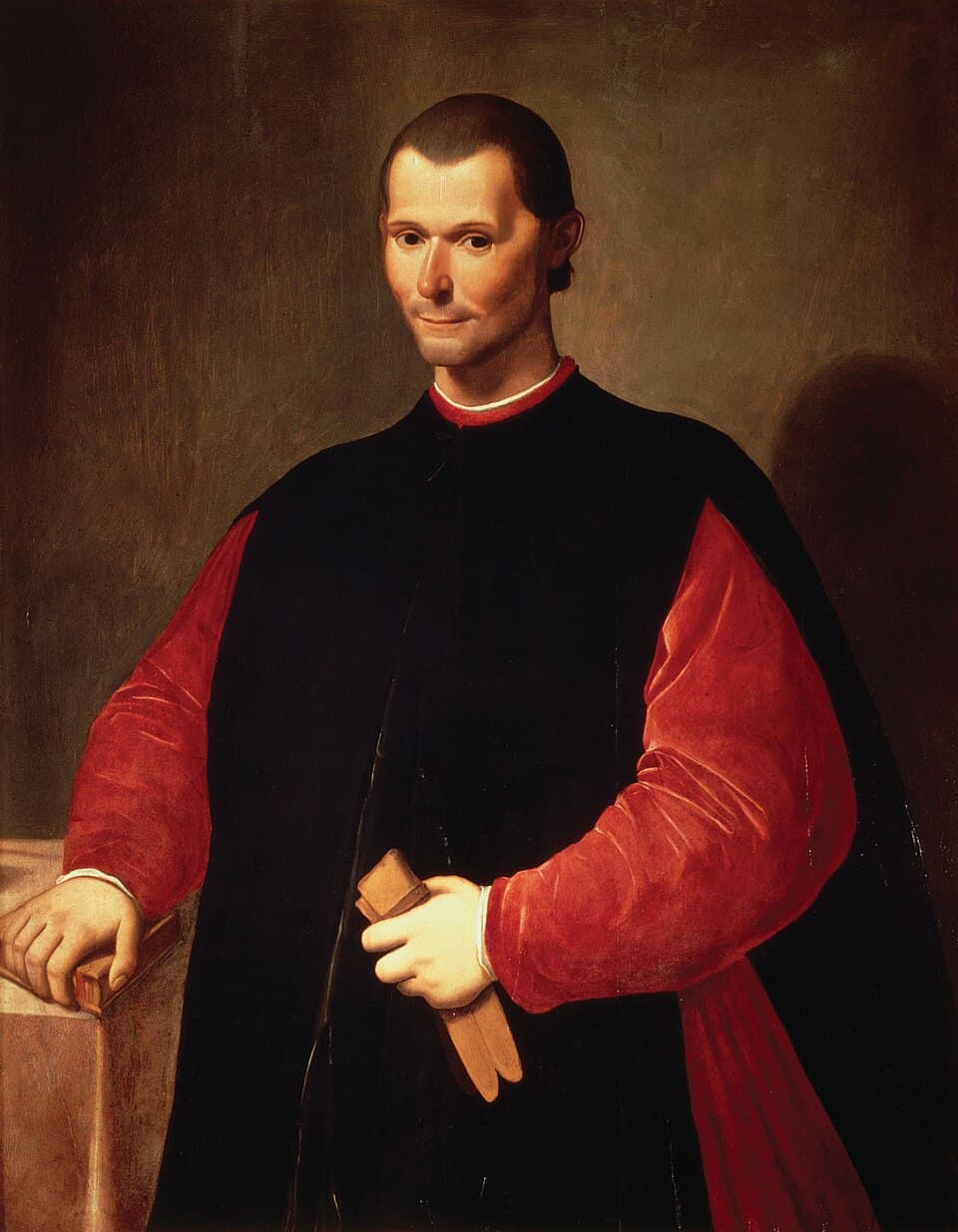
Counsel of the Few
Niccolo Machiavelli
The Prince

The author advises princes to encourage honest counsel from a select few while remaining resolute in their final decisions to avoid the pitfalls of flattery and indecision.

...erers except letting men understand that to tell you the truth does not offend you; but when every one may tell you the truth, respect for you abates. Therefore a wise prince ought to hold a third course by choosing the wise men in his state, and giving to them only the liberty of speaking the truth to him, and then only of those things of which he inquires, and of none others; but he ought to question them upon everything, and listen to their opinions, and afterwards form his own conclusions.
With these councillors, separately and collectively, he ought to carry himself in such a way that each of them should know that, the more freely he shall speak, the more he shall be preferred; outside of these, he should listen to no one, pursue the thing resolved on, and be steadfast in his resolutions. He who does otherwise is either overthrown by flatterers, or is so often changed by varying opinions that he falls into contempt.
I wish on this subject to adduce a modern example. Fra Luca, the man of affairs to Maximilian,[1] the present emperor, speaking of his majesty, said: He consulted with no one, yet never got his own way in anything. This arose because of his following a practice the opposite to the above; for the emperor is a secretive man—he does not communicate his designs to any one, nor does he receive opinions on them. But as in carrying them into effect they become revealed and known, they are at once obs...
3
The Prince's Reflection
Niccolo Machiavelli
The Prince

The author asserts that the wisdom of a prince is judged by the quality of his advisors, as the choice of capable servants reflects the ruler's own intelligence.

...rte.” Its root is that of the verb “rotisya,” to bind oneself by an oath; and it is generally admitted to be only another form of “rota,” which now signifies a “regimental company.” In both words the underlying idea is that of a body of men united by an oath. “Tribu” were possibly gentile groups, united by common descent, and included individuals connected by marriage. Perhaps our words “sects” or “clans” would be most appropriate. CHAPTER XXII. CONCERNING THE SECRETARIES OF PRINCES
The choice of servants is of no little importance to a prince, and they are good or not according to the discrimination of the prince. And the first opinion which one forms of a prince, and of his understanding, is by observing the men he has around him; and when they are capable and faithful he may always be considered wise, because he has known how to recognize the capable and to keep them faithful. But when they are otherwise one cannot form a good opinion of him, for the prime error which he made was in choosing them. There were none who knew Messer Antonio da Venafro as the servant of Pandolfo Petrucci, Prince of Siena, who would not…
Because there are three classes of intellects: one which comprehends by itself; another which appreciates what others comprehended; and a third which neither comprehends by itself nor by the showing of others; the first is the most excellent, the second is good, the third is useless. Therefore, it follows necessarily that, if Pandolfo was not in the first rank, he was in the second, for whenever one has judgment to know good and bad when it is said and done, although he himself may not have the...
Continue reading →
4
Fortune's Cruel Favor
Niccolo Machiavelli
The Prince

The author observes that many great historical figures rose from obscure or lowly origins, suggesting that Fortune often elevates such individuals to demonstrate her power over human wisdom. He implies that these humble beginnings serve as a canvas for Fortune to display her influence on the course of human events.

...the duke on Vitellozzo. Pagolo and the Duke di Gravina Orsini were kept alive until the duke heard from Rome that the pope had taken the Cardinal Orsino, the Archbishop of Florence, and Messer Jacopo da Santa Croce. After which news, on 18th January 1502, in the castle of Pieve, they also were strangled in the same way. THE LIFE OF CASTRUCCIO CASTRACANI OF LUCCA WRITTEN BY NICOLO MACHIAVELLI And sent to his friends ZANOBI BUONDELMONTI And LUIGI ALAMANNI CASTRUCCIO CASTRACANI 1284-1328
It appears, dearest Zanobi and Luigi, a wonderful thing to those who have considered the matter, that all men, or the larger number of them, who have performed great deeds in the world, and excelled all others in their day, have had their birth and beginning in baseness and obscurity; or have been aggrieved by Fortune in some outrageous way. They have either been exposed to the mercy of wild beasts, or they have had so mean a parentage that in shame they have given themselves out to be sons of Jove or of some other deity. It would be wearisome to relate who these persons may have been because they are well known to everybody, and, as such…
Castruccio Castracani of Lucca was one of those men who did great deeds, if he is measured by the times in which he lived and the city in which he was born; but, like many others, he was neither fortunate nor distinguished in his birth, as the course of this history will show. It appeared to be desirable to recall his memory, because I have discerned in him such indications of valour and fortune as should make him a great exemplar to men. I think also that I ought to call your attention to his...
Continue reading →
2
Ambition's Regret
Niccolo Machiavelli
The Prince

A reflective confession where the author admits that a less ambitious path might have resulted in a smaller but more secure and peaceful state.

...saddle and the last out of it. Here Castruccio stood exposed to a wind which often rises at midday on the banks of the Arno, and which is often very unhealthy; from this he took a chill, of which he thought nothing, as he was accustomed to such troubles; but it was the cause of his death. On the following night he was attacked with high fever, which increased so rapidly that the doctors saw it must prove fatal. Castruccio, therefore, called Pagolo Guinigi to him, and addressed him as follows:
“If I could have believed that Fortune would have cut me off in the midst of the career which was leading to that glory which all my successes promised, I should have laboured less, and I should have left thee, if a smaller state, at least with fewer enemies and perils, because I should have been content with the governorships of Lucca and Pisa. I should neither have subjugated the Pistoians, nor outraged the Florentines with so many injuries. But I would have made both these peoples my friends, and I should have lived, if no longer, at least more peacefully, and have left you a state without a doubt smaller, but one more secure and…
But Fortune, who insists upon having the arbitrament of human affairs, did not endow me with sufficient judgment to recognize this from the first, nor the time to surmount it. Thou hast heard, for many have told thee, and I have never concealed it, how I entered the house of thy father whilst yet a boy—a stranger to all those ambitions which every generous soul should feel—and how I was brought up by him, and loved as though I had been born of his blood; how under his governance I learned to be...
Continue reading →
2
Controlled Counsel
Niccolo Machiavelli
The Prince

The author advises that a prince should seek counsel only on his own terms and asserts that a ruler who is not personally wise can never be effectively guided by his advisors.

..., they are at once obstructed by those men whom he has around him, and he, being pliant, is diverted from them. Hence it follows that those things he does one day he undoes the next, and no one ever understands what he wishes or intends to do, and no one can rely on his resolutions. [1] Maximilian I, born in 1459, died 1519, Emperor of the Holy Roman Empire. He married, first, Mary, daughter of Charles the Bold; after her death, Bianca Sforza; and thus became involved in Italian politics.
A prince, therefore, ought always to take counsel, but only when he wishes and not when others wish; he ought rather to discourage every one from offering advice unless he asks it; but, however, he ought to be a constant inquirer, and afterwards a patient listener concerning the things of which he inquired; also, on learning that any one, on any consideration, has not told him the truth, he should let his anger be felt. And if there are some who think that a prince who conveys an impression of his wisdom is not so through his own ability, but through the good advisers that he has around him, beyond doubt they are deceived, because this is an…
In this case indeed he may be well governed, but it would not be for long, because such a governor would in a short time take away his state from him. But if a prince who is not inexperienced should take counsel from more than one he will never get united counsels, nor will he know how to unite them. Each of the counsellors will think of his own interests, and the prince will not know how to control them or to see through them. And they are not to be found otherwise, because men will always pr...
Continue reading →
2