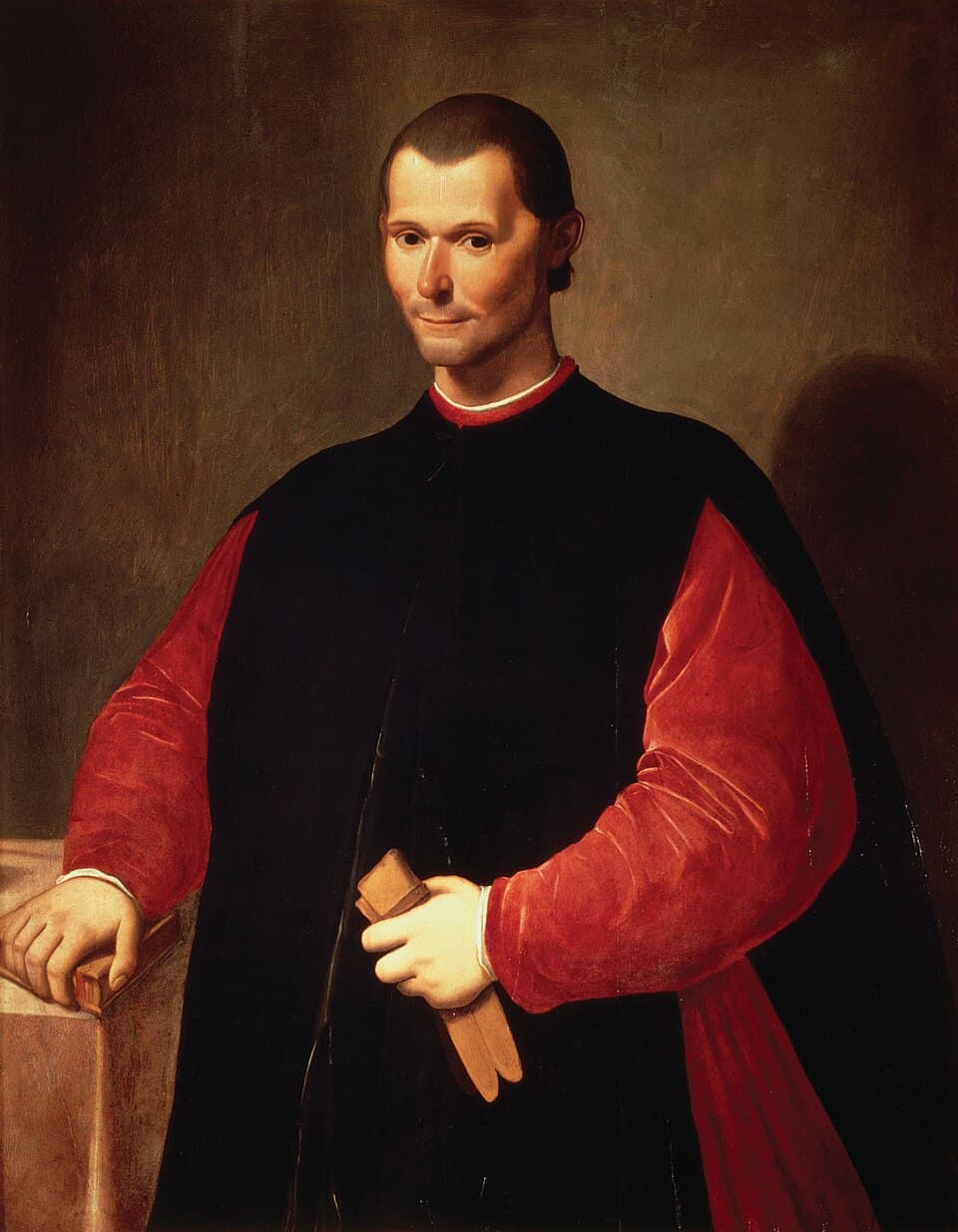
The Fox and Lion
Niccolo Machiavelli
The Prince

The author prescribes that a prince must master both deception and force, using the 'fox' to recognize traps and the 'lion' to drive away predators.

...t is necessary for a prince to understand how to avail himself of the beast and the man. This has been figuratively taught to princes by ancient writers, who describe how Achilles and many other princes of old were given to the Centaur Chiron to nurse, who brought them up in his discipline; which means solely that, as they had for a teacher one who was half beast and half man, so it is necessary for a prince to know how to make use of both natures, and that one without the other is not durable.
A prince, therefore, being compelled knowingly to adopt the beast, ought to choose the fox and the lion; because the lion cannot defend himself against snares and the fox cannot defend himself against wolves. Therefore, it is necessary to be a fox to discover the snares and a lion to terrify the wolves. Those who rely simply on the lion do not understand what they are about.
Therefore a wise lord cannot, nor ought he to, keep faith when such observance may be turned against him, and when the reasons that caused him to pledge it exist no longer. If men were entirely good this precept would not hold, but because they are bad, and will not keep faith with you, you too are not bound to observe it with them. Nor will there ever be wanting to a prince legitimate reasons to excuse this non-observance. Of this endless modern examples could be given, showing how many treati...
2
The Calculated Alliance
Niccolo Machiavelli
The Prince

The author argues that taking a clear side in a conflict is strategically superior to neutrality, as it builds a bond of gratitude and mutual respect with the victor.

...that it is better and more advantageous for your state not to interfere in our war, nothing can be more erroneous; because by not interfering you will be left, without favour or consideration, the guerdon of the conqueror.” Thus it will always happen that he who is not your friend will demand your neutrality, whilst he who is your friend will entreat you to declare yourself with arms. And irresolute princes, to avoid present dangers, generally follow the neutral path, and are generally ruined.
But when a prince declares himself gallantly in favour of one side, if the party with whom he allies himself conquers, although the victor may be powerful and may have him at his mercy, yet he is indebted to him, and there is established a bond of amity; and men are never so shameless as to become a monument of ingratitude by oppressing you. Victories after all are never so complete that the victor must not show some regard, especially to justice.
But if he with whom you ally yourself loses, you may be sheltered by him, and whilst he is able he may aid you, and you become companions on a fortune that may rise again. In the second case, when those who fight are of such a character that you have no anxiety as to who may conquer, so much the more is it greater prudence to be allied, because you assist at the destruction of one by the aid of another who, if he had been wise, would have saved him; and conquering, as it is impossible that he...
4
Swift Cruelty, Gradual Kindness
Niccolo Machiavelli
The Prince

The author advises that a usurper should commit all necessary cruelties at once to allow subjects to forget them, while dispensing benefits slowly to ensure they are savored.

...The badly employed are those which, notwithstanding they may be few in the commencement, multiply with time rather than decrease. Those who practise the first system are able, by aid of God or man, to mitigate in some degree their rule, as Agathocles did. It is impossible for those who follow the other to maintain themselves. [2] Mr Burd suggests that this word probably comes near the modern equivalent of Machiavelli’s thought when he speaks of “crudelta” than the more obvious “cruelties.”
Hence it is to be remarked that, in seizing a state, the usurper ought to examine closely into all those injuries which it is necessary for him to inflict, and to do them all at one stroke so as not to have to repeat them daily; and thus by not unsettling men he will be able to reassure them, and win them to himself by benefits. He who does otherwise, either from timidity or evil advice, is always compelled to keep the knife in his hand; neither can he rely on his subjects, nor can they attach themselves to him, owing to their continued and repeated wrongs. For injuries ought to be done all at one time, so that, being tasted less, they offend…
And above all things, a prince ought to live amongst his people in such a way that no unexpected circumstances, whether of good or evil, shall make him change; because if the necessity for this comes in troubled times, you are too late for harsh measures; and mild ones will not help you, for they will be considered as forced from you, and no one will be under any obligation to you for them. CHAPTER IX. CONCERNING A CIVIL PRINCIPALITY But coming to the other point—where a leading citizen...
Continue reading →
2
The Bond of Shared Suffering
Niccolo Machiavelli
The Prince

The author posits that a strong prince can maintain the loyalty of his subjects during a siege by balancing their hopes and fears, eventually binding them to him through the shared experience of sacrifice. He notes that men are naturally inclined to feel obligated to those they have suffered for or benefited from.

...oper ditches and walls, they have sufficient artillery, and they always keep in public depots enough for one year’s eating, drinking, and firing. And beyond this, to keep the people quiet and without loss to the state, they always have the means of giving work to the community in those labours that are the life and strength of the city, and on the pursuit of which the people are supported; they also hold military exercises in repute, and moreover have many ordinances to uphold them. Therefore,
A prince who has a strong city, and had not made himself odious, will not be attacked, or if any one should attack he will only be driven off with disgrace; again, because that the affairs of this world are so changeable, it is almost impossible to keep an army a whole year in the field without being interfered with. And whoever should reply: If the people have property outside the city, and see it burnt, they will not remain patient, and the long siege and self-interest will make them forget their prince; to this I answer that a powerful and courageous prince will overcome all such difficulties by giving at one time hope to his subjects that…
Therefore, if everything is well considered, it will not be difficult for a wise prince to keep the minds of his citizens steadfast from first to last, when he does not fail to support and defend them. CHAPTER XI. CONCERNING ECCLESIASTICAL PRINCIPALITIES It only remains now to speak of ecclesiastical principalities, touching which all difficulties are prior to getting possession, because they are acquired either by capacity or good fortune, and they can be held without either; for they ar...
Continue reading →
3
Controlled Counsel
Niccolo Machiavelli
The Prince

The author advises that a prince should seek counsel only on his own terms and asserts that a ruler who is not personally wise can never be effectively guided by his advisors.

..., they are at once obstructed by those men whom he has around him, and he, being pliant, is diverted from them. Hence it follows that those things he does one day he undoes the next, and no one ever understands what he wishes or intends to do, and no one can rely on his resolutions. [1] Maximilian I, born in 1459, died 1519, Emperor of the Holy Roman Empire. He married, first, Mary, daughter of Charles the Bold; after her death, Bianca Sforza; and thus became involved in Italian politics.
A prince, therefore, ought always to take counsel, but only when he wishes and not when others wish; he ought rather to discourage every one from offering advice unless he asks it; but, however, he ought to be a constant inquirer, and afterwards a patient listener concerning the things of which he inquired; also, on learning that any one, on any consideration, has not told him the truth, he should let his anger be felt. And if there are some who think that a prince who conveys an impression of his wisdom is not so through his own ability, but through the good advisers that he has around him, beyond doubt they are deceived, because this is an…
In this case indeed he may be well governed, but it would not be for long, because such a governor would in a short time take away his state from him. But if a prince who is not inexperienced should take counsel from more than one he will never get united counsels, nor will he know how to unite them. Each of the counsellors will think of his own interests, and the prince will not know how to control them or to see through them. And they are not to be found otherwise, because men will always pr...
Continue reading →
2