The author observes that different men achieve the same goals of glory and riches through vastly different temperaments, suggesting that success depends on the method's alignment with the times.
The Many Paths to Glory
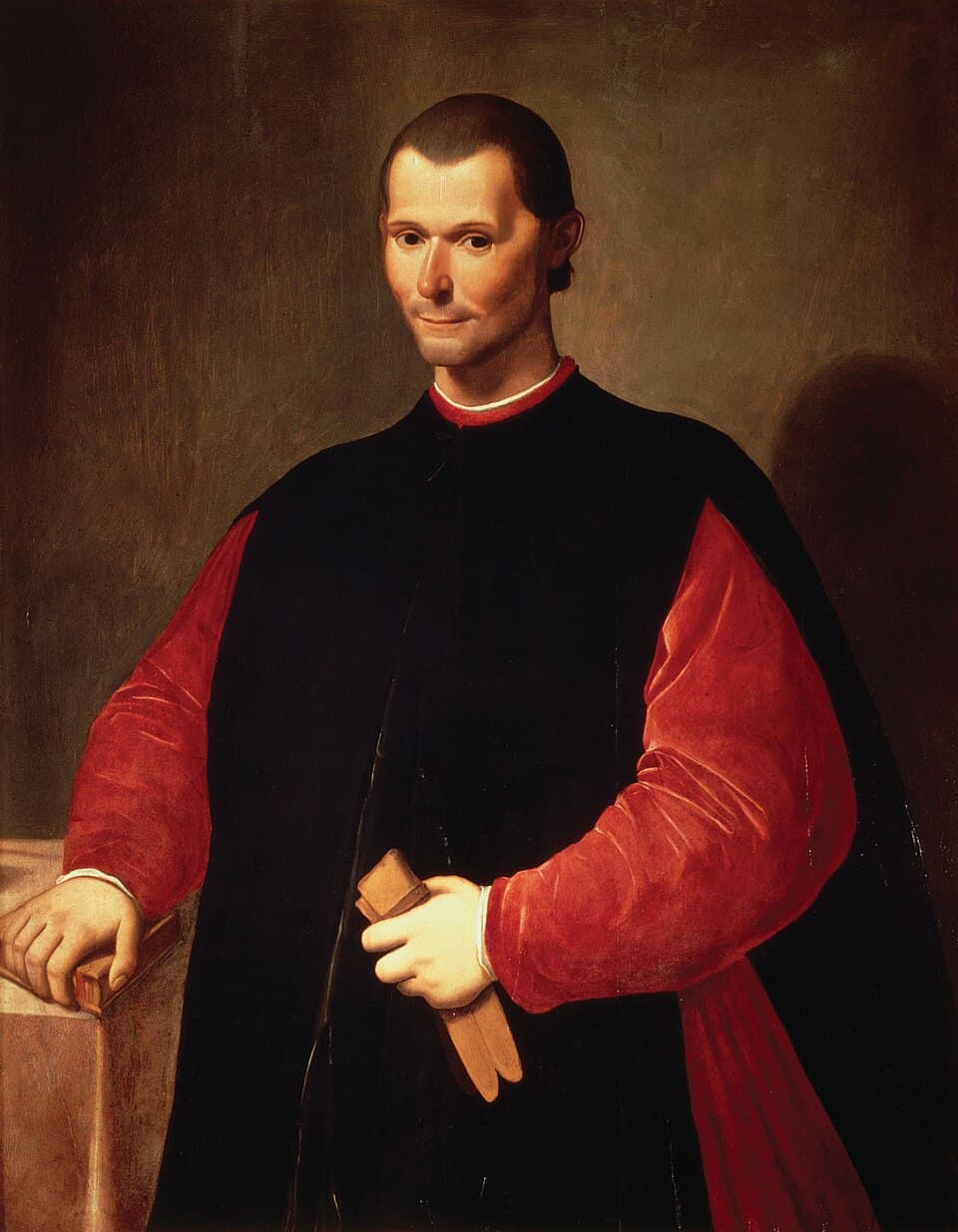
Niccolo Machiavelli
The Prince...re to the particular, I say that a prince may be seen happy to-day and ruined to-morrow without having shown any change of disposition or character. This, I believe, arises firstly from causes that have already been discussed at length, namely, that the prince who relies entirely on fortune is lost when it changes. I believe also that he will be successful who directs his actions according to the spirit of the times, and that he whose actions do not accord with the times will not be successful.
Because men are seen, in affairs that lead to the end which every man has before him, namely, glory and riches, to get there by various methods; one with caution, another with haste; one by force, another by skill; one by patience, another by its opposite; and each one succeeds in reaching the goal by a different method.
One can also see of two cautious men the one attain his end, the other fail; and similarly, two men by different observances are equally successful, the one being cautious, the other impetuous; all this arises from nothing else than whether or not they conform in their methods to the spirit of the times. This follows from what I have said, that two men working differently bring about the same effect, and of two working similarly, one attains his object and the other does not. Changes in estate...
6
⚖The Art of War

Niccolo Machiavelli
The PrinceA prescription stating that a ruler's primary and sole focus should be the art of war, as military proficiency is the foundation of both acquiring and retaining political power.
...es are those which are composed either of subjects, citizens, or dependents; all others are mercenaries or auxiliaries. And the way to make ready one’s own forces will be easily found if the rules suggested by me shall be reflected upon, and if one will consider how Philip, the father of Alexander the Great, and many republics and princes have armed and organized themselves, to which rules I entirely commit myself. CHAPTER XIV. THAT WHICH CONCERNS A PRINCE ON THE SUBJECT OF THE ART OF WAR
A prince ought to have no other aim or thought, nor select anything else for his study, than war and its rules and discipline; for this is the sole art that belongs to him who rules, and it is of such force that it not only upholds those who are born princes, but it often enables men to rise from a private station to that rank. And, on the contrary, it is seen that when princes have thought more of ease than of arms they have lost their states. And the first cause of your losing it is to neglect this art; and what enables you to acquire a state is to be master of the art. Francesco Sforza, through being martial, from a private person became…
Because there is nothing proportionate between the armed and the unarmed; and it is not reasonable that he who is armed should yield obedience willingly to him who is unarmed, or that the unarmed man should be secure among armed servants. Because, there being in the one disdain and in the other suspicion, it is not possible for them to work well together. And therefore a prince who does not understand the art of war, over and above the other misfortunes already mentioned, cannot be respected by...
Continue reading →
2
⚖Mercenaries' Rise

Niccolo Machiavelli
The PrinceThe author traces the historical decline of Italy's military strength to the rise of temporal church power and the reliance on foreign mercenaries by citizens unaccustomed to arms.
.... He was born about 1320 at Sible Hedingham, a village in Essex. He married Domnia, a daughter of Bernabo Visconti. [5] Carmignuola. Francesco Bussone, born at Carmagnola about 1390, executed at Venice, 5th May 1432. [6] Bartolomeo Colleoni of Bergamo; died 1457. Roberto of San Severino; died fighting for Venice against Sigismund, Duke of Austria, in 1487. “Primo capitano in Italia.”—Machiavelli. Count of Pitigliano; Nicolo Orsini, born 1442, died 1510. [7] Battle of Vaila in 1509.
And as with these examples I have reached Italy, which has been ruled for many years by mercenaries, I wish to discuss them more seriously, in order that, having seen their rise and progress, one may be better prepared to counteract them. You must understand that the empire has recently come to be repudiated in Italy, that the Pope has acquired more temporal power, and that Italy has been divided up into more states, for the reason that many of the great cities took up arms against their nobles, who, formerly favoured by the emperor, were oppressing them, whilst the Church was favouring them so as to gain authority in temporal power: in many…
The first who gave renown to this soldiery was Alberigo da Conio,[8] the Romagnian. From the school of this man sprang, among others, Braccio and Sforza, who in their time were the arbiters of Italy. After these came all the other captains who till now have directed the arms of Italy; and the end of all their valour has been, that she has been overrun by Charles, robbed by Louis, ravaged by Ferdinand, and insulted by the Switzers. The principle that has guided them has been, first, to lower th...
Continue reading →
3
⚖The Nobility-People Balance

Niccolo Machiavelli
The PrinceMachiavelli argues that a prince must balance the interests of the nobles and the people, promising to analyze Roman history to prove that ruin stems from failing this balance.
...the nobles for favouring the people, and from the people for favouring the nobles, he set up an arbiter, who should be one who could beat down the great and favour the lesser without reproach to the king. Neither could you have a better or a more prudent arrangement, or a greater source of security to the king and kingdom. From this one can draw another important conclusion, that princes ought to leave affairs of reproach to the management of others, and keep those of grace in their own hands.
And further, I consider that a prince ought to cherish the nobles, but not so as to make himself hated by the people. It may appear, perhaps, to some who have examined the lives and deaths of the Roman emperors that many of them would be an example contrary to my opinion, seeing that some of them lived nobly and showed great qualities of soul, nevertheless they have lost their empire or have been killed by subjects who have conspired against them. Wishing, therefore, to answer these objections, I will recall the characters of some of the emperors, and will show that the causes of their ruin were not different to those alleged by me; at the…
It seems to me sufficient to take all those emperors who succeeded to the empire from Marcus the philosopher down to Maximinus; they were Marcus and his son Commodus, Pertinax, Julian, Severus and his son Antoninus Caracalla, Macrinus, Heliogabalus, Alexander, and Maximinus. There is first to note that, whereas in other principalities the ambition of the nobles and the insolence of the people only have to be contended with, the Roman emperors had a third difficulty in having to put up with th...
Continue reading →
2
⚖Foundation Before Power

Niccolo Machiavelli
The PrinceA thesis on the importance of laying solid political foundations, using the example of a duke whose failure was attributed to extreme misfortune rather than poor strategy.
...chiavelli was the accredited agent of the Florentine Republic to Cesare Borgia (1478-1507) during the transactions which led up to the assassinations of the Orsini and Vitelli at Sinigalia, and along with his letters to his chiefs in Florence he has left an account, written ten years before The Prince, of the proceedings of the duke in his “Descritione del modo tenuto dal duca Valentino nello ammazzare Vitellozzo Vitelli,” etc., a translation of which is appended to the present work.
Because, as is stated above, he who has not first laid his foundations may be able with great ability to lay them afterwards, but they will be laid with trouble to the architect and danger to the building. If, therefore, all the steps taken by the duke be considered, it will be seen that he laid solid foundations for his future power, and I do not consider it superfluous to discuss them, because I do not know what better precepts to give a new prince than the example of his actions; and if his dispositions were of no avail, that was not his fault, but the extraordinary and extreme malignity of fortune.
Alexander the Sixth, in wishing to aggrandize the duke, his son, had many immediate and prospective difficulties. Firstly, he did not see his way to make him master of any state that was not a state of the Church; and if he was willing to rob the Church he knew that the Duke of Milan and the Venetians would not consent, because Faenza and Rimini were already under the protection of the Venetians. Besides this, he saw the arms of Italy, especially those by which he might have been assisted, in...
2