The author advises believers to treat small tasks with great reverence and large tasks with ease, recognizing the indwelling presence and omnipotence of Jesus Christ.
Christ's Scale Reversal
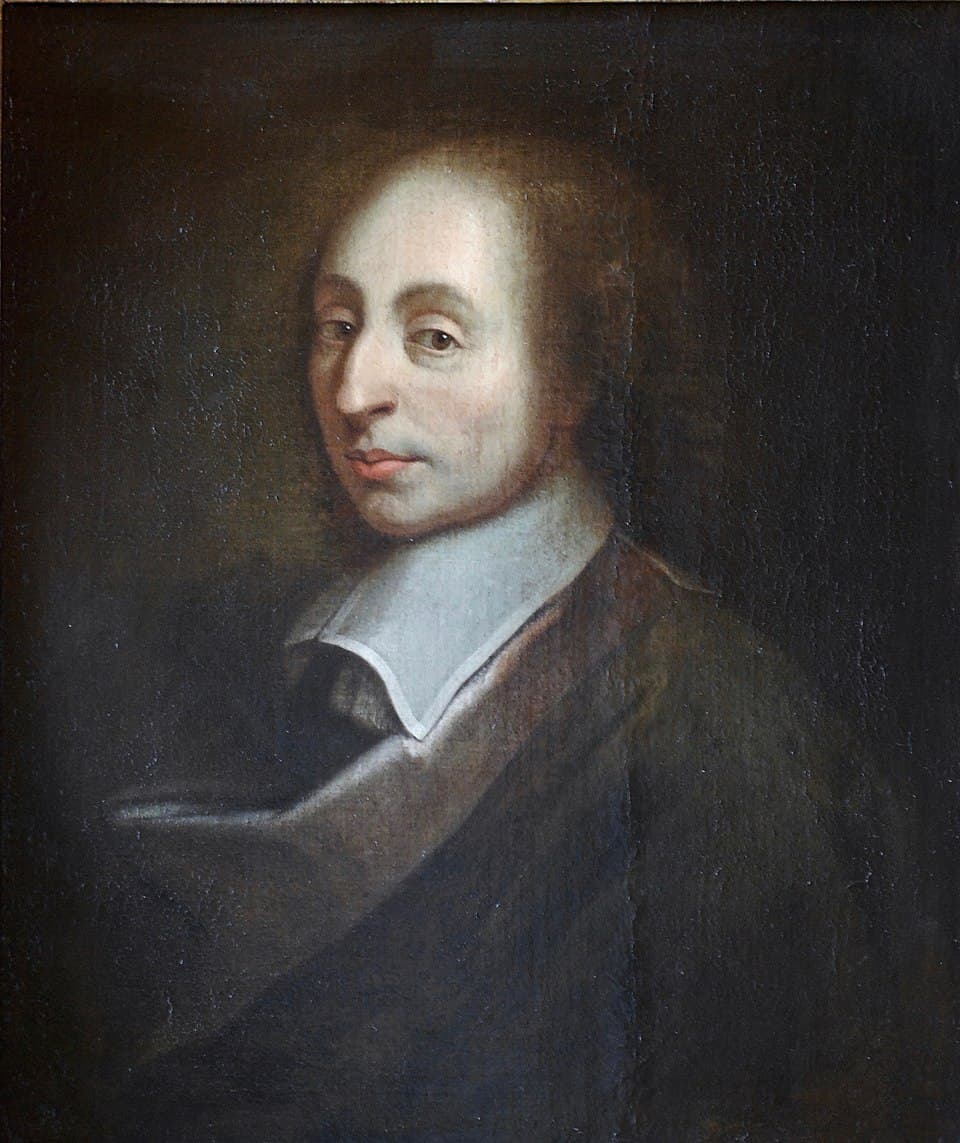
Blaise Pascal
Pensees...are fallen upon Him. He is more abominable than I, and, far from abhorring me, He holds Himself honoured that I go to Him and succour Him. But He has healed Himself, and still more so will He heal me. I must add my wounds to His, and join myself to Him; and He will save me in saving Himself. But this must not be postponed to the future. Eritis sicut dii scientes bonum et malum.[205] Each one creates his god, when judging, "This is good or bad"; and men mourn or rejoice too much at events.
Do little things as though they were great, because of the majesty of Jesus Christ who does them in us, and who lives our life; and do the greatest things as though they were little and easy, because of His omnipotence.
553 It seems to me that Jesus Christ only allowed His wounds to be touched after His resurrection: Noli me tangere.[206] We must unite ourselves only to His sufferings. At the Last Supper He gave Himself in communion as about to die; to the disciples at Emmaus as risen from the dead; to the whole Church as ascended into heaven. 554 "Compare not thyself with others, but with Me. If thou dost not find Me in those with whom thou comparest thyself, thou comparest thyself to one who is abom...
4
⚖Grace's Dual Embrace

Blaise Pascal
PenseesA personal confession of faith in which Pascal credits God's grace for transforming his inherent miseries and pride into a life of justice, sincerity, and devotion.
...ot know what is our life, nor our death, nor God, nor ourselves. Thus without the Scripture, which has Jesus Christ alone for its object, we know nothing, and see only darkness and confusion in the nature of God, and in our own nature. 548 It is not only impossible but useless to know God without Jesus Christ. They have not departed from Him, but approached; they have not humbled themselves, but ... Quo quisque optimus est, pessimus, si hoc ipsum, quod optimus est, adscribat sibi. 549
I love poverty because He loved it. I love riches because they afford me the means of helping the very poor. I keep faith with everybody; I do not render evil to those who wrong me, but I wish them a lot like mine, in which I receive neither evil nor good from men. I try to be just, true, sincere, and faithful to all men; I have a tender heart for those to whom God has more closely united me; and whether I am alone, or seen of men, I do all my actions in the sight of God, who must judge of them, and to whom I have consecrated them all. These are my sentiments; and every day of my life I bless my Redeemer, who has implanted them in me, and…
550 Dignior plagis quam osculis non timeo quia amo. 551 The Sepulchre of Jesus Christ.--Jesus Christ was dead, but seen on the Cross. He was dead, and hidden in the Sepulchre. Jesus Christ was buried by the saints alone. Jesus Christ wrought no miracle at the Sepulchre. Only the saints entered it. It is there, not on the Cross, that Jesus Christ takes a new life. It is the last mystery of the Passion and the Redemption. Jesus Christ had nowhere to rest on earth but in the Sepulc...
Continue reading →
2
⚖The Humble Know God

Blaise Pascal
PenseesPascal suggests that God is revealed to the humble and those who sincerely seek truth, while remaining hidden from the arrogant, and encourages gratitude for this selective revelation.
...ll say the same of himself. But those who know the proofs of religion will prove without difficulty that such a believer is truly inspired by God, though he cannot prove it himself. For God having said in His prophecies (which are undoubtedly prophecies), that in the reign of Jesus Christ He would spread His spirit abroad among nations, and that the youths and maidens and children of the Church would prophesy;[108] it is certain that the Spirit of God is in these, and not in the others. 288
Instead of complaining that God had hidden Himself, you will give Him thanks for having revealed so much of Himself; and you will also give Him thanks for not having revealed Himself to haughty sages, unworthy to know so holy a God. Two kinds of persons know Him: those who have a humble heart, and who love lowliness, whatever kind of intellect they may have, high or low; and those who have sufficient understanding to see the truth, whatever opposition they may have to it.
289 Proof.--1. The Christian religion, by its establishment, having established itself so strongly, so gently, whilst contrary to nature.--2. The sanctity, the dignity, and the humility of a Christian soul.--3. The miracles of Holy Scripture.--4. Jesus Christ in particular.--5. The apostles in particular.--6. Moses and the prophets in particular.--7. The Jewish people.--8. The prophecies.--9. Perpetuity; no religion has perpetuity.--10. The doctrine which gives a reason for everything.--11...
2
⚖Will Over Intellect

Blaise Pascal
PenseesThe author posits that God prioritizes the transformation of the human will over the intellect, as total intellectual clarity would prevent the necessary humbling of pride.
...ncerted? 578 God (and the Apostles), foreseeing that the seeds of pride would make heresies spring up, and being unwilling to give them occasion to arise from correct expressions, has put in Scripture and the prayers of the Church contrary words and sentences to produce their fruit in time. So in morals He gives charity, which produces fruits contrary to lust. 579 Nature has some perfections to show that she is the image of God, and some defects to show that she is only His image. 580
God prefers rather to incline the will than the intellect. Perfect clearness would be of use to the intellect, and would harm the will. To humble pride.
581 We make an idol of truth itself; for truth apart from charity is not God, but His image and idol, which we must neither love nor worship; and still less must we love or worship its opposite, namely, falsehood. I can easily love total darkness; but if God keeps me in a state of semi-darkness, such partial darkness displeases me, and, because I do not see therein the advantage of total darkness, it is unpleasant to me. This is a fault, and a sign that I make for myself an idol of darkness...
6
⚖Humility Through Penitence

Blaise Pascal
PenseesPascal critiques philosophers for failing to address man's dual nature, arguing instead for a balance of humility through penitence and greatness through divine grace.
...Catholics, and always strife; because the first birth makes the one, and the grace of the second birth the other. 521 The law imposed what it did not give. Grace gives what is imposes. 522 All faith consists in Jesus Christ and in Adam, and all morality in lust and in grace. 523 There is no doctrine more appropriate to man than this, which teaches him his double capacity of receiving and of losing grace, because of the double peril to which he is exposed, of despair or of pride. 524
The philosophers did not prescribe feelings suitable to the two states. They inspired feelings of pure greatness, and that is not man's state. They inspired feelings of pure littleness, and that is not man's state. There must be feelings of humility, not from nature, but from penitence, not to rest in them, but to go on to greatness. There must be feelings of greatness, not from merit, but from grace, and after having passed through humiliation.
525 Misery induces despair, pride induces presumption. The Incarnation shows man the greatness of his misery by the greatness of the remedy which he required. 526 The knowledge of God without that of man's misery causes pride. The knowledge of man's misery without that of God causes despair. The knowledge of Jesus Christ constitutes the middle course, because in Him we find both God and our misery. 527 Jesus Christ is a God whom we approach without pride, and before whom we humble ours...
4