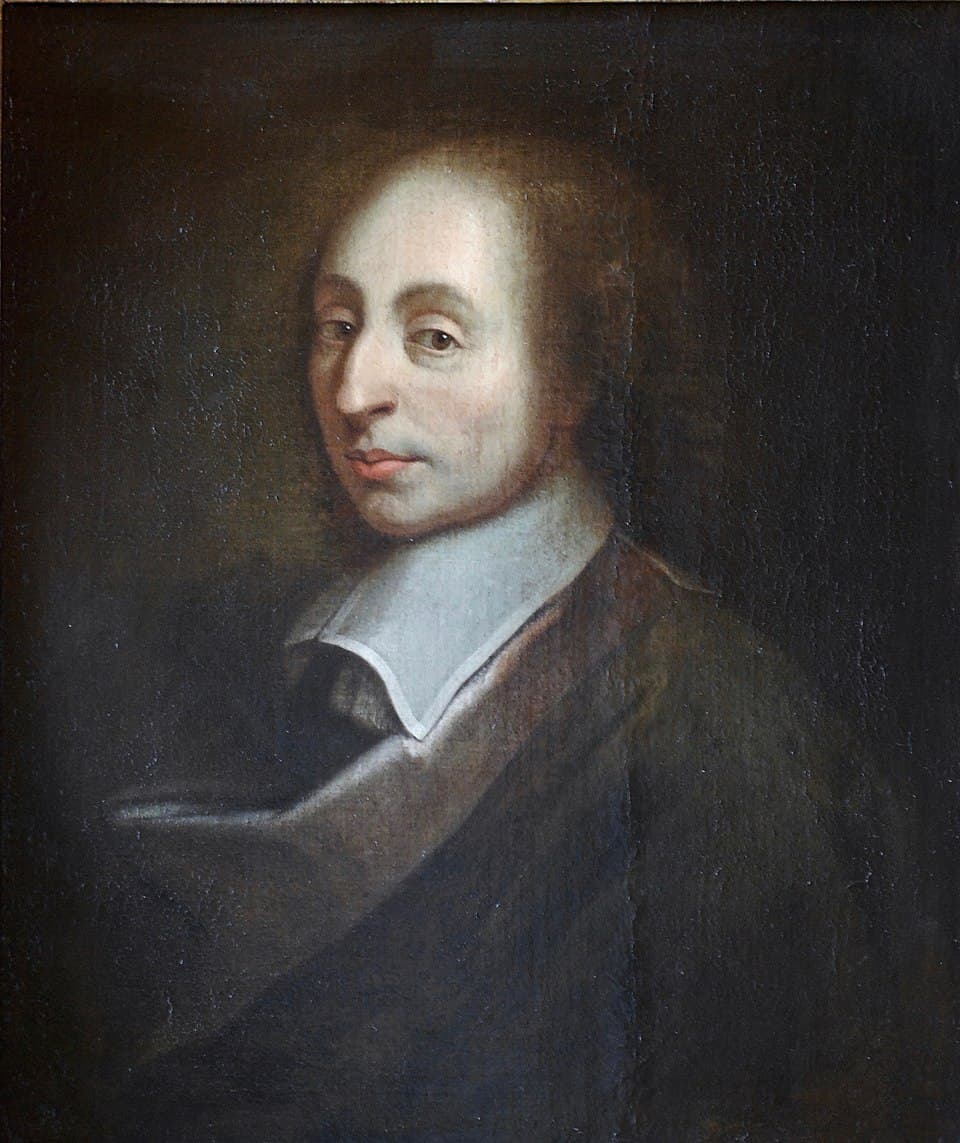
A reflection on the paradoxical nature of man, who possesses an innate idea of truth and happiness he cannot attain, suggesting a fallen state that can only be explained by the mystery of original sin.
The Fallen Paradox
Blaise Pascal
Pensees...nravel this tangle? Nature confutes the sceptics, and reason confutes the dogmatists. What then will you become, O men! who try to find out by your natural reason what is your true condition? You cannot avoid one of these sects, nor adhere to one of them. Know then, proud man, what a paradox you are to yourself. Humble yourself, weak reason; be silent, foolish nature; learn that man infinitely transcends man, and learn from your Master your true condition, of which you are ignorant. Hear God.
For in fact, if man had never been corrupt, he would enjoy in his innocence both truth and happiness with assurance; and if man had always been corrupt, he would have no idea of truth or bliss. But, wretched as we are, and more so than if there were no greatness in our condition, we have an idea of happiness, and cannot reach it. We perceive an image of truth, and possess only a lie. Incapable of absolute ignorance and of certain knowledge, we have thus been manifestly in a degree of perfection from which we have unhappily fallen. It is, however, an astonishing thing that the mystery furthest removed from our knowledge, namely, that of the…
This transmission does not only seem to us impossible, it seems also very unjust. For what is more contrary to the rules of our miserable justice than to damn eternally an infant incapable of will, for a sin wherein he seems to have so little a share, that it was committed six thousand years before he was in existence? Certainly nothing offends us more rudely than this doctrine; and yet, without this mystery, the most incomprehensible of all, we are incomprehensible to ourselves. The knot of ou...
Continue reading →
6
⚖God's Dual Revelation

Blaise Pascal
PenseesPascal describes the hidden nature of God, who reveals Himself only to those who sincerely seek Him, reflecting man's dual state of original capability and current corruption.
...ho hides Himself. Everything bears this character. ... Shall he alone who knows his nature know it only to be miserable? Shall he alone who knows it be alone unhappy? ... He must not see nothing at all, nor must he see sufficient for him to believe he possesses it; but he must see enough to know that he has lost it. For to know of his loss, he must see and not see; and that is exactly the state in which he naturally is. ... Whatever part he takes, I shall not leave him at rest ... 556 ...
It is then true that everything teaches man his condition, but he must understand this well. For it is not true that all reveals God, and it is not true that all conceals God. But it is at the same time true that He hides Himself from those who tempt Him, and that He reveals Himself to those who seek Him, because men are both unworthy and capable of God; unworthy by their corruption capable by their original nature.
557 What shall we conclude from all our darkness, but our unworthiness? 558 If there never had been any appearance of God, this eternal deprivation would have been equivocal, and might have as well corresponded with the absence of all divinity, as with the unworthiness of men to know Him; but His occasional, though not continual, appearances remove the ambiguity, If He appeared once, He exists always; and thus we cannot but conclude both that there is a God, and that men are unworthy of H...
2
⚖Pride vs Despair

Blaise Pascal
PenseesThe author contends that without divine knowledge, man is trapped between pride in his past greatness and despair over his present corruption, unable to achieve perfect virtue.
...clares this to us, when it says in some places: Deliciæ meæ esse cum filiis hominum.[162] Effundam spiritum meum super omnem carnem.[163] Dii estis[164], etc.; and in other places, Omnis caro fænum.[165] Homo assimilatus est jumentis insipientibus, et similis factus est illis.[166] Dixi in corde meo de filiis hominum. Eccles. iii. Whence it clearly seems that man by grace is made like unto God, and a partaker in His divinity, and that without grace he is like unto the brute beasts.] 435
Without this divine knowledge what could men do but either become elated by the inner feeling of their past greatness which still remains to them, or become despondent at the sight of their present weakness? For, not seeing the whole truth, they could not attain to perfect virtue. Some considering nature as incorrupt, others as incurable, they could not escape either pride or sloth, the two sources of all vice; since they cannot but either abandon themselves to it through cowardice, or escape it by pride. For if they knew the excellence of man, they were ignorant of his corruption; so that they easily avoided sloth, but fell into pride. And…
Thence arise the different schools of the Stoics and Epicureans, the Dogmatists, Academicians, etc. The Christian religion alone has been able to cure these two vices, not by expelling the one through means of the other according to the wisdom of the world, but by expelling both according to the simplicity of the Gospel. For it teaches the righteous that it raises them even to a participation in divinity itself; that in this lofty state they still carry the source of all corruption, which rend...
Continue reading →
6
⚖Christ as Sole Mediator

Blaise Pascal
PenseesPascal asserts that Jesus Christ is the essential mediator through whom humanity escapes misery and vice, claiming that true knowledge of God and virtue is impossible without Him.
...h all her strength. Self-love and lust, which hinder us, are unbearable to her. Thus God makes her feel that she has this root of self-love which destroys her, and which He alone can cure. 544 Jesus Christ did nothing but teach men that they loved themselves, that they were slaves, blind, sick, wretched, and sinners; that He must deliver them, enlighten, bless, and heal them; that this would be effected by hating self, and by following Him through suffering and the death on the cross. 545
Without Jesus Christ man must be in vice and misery; with Jesus Christ man is free from vice and misery; in Him is all our virtue and all our happiness. Apart from Him there is but vice, misery, darkness, death, despair. 546 We know God only by Jesus Christ. Without this mediator all communion with God is taken away; through Jesus Christ we know God.
All those who have claimed to know God, and to prove Him without Jesus Christ, have had only weak proofs. But in proof of Jesus Christ we have the prophecies, which are solid and palpable proofs. And these prophecies, being accomplished and proved true by the event, mark the certainty of these truths, and therefore the divinity of Christ. In Him then, and through Him, we know God. Apart from Him, and without the Scripture, without original sin, without a necessary Mediator promised and come, we...
2
⚖Rest's Paradox

Blaise Pascal
PenseesA reflection on the restlessness of the human heart, which seeks struggle to avoid the insufferable weariness and 'poison' that naturally arise during periods of rest.
...l nature, which teaches them that happiness in reality consists only in rest, and not in stir. And of these two contrary instincts they form within themselves a confused idea, which hides itself from their view in the depths of their soul, inciting them to aim at rest through excitement, and always to fancy that the satisfaction which they have not will come to them, if, by surmounting whatever difficulties confront them, they can thereby open the door to rest. Thus passes away all man's life.
Men seek rest in a struggle against difficulties; and when they have conquered these, rest becomes insufferable. For we think either of the misfortunes we have or of those which threaten us. And even if we should see ourselves sufficiently sheltered on all sides, weariness of its own accord would not fail to arise from the depths of the heart wherein it has its natural roots, and to fill the mind with its poison.
Thus so wretched is man that he would weary even without any cause for weariness from the peculiar state of his disposition; and so frivolous is he, that, though full of a thousand reasons for weariness, the least thing, such as playing billiards or hitting a ball, is sufficient to amuse him. But will you say what object has he in all this? The pleasure of bragging to-morrow among his friends that he has played better than another. So others sweat in their own rooms to show to the learned tha...
2