The author defines the second tier of happiness as the life of moral virtue, which is uniquely human and inextricably linked to practical wisdom and the passions.
Virtue's Human Workings
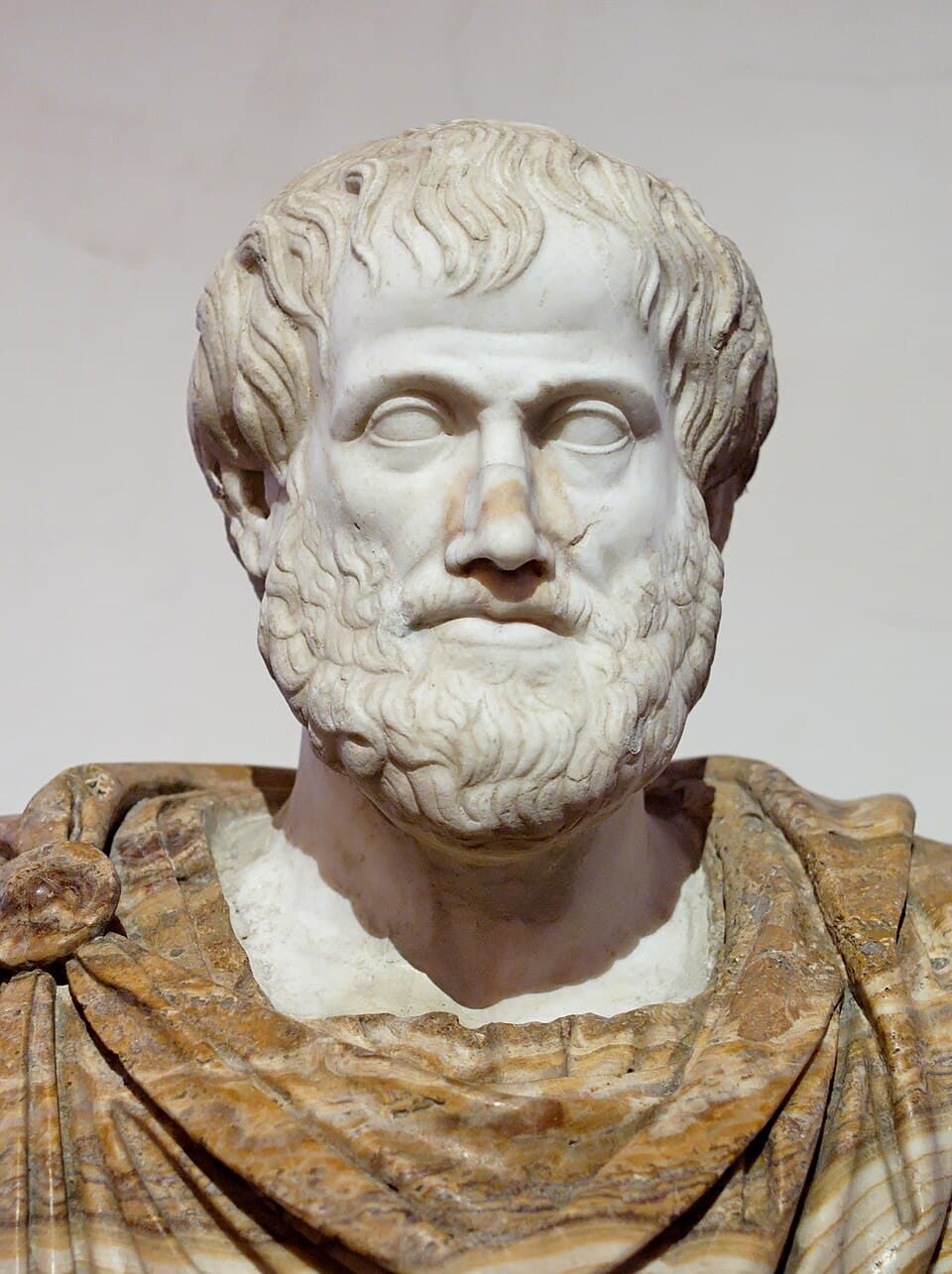
Aristotle
Nicomachean Ethics...xcels all the others. In fact this Principle would seem to constitute each man’s “Self,” since it is supreme and above all others in goodness it would be absurd then for a man not to choose his own life but that of some other. And here will apply an observation made before, that whatever is proper to each is naturally best and pleasantest to him: such then is to Man the life in accordance with pure Intellect (since this Principle is most truly Man), and if so, then it is also the happiest.
And second in degree of Happiness will be that Life which is in accordance with the other kind of Excellence, for the Workings in accordance with this are proper to Man: I mean, we do actions of justice, courage, and the other virtues, towards one another, in contracts, services of different kinds, and in all kinds of actions and feelings too, by observing what is befitting for each: and all these plainly are proper to man. Further, the Excellence of the Moral character is thought to result in some points from physical circumstances, and to be, in many, very closely connected with the passions. Again, Practical Wisdom and Excellence of the…
These moreover, as bound up with the passions, must belong to the composite nature, and the Excellences or Virtues of the composite nature are proper to man: therefore so too will be the life and Happiness which is in accordance with them. But that of the Pure Intellect is separate and distinct: and let this suffice upon the subject, since great exactness is beyond our purpose, It would seem, moreover, to require supply of external goods to a small degree, or certainly less than the Moral Hap...
Continue reading →
3
⚖The Brave Man's Pain

Aristotle
Nicomachean EthicsAn existential observation that the virtuous man finds death most painful because he truly values his life, yet he chooses courage regardless.
...they act, I mean the crown and the honours; but the receiving the blows they do is painful and annoying to flesh and blood, and so is all the labour they have to undergo; and, as these drawbacks are many, the object in view being small appears to have no pleasantness in it. If then we may say the same of Courage, of course death and wounds must be painful to the Brave man and against his will: still he endures these because it is honourable so to do or because it is dishonourable not to do so.
And the more complete his virtue and his happiness so much the more will he be pained at the notion of death: since to such a man as he is it is best worth while to live, and he with full consciousness is deprived of the greatest goods by death, and this is a painful idea. But he is not the less Brave for feeling it to be so, nay rather it may be he is shown to be more so because he chooses the honour that may be reaped in war in preference to retaining safe possession of these other goods.
The fact is that to act with pleasure does not belong to all the virtues, except so far as a man realises the End of his actions. But there is perhaps no reason why not such men should make the best soldiers, but those who are less truly Brave but have no other good to care for: these being ready to meet danger and bartering their lives against small gain. Let thus much be accepted as sufficient on the subject of Courage; the true nature of which it is not difficult to gather, in outline at l...
2
⚖Self-Esteem's Just Measure

Aristotle
Nicomachean EthicsAristotle classifies different types of self-estimation, distinguishing the modest man from the great-minded, the vain, and the small-minded based on the accuracy of their self-worth.
...name of Great-mindedness implies, that great things are its object-matter; and we will first settle what kind of things. It makes no difference, of course, whether we regard the moral state in the abstract or as exemplified in an individual. Well then, he is thought to be Great-minded who values himself highly and at the same time justly, because he that does so without grounds is foolish, and no virtuous character is foolish or senseless. Well, the character I have described is Great-minded.
The man who estimates himself lowly, and at the same time justly, is modest; but not Great-minded, since this latter quality implies greatness, just as beauty implies a large bodily conformation while small people are neat and well made but not beautiful. Again, he who values himself highly without just grounds is a Vain man: though the name must not be applied to every case of unduly high self-estimation. He that values himself below his real worth is Small-minded, and whether that worth is great, moderate, or small, his own estimate falls below it.
And he is the strongest case of this error who is really a man of great worth, for what would he have done had his worth been less? The Great-minded man is then, as far as greatness is concerned, at the summit, but in respect of propriety he is in the mean, because he estimates himself at his real value (the other characters respectively are in excess and defect). Since then he justly estimates himself at a high, or rather at the highest possible rate, his character will have respect specially...
6
⚖Nobility Through Misfortune

Aristotle
Nicomachean EthicsThe author describes the noble person as one who maintains their character through all fortunes, likening them to a skilled artisan who creates the best possible result from whatever materials they are given.
...less cube.” And whereas the incidents of chance are many, and differ in greatness and smallness, the small pieces of good or ill fortune evidently do not affect the balance of life, but the great and numerous, if happening for good, will make life more blessed (for it is their nature to contribute to ornament, and the using of them comes to be noble and excellent), but if for ill, they bruise as it were and maim the blessedness: for they bring in positive pain, and hinder many acts of working.
But still, even in these, nobleness shines through when a man bears contentedly many and great mischances not from insensibility to pain but because he is noble and high-spirited. And if, as we have said, the acts of working are what determine the character of the life, no one of the blessed can ever become wretched, because he will never do those things which are hateful and mean. For the man who is truly good and sensible bears all fortunes, we presume, becomingly, and always does what is noblest under the circumstances, just as a good general employs to the best advantage the force he has with him; or a good shoemaker makes the handsomest…
And if this be so, wretched never can the happy man come to be: I do not mean to say he will be blessed should he fall into fortunes like those of Priam. Nor, in truth, is he shifting and easily changeable, for on the one hand from his happiness he will not be shaken easily nor by ordinary mischances, but, if at all, by those which are great and numerous; and, on the other, after such mischances he cannot regain his happiness in a little time; but, if at all, in a long and complete period, dur...
Continue reading →
2
⚖Pleasure's False Crown

Aristotle
Nicomachean EthicsAristotle argues that certain excellences like sight and knowledge are inherently valuable regardless of the pleasure they produce, proving pleasure is not the sole Chief Good.
...ent kinds of Pleasure: for the former is thought to have good as the object of his intercourse, the latter Pleasure only; and this last is reproached, but the former men praise as having different objects in his intercourse. Again, no one would choose to live with a child’s intellect all his life through, though receiving the highest possible Pleasure from such objects as children receive it from; or to take Pleasure in doing any of the most disgraceful things, though sure never to be pained.
There are many things also about which we should be diligent even though they brought no Pleasure; as seeing, remembering, knowing, possessing the various Excellences; and the fact that Pleasures do follow on these naturally makes no difference, because we should certainly choose them even though no Pleasure resulted from them. It seems then to be plain that Pleasure is not the Chief Good, nor is every kind of it choice-worthy: and that there are some choice-worthy in themselves, differing in kind, i.e. in the sources from which they are derived.
Let this then suffice by way of an account of the current maxims respecting Pleasure and Pain. Chapter III. Now what it is, and how characterised, will be more plain if we take up the subject afresh. An act of Sight is thought to be complete at any moment; that is to say, it lacks nothing the accession of which subsequently will complete its whole nature. Well, Pleasure resembles this: because it is a whole, as one may say; and one could not at any moment of time take a Pleasure whose whole...
4