The text distinguishes between the self-controlled man and the 'positive' or opinionated man, noting that the latter is driven by the pleasure of victory rather than reason.
Self-Control's Fixed Core
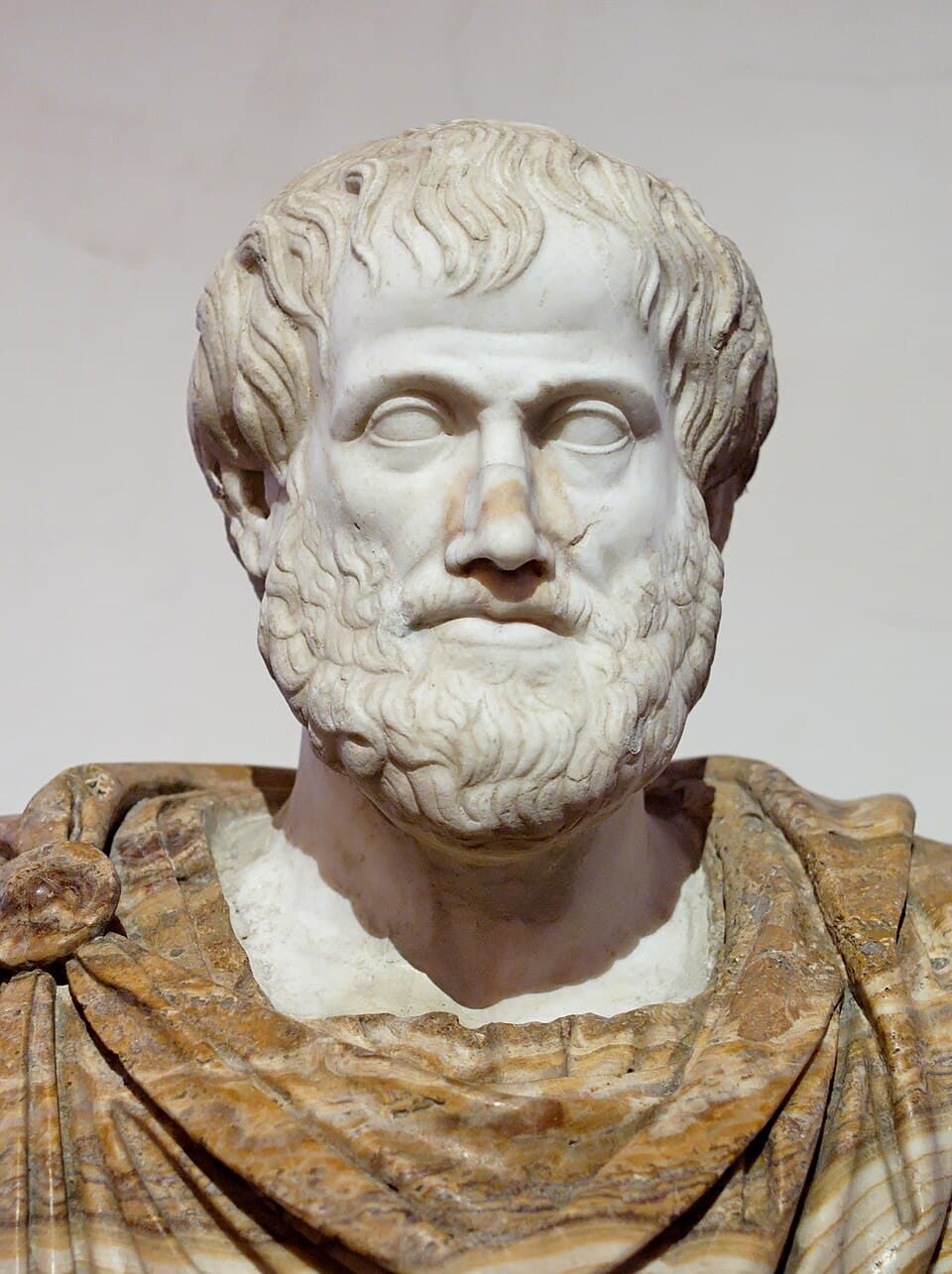
Aristotle
Nicomachean Ethics...wo characters respectively abide or not, but he is “simply” entitled to the designations who abides or not by the true opinion. There are also people, who have a trick of abiding by their, own opinions, who are commonly called Positive, as they who are hard to be persuaded, and whose convictions are not easily changed: now these people bear some resemblance to the character of Self-Control, just as the prodigal to the liberal or the rash man to the brave, but they are different in many points.
The man of Self-Control does not change by reason of passion and lust, yet when occasion so requires he will be easy of persuasion: but the Positive man changes not at the call of Reason, though many of this class take up certain desires and are led by their pleasures. Among the class of Positive are the Opinionated, the Ignorant, and the Bearish: the first, from the motives of pleasure and pain: I mean, they have the pleasurable feeling of a kind of victory in not having their convictions changed, and they are pained when their decrees, so to speak, are reversed: so that, in fact, they rather resemble the man of Imperfect Self-Control than the man of Self-Control.
Again, there are some who depart from their resolutions not by reason of any Imperfection of Self-Control; take, for instance, Neoptolemus in the Philoctetes of Sophocles. Here certainly pleasure was the motive of his departure from his resolution, but then it was one of a noble sort: for to be truthful was noble in his eyes and he had been persuaded by Ulysses to lie. So it is not every one who acts from the motive of pleasure who is utterly destitute of Self-Control or base or of Imperfect...
5
⚖The Measured Anger

Aristotle
Nicomachean EthicsThe text describes the 'Meek' man as one who governs his anger according to reason, striking a balance between passion and forgiveness.
...e extreme characters appear to be opposed, because the mean has no name appropriated to it. Chapter VII. Meekness is a mean state, having for its object-matter Anger: and as the character in the mean has no name, and we may almost say the same of the extremes, we give the name of Meekness (leaning rather to the defect, which has no name either) to the character in the mean. The excess may be called an over-aptness to Anger: for the passion is Anger, and the producing causes many and various.
Now he who is angry at what and with whom he ought, and further, in right manner and time, and for proper length of time, is praised, so this Man will be Meek since Meekness is praised. For the notion represented by the term Meek man is the being imperturbable, and not being led away by passion, but being angry in that manner, and at those things, and for that length of time, which Reason may direct. This character however is thought to err rather on the side of defect, inasmuch as he is not apt to take revenge but rather to make allowances and forgive.
And the defect, call it Angerlessness or what you will, is blamed: I mean, they who are not angry at things at which they ought to be angry are thought to be foolish, and they who are angry not in right manner, nor in right time, nor with those with whom they ought; for a man who labours under this defect is thought to have no perception, nor to be pained, and to have no tendency to avenge himself, inasmuch as he feels no anger: now to bear with scurrility in one’s own person, and patiently see...
2
⚖Reason's Dual Domains

Aristotle
Nicomachean EthicsThe author divides the human soul into rational and irrational parts, further subdividing the irrational part into a vegetative state and a desiderative state that can be persuaded by reason.
...we do not. But, it may be, not the less[42] on that account are we to suppose that there is in the Soul also somewhat besides the Reason, which is opposed to this and goes against it; as to how it is different, that is irrelevant.) But of Reason this too does evidently partake, as we have said: for instance, in the man of self-control it obeys Reason: and perhaps in the man of perfected self-mastery,[43] or the brave man, it is yet more obedient; in them it agrees entirely with the Reason.
So then the Irrational is plainly twofold: the one part, the merely vegetative, has no share of Reason, but that of desire, or appetition generally, does partake of it in a sense, in so far as it is obedient to it and capable of submitting to its rule. (So too in common phrase we say we have λόγος of our father or friends, and this in a different sense from that in which we say we have λόγος of mathematics.) Now that the Irrational is in some way persuaded by the Reason, admonition, and every act of rebuke and exhortation indicate. If then we are to say that this also has Reason, then the Rational, as well as the Irrational, will be twofold,…
pure science, intelligence, and practical wisdom—Intellectual: liberality, and perfected self-mastery—Moral: in speaking of a man’s Moral character, we do not say he is a scientific or intelligent but a meek man, or one of perfected self-mastery: and we praise the man of science in right of his mental state;[45] and of these such as are praiseworthy we call Excellences. BOOK II Chapter I. Well: human Excellence is of two kinds, Intellectual and Moral:[1] now the Intellectual springs orig...
Continue reading →
5
⚖Anger's Misguided Reason

Aristotle
Nicomachean EthicsThe author compares anger to a hasty servant who mishears reason, arguing it is less disgraceful than lust because it still maintains a tenuous connection to the rational faculty.
...ture of utter absence of Self-Control, as it is found in Man. Chapter VI. It is plain then that the object-matter of Imperfect Self-Control and Self-Control is restricted to the same as that of utter absence of Self-Control and that of Perfected Self-Mastery, and that the rest is the object-matter of a different species so named metaphorically and not simply: we will now examine the position, “that Imperfect Self-Control in respect of Anger is less disgraceful than that in respect of Lusts.”
In the first place, it seems that Anger does in a way listen to Reason but mishears it; as quick servants who run out before they have heard the whole of what is said and then mistake the order; dogs, again, bark at the slightest stir, before they have seen whether it be friend or foe; just so Anger, by reason of its natural heat and quickness, listening to Reason, but without having heard the command of Reason, rushes to its revenge. That is to say, Reason or some impression on the mind shows there is insolence or contempt in the offender, and then Anger, reasoning as it were that one ought to fight against what is such, fires up…
Again, a man is more excusable for following such desires as are natural, just as he is for following such Lusts as are common to all and to that degree in which they are common. Now Anger and irritability are more natural than Lusts when in excess and for objects not necessary. (This was the ground of the defence the man made who beat his father, “My father,” he said, “used to beat his, and his father his again, and this little fellow here,” pointing to his child, “will beat me when he is gro...
Continue reading →
6
⚖Virtue as the Mean

Aristotle
Nicomachean EthicsThe author provides a formal definition of virtue as a deliberate choice of the mean between excess and defect, as determined by practical wisdom.
...aptitude for aiming at the mean. Again, one may go wrong in many different ways (because, as the Pythagoreans expressed it, evil is of the class of the infinite, good of the finite), but right only in one; and so the former is easy, the latter difficult; easy to miss the mark, but hard to hit it: and for these reasons, therefore, both the excess and defect belong to Vice, and the mean state to Virtue; for, as the poet has it, “Men may be bad in many ways, But good in one alone.” Chapter VI.
Virtue then is “a state apt to exercise deliberate choice, being in the relative mean, determined by reason, and as the man of practical wisdom would determine.” It is a middle state between too faulty ones, in the way of excess on one side and of defect on the other: and it is so moreover, because the faulty states on one side fall short of, and those on the other exceed, what is right, both in the case of the feelings and the actions; but Virtue finds, and when found adopts, the mean. And so, viewing it in respect of its essence and definition, Virtue is a mean state; but in reference to the chief good and to excellence it is the highest…
But it must not be supposed that every action or every feeling is capable of subsisting in this mean state, because some there are which are so named as immediately to convey the notion of badness, as malevolence, shamelessness, envy; or, to instance in actions, adultery, theft, homicide; for all these and suchlike are blamed because they are in themselves bad, not the having too much or too little of them. In these then you never can go right, but must always be wrong: nor in such does the r...
Continue reading →
4