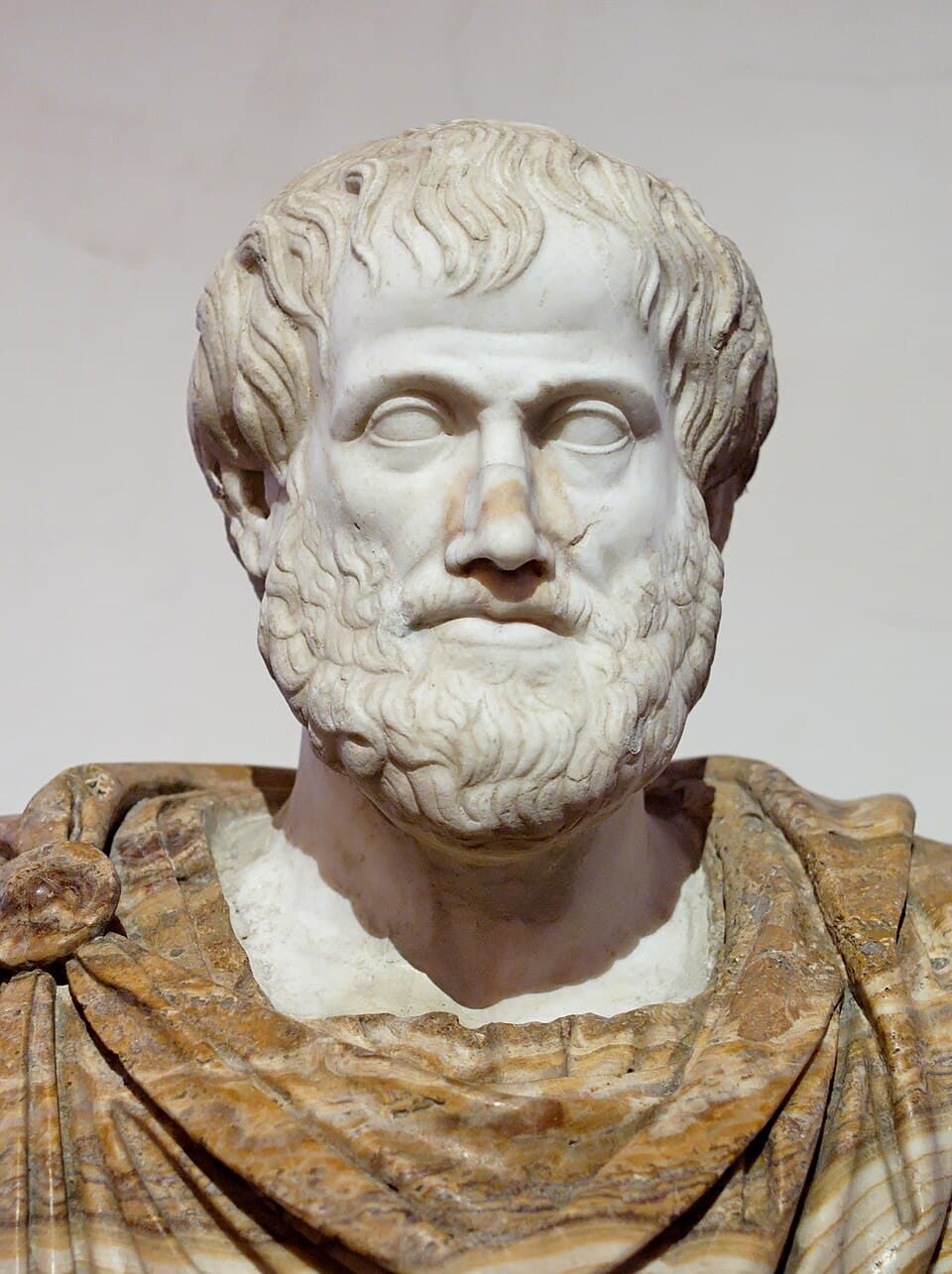
The author classifies shame as a physical feeling or passion rather than a stable moral virtue, noting its specific utility as a check on the behavior of the young.
Shame as Feeling
Aristotle
Nicomachean Ethics...ocose of his own he is savage with all who do. Yet some pause and amusement in life are generally judged to be indispensable. The three mean states which have been described do occur in life, and the object-matter of all is interchange of words and deeds. They differ, in that one of them is concerned with truth, and the other two with the pleasurable: and of these two again, the one is conversant with the jocosities of life, the other with all other points of social intercourse. Chapter XI.
To speak of Shame as a Virtue is incorrect, because it is much more like a feeling than a moral state. It is defined, we know, to be “a kind of fear of disgrace,” and its effects are similar to those of the fear of danger, for they who feel Shame grow red and they who fear death turn pale. So both are evidently in a way physical, which is thought to be a mark of a feeling rather than a moral state. Moreover, it is a feeling not suitable to every age, but only to youth: we do think that the young should be Shamefaced, because since they live at the beck and call of passion they do much that is wrong and Shame acts on them as a check.
In fact, we praise such young men as are Shamefaced, but no one would ever praise an old man for being given to it, inasmuch as we hold that he ought not to do things which cause Shame; for Shame, since it arises at low bad actions, does not at all belong to the good man, because such ought not to be done at all: nor does it make any difference to allege that some things are disgraceful really, others only because they are thought so; for neither should be done, so that a man ought not to be in...
6
⚖Good's Relative Nature

Aristotle
Nicomachean EthicsAristotle categorizes goods and pleasures into absolute and relative types, noting that some perceived pleasures are merely curative processes for pain.
...e second (that not all Pleasures are good), That there are some base and matter of reproach, and some even hurtful: because some things that are pleasant produce disease. In support of the third (that Pleasure is not the Chief Good), That it is not an End but a process towards creating an End. This is, I think, a fair account of current views on the matter. But that the reasons alleged do not prove it either to be not-good or the Chief Good is plain from the following considerations. First.
Good being either absolute or relative, of course the natures and states embodying it will be so too; therefore also the movements and the processes of creation. So, of those which are thought to be bad some will be bad absolutely, but relatively not bad, perhaps even choice-worthy; some not even choice-worthy relatively to any particular person, only at certain times or for a short time but not in themselves choice-worthy. Others again are not even Pleasures at all though they produce that impression on the mind: all such I mean as imply pain and whose purpose is cure; those of sick people, for instance.
Next, since Good may be either an active working or a state, those [κινήσεις or γενέσεις] which tend to place us in our natural state are pleasant incidentally because of that tendency: but the active working is really in the desires excited in the remaining (sound) part of our state or nature: for there are Pleasures which have no connection with pain or desire: the acts of contemplative intellect, for instance, in which case there is no deficiency in the nature or state of him who performs t...
5
⚖Knowledge in Passion

Aristotle
Nicomachean EthicsThe author compares those lacking self-control to people who are asleep or drunk, noting that they may recite knowledge without truly possessing or exercising it.
...ing in question: take the following for instance; “dry food is good for every man,” this may have the two minor premisses, “this is a man,” and “so and so is dry food;” but whether a given substance is so and so a man either has not the Knowledge or does not exert it. According to these different senses there will be an immense difference, so that for a man to know in the one sense, and yet act wrongly, would be nothing strange, but in any of the other senses it would be a matter for wonder.
Again, men may have Knowledge in a way different from any of those which have been now stated: for we constantly see a man’s state so differing by having and not using Knowledge, that he has it in a sense and also has not; when a man is asleep, for instance, or mad, or drunk: well, men under the actual operation of passion are in exactly similar conditions; for anger, lust, and some other such-like things, manifestly make changes even in the body, and in some they even cause madness; it is plain then that we must say the men of Imperfect Self-Control are in a state similar to these. And their saying what embodies Knowledge is no proof of…
Furthermore, a man may look at the account of the phænomenon in the following way, from an examination of the actual working of the mind: All action may be analysed into a syllogism, in which the one premiss is an universal maxim and the other concerns particulars of which Sense [moral or physical, as the case may be] is cognisant: now when one results from these two, it follows necessarily that, as far as theory goes the mind must assert the conclusion, and in practical propositions the man m...
Continue reading →
3
⚖Reason's Dual Domains

Aristotle
Nicomachean EthicsThe author divides the human soul into rational and irrational parts, further subdividing the irrational part into a vegetative state and a desiderative state that can be persuaded by reason.
...we do not. But, it may be, not the less[42] on that account are we to suppose that there is in the Soul also somewhat besides the Reason, which is opposed to this and goes against it; as to how it is different, that is irrelevant.) But of Reason this too does evidently partake, as we have said: for instance, in the man of self-control it obeys Reason: and perhaps in the man of perfected self-mastery,[43] or the brave man, it is yet more obedient; in them it agrees entirely with the Reason.
So then the Irrational is plainly twofold: the one part, the merely vegetative, has no share of Reason, but that of desire, or appetition generally, does partake of it in a sense, in so far as it is obedient to it and capable of submitting to its rule. (So too in common phrase we say we have λόγος of our father or friends, and this in a different sense from that in which we say we have λόγος of mathematics.) Now that the Irrational is in some way persuaded by the Reason, admonition, and every act of rebuke and exhortation indicate. If then we are to say that this also has Reason, then the Rational, as well as the Irrational, will be twofold,…
pure science, intelligence, and practical wisdom—Intellectual: liberality, and perfected self-mastery—Moral: in speaking of a man’s Moral character, we do not say he is a scientific or intelligent but a meek man, or one of perfected self-mastery: and we praise the man of science in right of his mental state;[45] and of these such as are praiseworthy we call Excellences. BOOK II Chapter I. Well: human Excellence is of two kinds, Intellectual and Moral:[1] now the Intellectual springs orig...
Continue reading →
5
⚖Self-Control's Fixed Core

Aristotle
Nicomachean EthicsThe text distinguishes between the self-controlled man and the 'positive' or opinionated man, noting that the latter is driven by the pleasure of victory rather than reason.
...wo characters respectively abide or not, but he is “simply” entitled to the designations who abides or not by the true opinion. There are also people, who have a trick of abiding by their, own opinions, who are commonly called Positive, as they who are hard to be persuaded, and whose convictions are not easily changed: now these people bear some resemblance to the character of Self-Control, just as the prodigal to the liberal or the rash man to the brave, but they are different in many points.
The man of Self-Control does not change by reason of passion and lust, yet when occasion so requires he will be easy of persuasion: but the Positive man changes not at the call of Reason, though many of this class take up certain desires and are led by their pleasures. Among the class of Positive are the Opinionated, the Ignorant, and the Bearish: the first, from the motives of pleasure and pain: I mean, they have the pleasurable feeling of a kind of victory in not having their convictions changed, and they are pained when their decrees, so to speak, are reversed: so that, in fact, they rather resemble the man of Imperfect Self-Control than the man of Self-Control.
Again, there are some who depart from their resolutions not by reason of any Imperfection of Self-Control; take, for instance, Neoptolemus in the Philoctetes of Sophocles. Here certainly pleasure was the motive of his departure from his resolution, but then it was one of a noble sort: for to be truthful was noble in his eyes and he had been persuaded by Ulysses to lie. So it is not every one who acts from the motive of pleasure who is utterly destitute of Self-Control or base or of Imperfect...
5