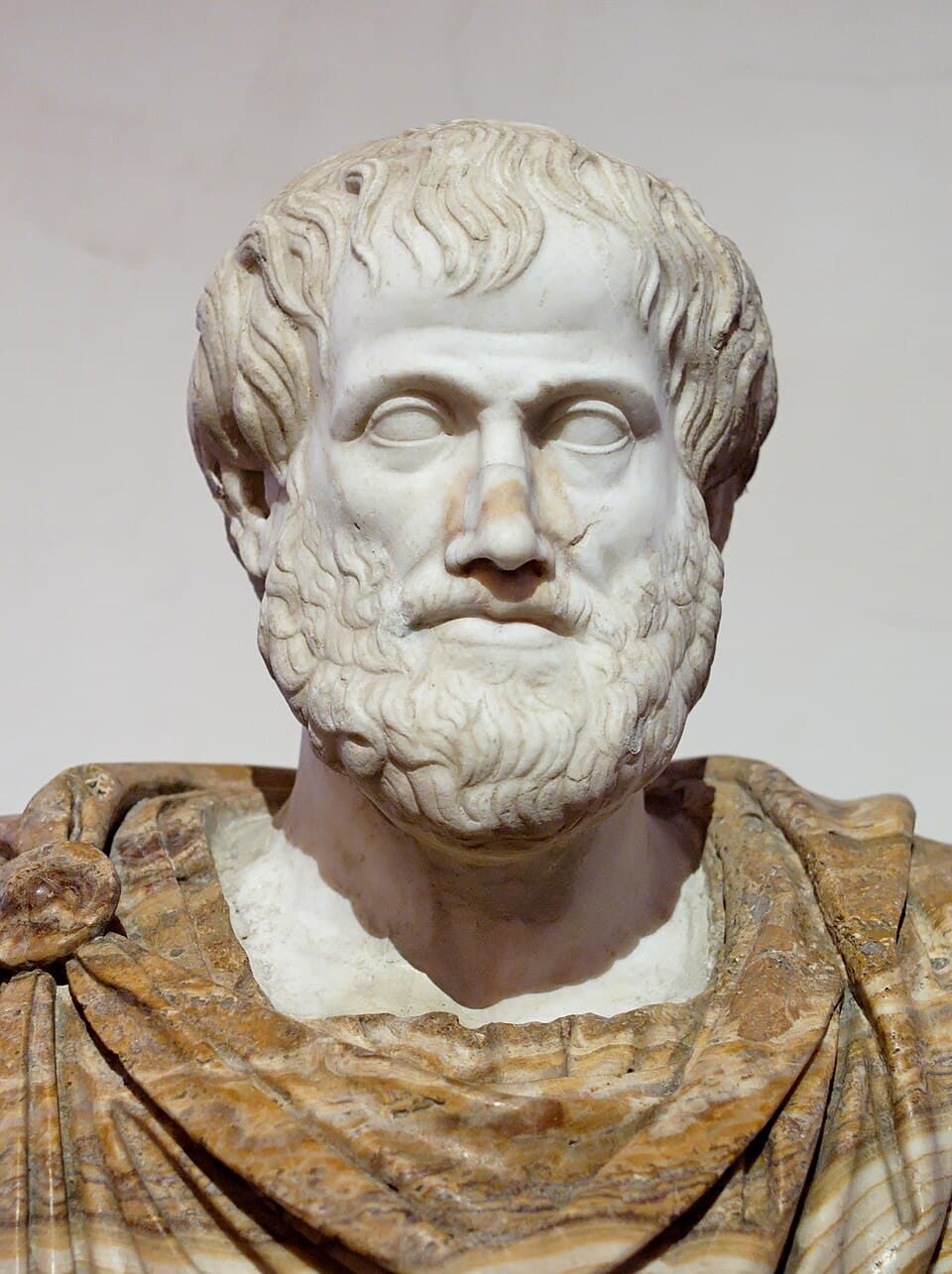
Send Pleasure Away
Aristotle
Nicomachean Ethics

The author commands a cautious and guarded attitude toward pleasure to avoid error and successfully attain the virtuous mean.

...ust take the least of the evils as the safest plan;[21] and this a man will be doing, if he follows this method. We ought also to take into consideration our own natural bias; which varies in each man’s case, and will be ascertained from the pleasure and pain arising in us. Furthermore, we should force ourselves off in the contrary direction, because we shall find ourselves in the mean after we have removed ourselves far from the wrong side, exactly as men do in straightening bent timber.[22]
But in all cases we must guard most carefully against what is pleasant, and pleasure itself, because we are not impartial judges of it. We ought to feel in fact towards pleasure as did the old counsellors towards Helen, and in all cases pronounce a similar sentence; for so by sending it away from us, we shall err the less. Well, to speak very briefly, these are the precautions by adopting which we shall be best able to attain the mean.
Still, perhaps, after all it is a matter of difficulty, and specially in the particular instances: it is not easy, for instance, to determine exactly in what manner, with what persons, for what causes, and for what length of time, one ought to feel anger: for we ourselves sometimes praise those who are defective in this feeling, and we call them meek; at another, we term the hot-tempered manly and spirited. Then, again, he who makes a small deflection from what is right, be it on the side of...
3
The Virtuous Mean
Aristotle
Nicomachean Ethics

The author argues that a total lack of desire is inhuman and imaginary, while the virtuous man finds the mean by regulating his desires for health and propriety.

...isses the attainment of his objects but, in the very desiring them, since all desire is accompanied by pain. Surely it is a strange case this, being pained by reason of pleasure. As for men who are defective on the side of pleasure, who take less pleasure in things than they ought, they are almost imaginary characters, because such absence of sensual perception is not natural to man: for even the other animals distinguish between different kinds of food, and like some kinds and dislike others.
In fact, could a man be found who takes no pleasure in anything and to whom all things are alike, he would be far from being human at all: there is no name for such a character because it is simply imaginary. But the man of Perfected Self-Mastery is in the mean with respect to these objects: that is to say, he neither takes pleasure in the things which delight the vicious man, and in fact rather dislikes them, nor at all in improper objects; nor to any great degree in any object of the class; nor is he pained at their absence; nor does he desire them; or, if he does, only in moderation, and neither more than he ought, nor at improper times,…
because he that should grasp at such would be liking such pleasures more than is proper; but the man of Perfected Self-Mastery is not of this character, but regulates his desires by the dictates of right reason. Chapter XIV. Now the vice of being destitute of all Self-Control seems to be more truly voluntary than Cowardice, because pleasure is the cause of the former and pain of the latter, and pleasure is an object of choice, pain of avoidance. And again, pain deranges and spoils the natural...
Continue reading →
5
The Mean's Moving Target
Aristotle
Nicomachean Ethics

The author acknowledges that while following 'Right Reason' and the 'mean' is a correct rule, it is too vague to be useful without a more definite understanding of how to apply it in practice.

...s thought that there is Just of a certain kind between these parts mutually, as between ruler and ruled. Let this then be accepted as an account of the distinctions which we recognise respecting Justice and the rest of the moral virtues.[30] BOOK VI Chapter I. Having stated in a former part of this treatise that men should choose the mean instead of either the excess or defect, and that the mean is according to the dictates of Right Reason; we will now proceed to explain this term. For
In all the habits which we have expressly mentioned, as likewise in all the others, there is, so to speak, a mark with his eye fixed on which the man who has Reason tightens or slacks his rope; and there is a certain limit of those mean states which we say are in accordance with Right Reason, and lie between excess on the one hand and defect on the other. Now to speak thus is true enough but conveys no very definite meaning: as, in fact, in all other pursuits requiring attention and diligence on which skill and science are brought to bear; it is quite true of course to say that men are neither to labour nor relax too much or too little, but…
as, for instance, if in answer to the question, what are proper applications to the body, he were to be told, “Oh! of course, whatever the science of medicine, and in such manner as the physician, directs.” And so in respect of the mental states it is requisite not merely that this should be true which has been already stated, but further that it should be expressly laid down what Right Reason is, and what is the definition of it. Chapter II. Now in our division of the Excellences of the Sou...
Continue reading →
3
Relative vs Absolute Mean
Aristotle
Nicomachean Ethics

The author differentiates between an absolute mathematical mean and a relative mean that is tailored to the specific needs and capacities of an individual.

...must be a state whereby Man comes to be good and whereby he will perform well his proper work. Now how this shall be it is true we have said already, but still perhaps it may throw light on the subject to see what is its characteristic nature. In all quantity then, whether continuous or discrete,[11] one may take the greater part, the less, or the exactly equal, and these either with reference to the thing itself, or relatively to us: and the exactly equal is a mean between excess and defect.
Now by the mean of the thing, i.e. absolute mean, I denote that which is equidistant from either extreme (which of course is one and the same to all), and by the mean relatively to ourselves, that which is neither too much nor too little for the particular individual. This of course is not one nor the same to all: for instance, suppose ten is too much and two too little, people take six for the absolute mean; because it exceeds the smaller sum by exactly as much as it is itself exceeded by the larger, and this mean is according to arithmetical proportion. But the mean relatively to ourselves must not be so found ; for it does not follow,…
So then it seems every one possessed of skill avoids excess and defect, but seeks for and chooses the mean, not the absolute but the relative. Now if all skill thus accomplishes well its work by keeping an eye on the mean, and bringing the works to this point (whence it is common enough to say of such works as are in a good state, “one cannot add to or take ought from them,” under the notion of excess or defect destroying goodness but the mean state preserving it), and good artisans, as we sa...
Continue reading →
5
Moderate Desires
Aristotle
Nicomachean Ethics

The author describes the ideal behavior of a self-mastered person, who regulates desires according to right reason and avoids improper pleasures.

...n the side of pleasure, who take less pleasure in things than they ought, they are almost imaginary characters, because such absence of sensual perception is not natural to man: for even the other animals distinguish between different kinds of food, and like some kinds and dislike others. In fact, could a man be found who takes no pleasure in anything and to whom all things are alike, he would be far from being human at all: there is no name for such a character because it is simply imaginary.
But the man of Perfected Self-Mastery is in the mean with respect to these objects: that is to say, he neither takes pleasure in the things which delight the vicious man, and in fact rather dislikes them, nor at all in improper objects; nor to any great degree in any object of the class; nor is he pained at their absence; nor does he desire them; or, if he does, only in moderation, and neither more than he ought, nor at improper times, and so forth; but such things as are conducive to health and good condition of body, being also pleasant, these he will grasp at in moderation and as he ought to do, and also such other pleasant things as do…
Chapter XIV. Now the vice of being destitute of all Self-Control seems to be more truly voluntary than Cowardice, because pleasure is the cause of the former and pain of the latter, and pleasure is an object of choice, pain of avoidance. And again, pain deranges and spoils the natural disposition of its victim, whereas pleasure has no such effect and is more voluntary and therefore more justly open to reproach. It is so also for the following reason; that it is easier to be inured by habit t...
Continue reading →
3