The author observes that while everyone agrees happiness is the ultimate goal, there is deep disagreement between the masses and the wise regarding its true nature.
Happiness's Elusive Nature
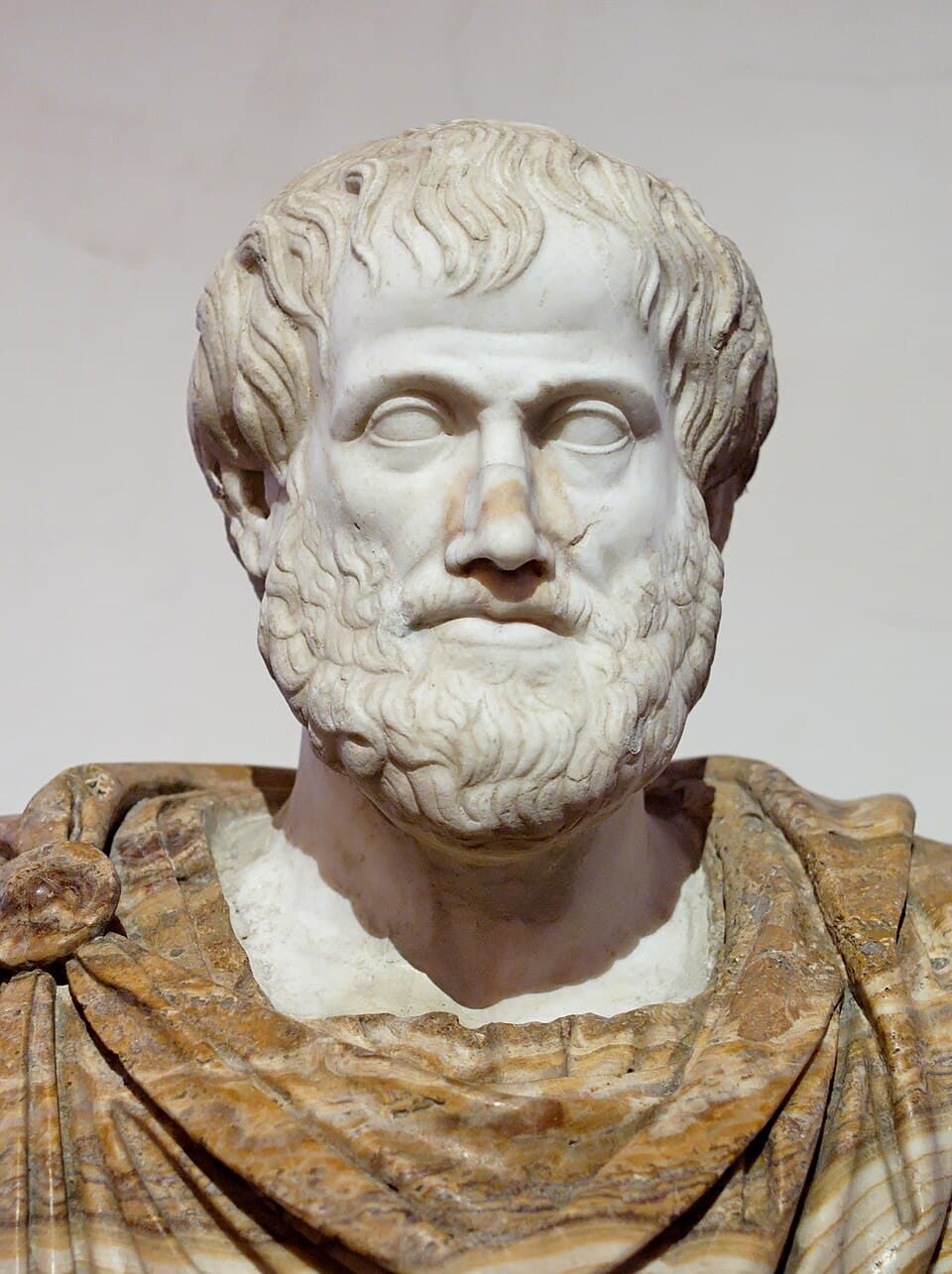
Aristotle
Nicomachean Ethics...dge on these points must be very profitable. Let thus much suffice by way of preface on these three points, the student, the spirit in which our observations should be received, and the object which we propose. Chapter II. And now, resuming the statement with which we commenced, since all knowledge and moral choice grasps at good of some kind or another, what good is that which we say πολιτικὴ aims at? or, in other words, what is the highest of all the goods which are the objects of action?
So far as name goes, there is a pretty general agreement: for HAPPINESS both the multitude and the refined few call it, and “living well” and “doing well” they conceive to be the same with “being happy;” but about the Nature of this Happiness, men dispute, and the multitude do not in their account of it agree with the wise. For some say it is some one of those things which are palpable and apparent, as pleasure or wealth or honour; in fact, some one thing, some another; nay, oftentimes the same man gives a different account of it; for when ill, he calls it health; when poor, wealth: and conscious of their own ignorance, men admire those who…
Some again held it to be something by itself, other than and beside these many good things, which is in fact to all these the cause of their being good. Now to sift all the opinions would be perhaps rather a fruitless task; so it shall suffice to sift those which are most generally current, or are thought to have some reason in them. And here we must not forget the difference between reasoning from principles, and reasoning to principles: for with good cause did Plato too doubt about this, an...
Continue reading →
6
⚖The Complete Life

Aristotle
Nicomachean EthicsAristotle contemplates the definition of a truly happy life, suggesting it requires both virtuous activity and a fitting conclusion to one's existence.
...I do not mean to say he will be blessed should he fall into fortunes like those of Priam. Nor, in truth, is he shifting and easily changeable, for on the one hand from his happiness he will not be shaken easily nor by ordinary mischances, but, if at all, by those which are great and numerous; and, on the other, after such mischances he cannot regain his happiness in a little time; but, if at all, in a long and complete period, during which he has made himself master of great and noble things.
Why then should we not call happy the man who works in the way of perfect virtue, and is furnished with external goods sufficient for acting his part in the drama of life: and this during no ordinary period but such as constitutes a complete life as we have been describing it. Or we must add, that not only is he to live so, but his death must be in keeping with such life, since the future is dark to us, and Happiness we assume to be in every way an end and complete.
And, if this be so, we shall call them among the living blessed who have and will have the things specified, but blessed as Men.[36] On these points then let it suffice to have denned thus much. Chapter IX. Now that the fortunes of their descendants, and friends generally, contribute nothing towards forming the condition of the dead, is plainly a very heartless notion, and contrary to the current opinions. But since things which befall are many, and differ in all kinds of ways, and some t...
2
⚖Excellence as Happiness

Aristotle
Nicomachean EthicsThe author links the study of ethics to statesmanship, arguing that the goal of a true leader is to understand human excellence to make citizens good.
...However, it is perhaps more suitable to a regular treatise on encomia to pursue this topic with exactness: it is enough for our purpose that from what has been said it is evident that Happiness belongs to the class of things precious and final. And it seems to be so also because of its being a starting-point; which it is, in that with a view to it we all do everything else that is done; now the starting-point and cause of good things we assume to be something precious and divine. Chapter XI.
Moreover, since Happiness is a kind of working of the soul in the way of perfect Excellence, we must enquire concerning Excellence: for so probably shall we have a clearer view concerning Happiness; and again, he who is really a statesman is generally thought to have spent most pains on this, for he wishes to make the citizens good and obedient to the laws. (For examples of this class we have the lawgivers of the Cretans and Lacedæmonians and whatever other such there have been.) But if this investigation belongs properly to πολιτικὴ, then clearly the enquiry will be in accordance with our original design. Well, we are to enquire concerning…
And by Human Excellence we mean not that of man’s body but that of his soul; for we call Happiness a working of the Soul. And if this is so, it is plain that some knowledge of the nature of the Soul is necessary for the statesman, just as for the oculist a knowledge of the whole body, and the more so in proportion as πολιτικὴ is more precious and higher than the healing art: and in fact physicians of the higher class do busy themselves much with the knowledge of the body. So then the statesm...
Continue reading →
5
⚖The Three Lives

Aristotle
Nicomachean EthicsThe author provides a critical overview of the different modes of life, metaphorically describing the pursuit of pure sensual pleasure as 'slavish' and fit for 'brute animals'.
...e no need in addition of the reason for the fact. And he that has been thus trained either has principles already, or can receive them easily: as for him who neither has nor can receive them, let him hear his sentence from Hesiod: He is best of all who of himself conceiveth all things; Good again is he too who can adopt a good suggestion; But whoso neither of himself conceiveth nor hearing from another Layeth it to heart;—he is a useless man. Chapter III. But to return from this digression.
Now of the Chief Good (i.e. of Happiness) men seem to form their notions from the different modes of life, as we might naturally expect: the many and most low conceive it to be pleasure, and hence they are content with the life of sensual enjoyment. For there are three lines of life which stand out prominently to view: that just mentioned, and the life in society, and, thirdly, the life of contemplation. Now the many are plainly quite slavish, choosing a life like that of brute animals: yet they obtain some consideration, because many of the great share the tastes of Sardanapalus.
The refined and active again conceive it to be honour: for this may be said to be the end of the life in society: yet it is plainly too superficial for the object of our search, because it is thought to rest with those who pay rather than with him who receives it, whereas the Chief Good we feel instinctively must be something which is our own, and not easily to be taken from us. And besides, men seem to pursue honour, that they may believe themselves to be good:[6] for instance, they seek to b...
2
⚖Happiness as Ultimate End

Aristotle
Nicomachean EthicsHappiness is identified as the ultimate end because it is the only thing chosen exclusively for its own sake, while all other virtues are chosen as means to achieve it.
...e object of our search: but if several, then the most final of them will be it. Now that which is an object of pursuit in itself we call more final than that which is so with a view to something else; that again which is never an object of choice with a view to something else than those which are so both in themselves and with a view to this ulterior object: and so by the term “absolutely final,” we denote that which is an object of choice always in itself, and never with a view to any other.
And of this nature Happiness is mostly thought to be, for this we choose always for its own sake, and never with a view to anything further: whereas honour, pleasure, intellect, in fact every excellence we choose for their own sakes, it is true (because we would choose each of these even if no result were to follow), but we choose them also with a view to happiness, conceiving that through their instrumentality we shall be happy: but no man chooses happiness with a view to them, nor in fact with a view to any other thing whatsoever.
The same result[15] is seen to follow also from the notion of self-sufficiency, a quality thought to belong to the final good. Now by sufficient for Self, we mean not for a single individual living a solitary life, but for his parents also and children and wife, and, in general, friends and countrymen; for man is by nature adapted to a social existence. But of these, of course, some limit must be fixed: for if one extends it to parents and descendants and friends’ friends, there is no end to i...
4