The author differentiates between an absolute mathematical mean and a relative mean that is tailored to the specific needs and capacities of an individual.
Relative vs Absolute Mean
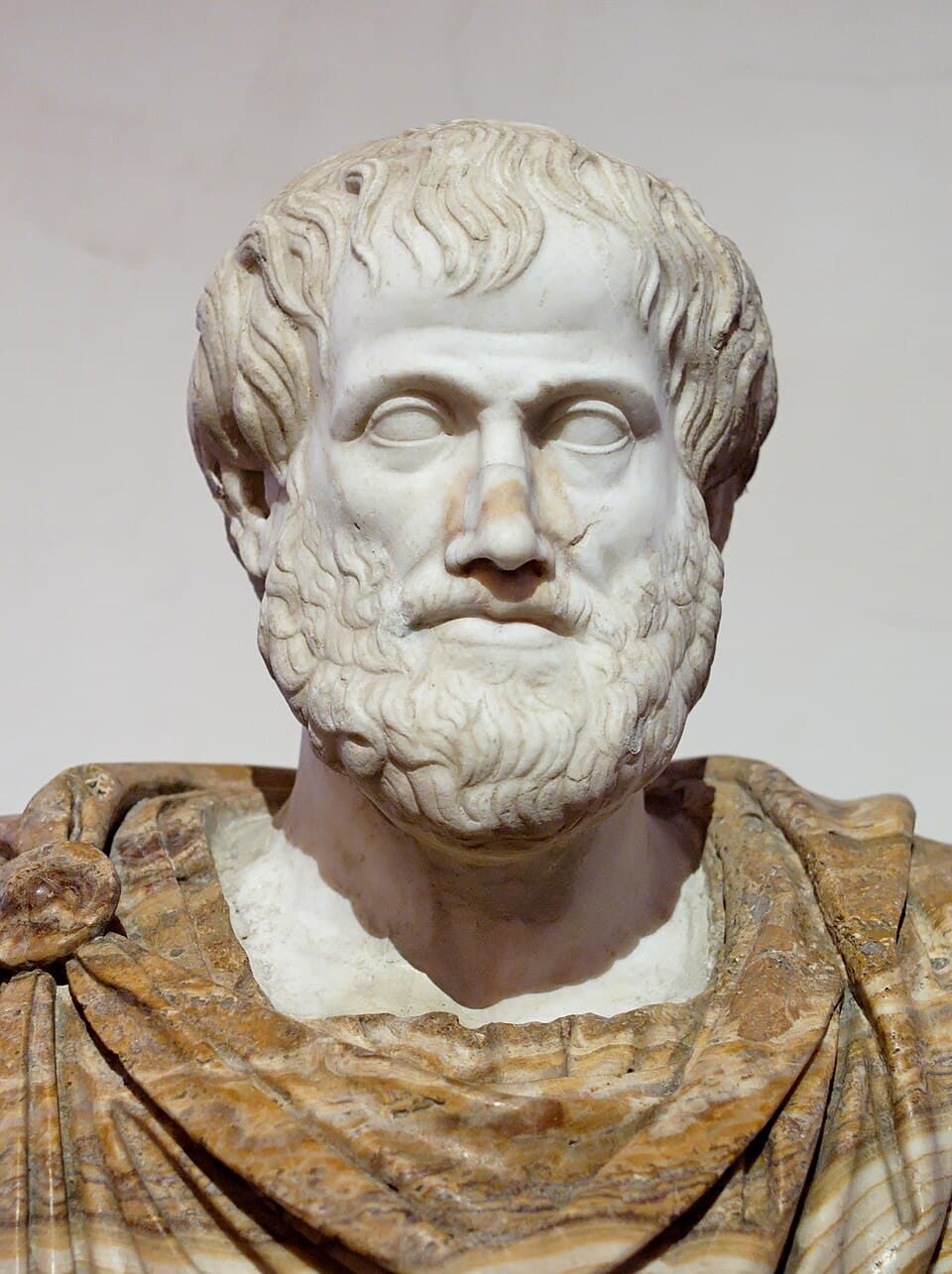
Aristotle
Nicomachean Ethics...must be a state whereby Man comes to be good and whereby he will perform well his proper work. Now how this shall be it is true we have said already, but still perhaps it may throw light on the subject to see what is its characteristic nature. In all quantity then, whether continuous or discrete,[11] one may take the greater part, the less, or the exactly equal, and these either with reference to the thing itself, or relatively to us: and the exactly equal is a mean between excess and defect.
Now by the mean of the thing, i.e. absolute mean, I denote that which is equidistant from either extreme (which of course is one and the same to all), and by the mean relatively to ourselves, that which is neither too much nor too little for the particular individual. This of course is not one nor the same to all: for instance, suppose ten is too much and two too little, people take six for the absolute mean; because it exceeds the smaller sum by exactly as much as it is itself exceeded by the larger, and this mean is according to arithmetical proportion. But the mean relatively to ourselves must not be so found ; for it does not follow,…
So then it seems every one possessed of skill avoids excess and defect, but seeks for and chooses the mean, not the absolute but the relative. Now if all skill thus accomplishes well its work by keeping an eye on the mean, and bringing the works to this point (whence it is common enough to say of such works as are in a good state, “one cannot add to or take ought from them,” under the notion of excess or defect destroying goodness but the mean state preserving it), and good artisans, as we sa...
Continue reading →
5
⚖Share Joy, Spare Sorrow

Aristotle
Nicomachean EthicsThe author provides social etiquette for friendship, advising that one should share good fortune readily but seek help in bad fortune only with great reluctance.
...pain which is thus caused to his friends: in short, he does not admit men to wail with him, not being given to wail at all: women, it is true, and men who resemble women, like to have others to groan with them, and love such as friends and sympathisers. But it is plain that it is our duty in all things to imitate the highest character. On the other hand, the advantages of friends in our prosperity are the pleasurable intercourse and the consciousness that they are pleased at our good fortune.
It would seem, therefore, that we ought to call in friends readily on occasion of good fortune, because it is noble to be ready to do good to others: but on occasion of bad fortune, we should do so with reluctance; for we should as little as possible make others share in our ills; on which principle goes the saying, “I am unfortunate, let that suffice.” The most proper occasion for calling them in is when with small trouble or annoyance to themselves they can be of very great use to the person who needs them. But, on the contrary, it is fitting perhaps to go to one’s friends in their misfortunes unasked and with alacrity (because kindness is…
and on occasion of their good fortune to go readily, if we can forward it in any way (because men need their friends for this likewise), but to be backward in sharing it, any great eagerness to receive advantage not being creditable. One should perhaps be cautious not to present the appearance of sullenness in declining the sympathy or help of friends, for this happens occasionally. It appears then that the presence of friends is, under all circumstances, choice-worthy. Chapter XII. May we...
Continue reading →
4
⚖The Enduring Benefactor

Aristotle
Nicomachean EthicsThe author distinguishes between types of pleasure, claiming that the pleasure of the benefactor is more enduring because it is tied to the lasting nature of an honorable work.
..., by his act of working: therefore he loves his work because he loves existence. And this is natural, for the work produced displays in act what existed before potentially. Then again, the benefactor has a sense of honour in right of his action, so that he may well take pleasure in him in whom this resides; but to him who has received the benefit there is nothing honourable in respect of his benefactor, only something advantageous which is both less pleasant and less the object of Friendship.
Again, pleasure is derived from the actual working out of a present action, from the anticipation of a future one, and from the recollection of a past one: but the highest pleasure and special object of affection is that which attends on the actual working. Now the benefactor’s work abides (for the honourable is enduring), but the advantage of him who has received the kindness passes away. Again, there is pleasure in recollecting honourable actions, but in recollecting advantageous ones there is none at all or much less (by the way though, the contrary is true of the expectation of advantage).
Further, the entertaining the feeling of Friendship is like acting on another; but being the object of the feeling is like being acted upon. So then, entertaining the sentiment of Friendship, and all feelings connected with it, attend on those who, in the given case of a benefaction, are the superior party. Once more: all people value most what has cost them much labour in the production; for instance, people who have themselves made their money are fonder of it than those who have inherited...
4
⚖Claims of Different Relationships

Aristotle
Nicomachean EthicsThe author advises that moral obligations must be tailored to the specific nature of the relationship, such as those with parents or companions.
...him to be a scoundrel. And again, in certain cases no obligation lies on a man to lend to one who has lent to him; suppose, for instance, that a bad man lent to him, as being a good man, under the notion that he should get repaid, whereas the said good man has no hope of repayment from him being a bad man. Either then the case is really as we have supposed it and then the claim is not equal, or it is not so but supposed to be; and still in so acting people are not to be thought to act wrongly.
In short, as has been oftentimes stated before, all statements regarding feelings and actions can be definite only in proportion as their object-matter is so; it is of course quite obvious that all people have not the same claim upon one, nor are the claims of one’s father unlimited; just as Jupiter does not claim all kinds of sacrifice without distinction: and since the claims of parents, brothers, companions, and benefactors, are all different, we must give to each what belongs to and befits each.
And this is seen to be the course commonly pursued: to marriages men commonly invite their relatives, because these are from a common stock and therefore all the actions in any way pertaining thereto are common also: and to funerals men think that relatives ought to assemble in preference to other people, for the same reason. And it would seem that in respect of maintenance it is our duty to assist our parents in preference to all others, as being their debtors, and because it is more honoura...
4
⚖Deliberation's Right Aim

Aristotle
Nicomachean EthicsThe author defines 'Good Counsel' as a specific type of right deliberation that is directed toward attaining a truly good end, rather than just any calculated goal.
...ong, and Rightness of Opinion is Truth: and again, all which is the object of opinion is definitely marked out.[36] Still, however, Good Counsel is not independent of Reason, Does it remain then that it is a rightness of Intellectual Operation simply, because this does not amount to an assertion; and the objection to Opinion was that it is not a process of enquiry but already a definite assertion; whereas whosoever deliberates, whether well or ill, is engaged in enquiry and calculation. Well,
Good Counsel is a Rightness of deliberation, and so the first question must regard the nature and objects of deliberation. Now remember Rightness is an equivocal term; we plainly do not mean Rightness of any kind whatever; the ἀκρατὴς, for instance, or the bad man, will obtain by his calculation what he sets before him as an object, and so he may be said to have deliberated rightly in one sense, but will have attained a great evil. Whereas to have deliberated well is thought to be a good, because Good Counsel is Rightness of deliberation of such a nature as is apt to attain good.
But even this again you may get by false reasoning, and hit upon the right effect though not through right means,[37] your middle term being fallacious: and so neither will this be yet Good Counsel in consequence of which you get what you ought but not through proper means. Again, one man may hit on a thing after long deliberation, another quickly. And so that before described will not be yet Good Counsel, but the Rightness must be with reference to what is expedient; and you must have a prop...
5