1 of 18 in Section I THOUGHTS ON MAN AND ON STYLE6 of 448 in work
Now entering Section I THOUGHTS ON MAN AND ON STYLE
Mathematical vs Intuitive Mind
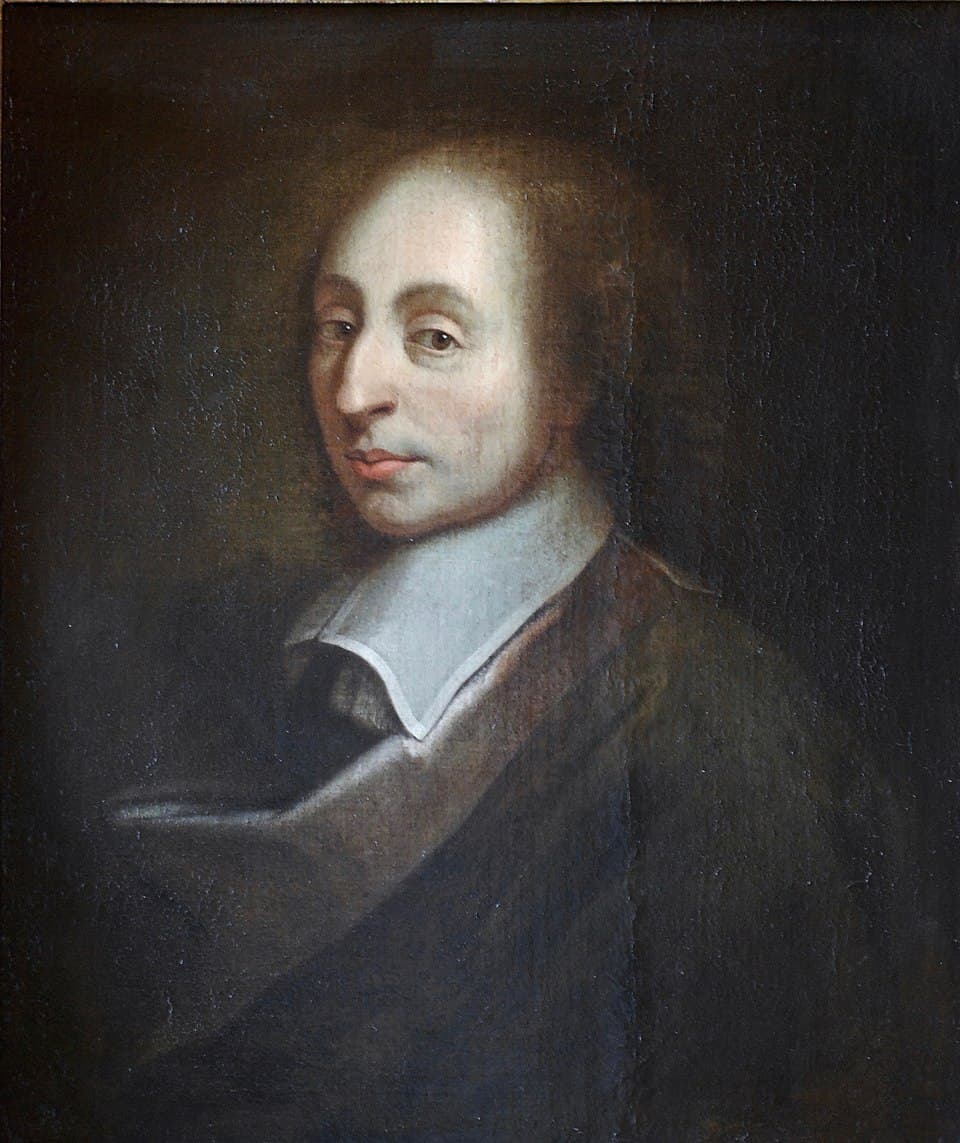
Blaise Pascal
Pensees

The author distinguishes between the mathematical mind, which reasons from rare but clear principles, and the intuitive mind, which must navigate numerous, subtle, and common principles with precision.

...273 INDEX 289 * * * * * NOTE Passages erased by Pascal are enclosed in square brackets, thus []. Words, added or corrected by the editor of the text, are similarly denoted, but are in italics. It has been seen fit to transfer Fragment 514 of the French edition to the Notes. All subsequent Fragments have accordingly been renumbered. SECTION I THOUGHTS ON MIND AND ON STYLE 1
The difference between the mathematical and the intuitive mind.--In the one the principles are palpable, but removed from ordinary use; so that for want of habit it is difficult to turn one's mind in that direction: but if one turns it thither ever so little, one sees the principles fully, and one must have a quite inaccurate mind who reasons wrongly from principles so plain that it is almost impossible they should escape notice. But in the intuitive mind the principles are found in common use, and are before the eyes of everybody. One has only to look, and no effort is necessary; it is only a question of good eyesight, but it must be good,…
All mathematicians would then be intuitive if they had clear sight, for they do not reason incorrectly from principles known to them; and intuitive minds would be mathematical if they could turn their eyes to the principles of mathematics to which they are unused. The reason, therefore, that some intuitive minds are not mathematical is that they cannot at all turn their attention to the principles of mathematics. But the reason that mathematicians are not intuitive is that they do not see wha...
Continue reading →
6
2 of 18 in Section I THOUGHTS ON MAN AND ON STYLE7 of 448 in work
Intuition vs Mathematics
Blaise Pascal
Pensees

A comparison between the intuitive and mathematical minds, noting that their mutual misunderstanding stems from different ways of perceiving principles. While mathematicians require structured arrangement, intuitive minds grasp truths through a felt perception that is difficult to demonstrate to others.

...question of good eyesight, but it must be good, for the principles are so subtle and so numerous, that it is almost impossible but that some escape notice. Now the omission of one principle leads to error; thus one must have very clear sight to see all the principles, and in the next place an accurate mind not to draw false deductions from known principles. All mathematicians would then be intuitive if they had clear sight, for they do not reason incorrectly from principles known to them; and
Intuitive minds would be mathematical if they could turn their eyes to the principles of mathematics to which they are unused. The reason, therefore, that some intuitive minds are not mathematical is that they cannot at all turn their attention to the principles of mathematics. But the reason that mathematicians are not intuitive is that they do not see what is before them, and that, accustomed to the exact and plain principles of mathematics, and not reasoning till they have well inspected and arranged their principles, they are lost in matters of intuition where the principles do not allow of such arrangement. They are scarcely seen; they…
These principles are so fine and so numerous that a very delicate and very clear sense is needed to perceive them, and to judge rightly and justly when they are perceived, without for the most part being able to demonstrate them in order as in mathematics; because the principles are not known to us in the same way, and because it would be an endless matter to undertake it. We must see the matter at once, at one glance, and not by a process of reasoning, at least to a certain degree. And thus it...
Continue reading →
6
3 of 18 in Section I THOUGHTS ON MAN AND ON STYLE8 of 448 in work
True Eloquence's Paradox
Blaise Pascal
Pensees

Pascal suggests that true philosophy and morality transcend intellectual rules, favoring the intuitive power of judgment over the rigid structures of science and mathematics.

...lity can exist without the other; the intellect can be strong and narrow, and can also be comprehensive and weak. 3 Those who are accustomed to judge by feeling do not understand the process of reasoning, for they would understand at first sight, and are not used to seek for principles. And others, on the contrary, who are accustomed to reason from principles, do not at all understand matters of feeling, seeking principles, and being unable to see at a glance. 4 Mathematics, intuition.--
True eloquence makes light of eloquence, true morality makes light of morality; that is to say, the morality of the judgment, which has no rules, makes light of the morality of the intellect. For it is to judgment that perception belongs, as science belongs to intellect. Intuition is the part of judgment, mathematics of intellect. To make light of philosophy is to be a true philosopher.
5 Those who judge of a work by rule[3] are in regard to others as those who have a watch are in regard to others. One says, "It is two hours ago"; the other says, "It is only three-quarters of an hour." I look at my watch, and say to the one, "You are weary," and to the other, "Time gallops with you"; for it is only an hour and a half ago, and I laugh at those who tell me that time goes slowly with me, and that I judge by imagination. They do not know that I judge by my watch.[4] 6 Just a...
6
4 of 18 in Section I THOUGHTS ON MAN AND ON STYLE9 of 448 in work
Intellect's Originality Perception
Blaise Pascal
Pensees

The author suggests that intellectual depth allows one to perceive the unique individuality of others, whereas a lack of intellect leads to seeing people as indistinguishable.

...watch.[4] 6 Just as we harm the understanding, we harm the feelings also. The understanding and the feelings are moulded by intercourse; the understanding and feelings are corrupted by intercourse. Thus good or bad society improves or corrupts them. It is, then, all-important to know how to choose in order to improve and not to corrupt them; and we cannot make this choice, if they be not already improved and not corrupted. Thus a circle is formed, and those are fortunate who escape it. 7
The greater intellect one has, the more originality one finds in men. Ordinary persons find no difference between men.
8 There are many people who listen to a sermon in the same way as they listen to vespers. 9 When we wish to correct with advantage, and to show another that he errs, we must notice from what side he views the matter, for on that side it is usually true, and admit that truth to him, but reveal to him the side on which it is false. He is satisfied with that, for he sees that he was not mistaken, and that he only failed to see all sides. Now, no one is offended at not seeing everything; but...
6
5 of 18 in Section I THOUGHTS ON MAN AND ON STYLE10 of 448 in work
Correct by Admitting Truth
Blaise Pascal
Pensees

Pascal suggests that the most effective way to correct someone is to acknowledge the partial truth of their perspective before revealing the side they have failed to see.

...d society improves or corrupts them. It is, then, all-important to know how to choose in order to improve and not to corrupt them; and we cannot make this choice, if they be not already improved and not corrupted. Thus a circle is formed, and those are fortunate who escape it. 7 The greater intellect one has, the more originality one finds in men. Ordinary persons find no difference between men. 8 There are many people who listen to a sermon in the same way as they listen to vespers. 9
When we wish to correct with advantage, and to show another that he errs, we must notice from what side he views the matter, for on that side it is usually true, and admit that truth to him, but reveal to him the side on which it is false. He is satisfied with that, for he sees that he was not mistaken, and that he only failed to see all sides. Now, no one is offended at not seeing everything; but one does not like to be mistaken, and that perhaps arises from the fact that man naturally cannot see everything, and that naturally he cannot err in the side he looks at, since the perceptions of our senses are always true.
10 People are generally better persuaded by the reasons which they have themselves discovered than by those which have come into the mind of others. 11 All great amusements are dangerous to the Christian life; but among all those which the world has invented there is none more to be feared than the theatre. It is a representation of the passions so natural and so delicate that it excites them and gives birth to them in our hearts, and, above all, to that of love, principally when it is re...
4