3 of 72 in Preface3 of 175 in work
Faith's Lost Lifelong Task
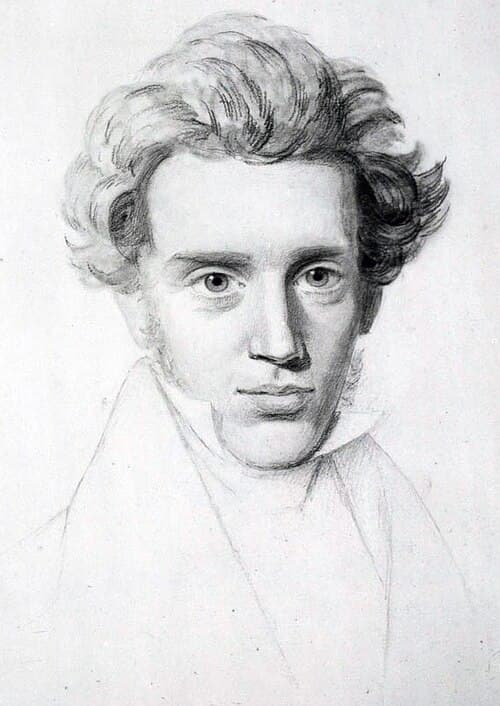
Søren Kierkegaard
Fear and Trembling

The author observes with irony that while his contemporaries treat faith as a starting point to be surpassed, it was historically understood as a lifelong, difficult task.

...nding of philosophy) regarded as a task for a whole lifetime, seeing that dexterity in doubting is not acquired in a few days or weeks, what the veteran combatant attained when he had preserved the equilibrium of doubt through all the pitfalls he encountered, who intrepidly denied the certainty of sense-perception and the certainty of the processes of thought, incorruptibly defied the apprehensions of self-love and the insinuations of sympathy–that is where everybody begins in our time.
In our time nobody is content to stop with faith but wants to go further. It would perhaps be rash to ask where these people are going, but it is surely a sign of breeding and culture for me to assume that everybody has faith, for otherwise it would be queer for them to be … going further. In those old days it was different, then faith was a task for a whole lifetime, because it was assumed that dexterity in faith is not acquired in a few days or weeks.
When the tried oldster drew near to his last hour, having fought the good fight and kept the faith, his heart was still young enough not to have forgotten that fear and trembling which chastened the youth, which the man indeed held in check, but which no man quite outgrows … except as he might succeed at the earliest opportunity in going further. Where these revered figures arrived, that is the point where everybody in our day begins to go further. The present writer is nothing of a phi...
2
4 of 72 in Preface4 of 175 in work
Faith Beyond Concepts
Søren Kierkegaard
Fear and Trembling

The author distances himself from formal philosophy and 'the System,' identifying instead as an amateur poet who believes faith cannot be fully captured by concepts.

...ows … except as he might succeed at the earliest opportunity in going further. Where these revered figures arrived, that is the point where everybody in our day begins to go further. The present writer is nothing of a philosopher, he has not understood the System, does not know whether it actually exists, whether it is completed; already he has enough for his weak head in the thought of what a prodigious head everybody in our day must have, since everybody has such a prodigious thought.
Even though one were capable of converting the whole content of faith into the form of a concept, it does not follow that one has adequately conceived faith and understands how one got into it, or how it got into one. The present writer is nothing of a philosopher; he is, poetice et eleganter, an amateur writer who neither writes the System nor promises of the System, who neither subscribes to the System nor ascribes anything to it.
He writes because for him it is a luxury which becomes the more agreeable and more evident, the fewer there are who buy and read what he writes. He can easily foresee his fate in an age when passion has been obliterated in favor of learning, in an age when an author who wants to have readers must take care to write in such a way that the book can easily be perused during the afternoon nap, and take care to fashion his outward deportment in likeness to the picture of that polite young gar...
2
5 of 72 in Preface5 of 175 in work
Life Without Eternity
Søren Kierkegaard
Fear and Trembling

The author reflects on the existential despair and emptiness that would characterize human life if there were no eternal consciousness or sacred bond to unite generations against oblivion.

...period and thirty-five for a semicolon. I prostrate myself with the profoundest deference before every systematic "bag-peerer" at the custom house, protesting, "This is not the System, it has nothing whatever to do with the System." I call down every blessing upon the System and upon the Danish shareholders in this omnibus–for a tower it is hardly likely to become. I wish them all and sundry good luck and all prosperity. Respectfully, Johannes DE SILENTIO A PANEGYRIC UPON ABRAHAM
If there were no eternal consciousness in a man, if at the foundation of all there lay only a wildly seething power which writhing with obscure passions produced everything that is great and everything that is insignificant, if a bottomless void never satiated lay hidden beneath all– what then would life be but despair? If such were the case, if there were no sacred bond which united mankind, if one generation arose after another like the leafage in the forest, if the one generation replaced the other like the song of birds in the forest, if the human race passed through the world as the ship goes through the sea, like the wind through the…
But therefore it is not thus, but as God created man and woman, so too He fashioned the hero and the poet or orator. The poet cannot do what that other does, he can only admire, love and rejoice in the hero. Yet he too is happy, and not less so, for the hero is as it were his better nature, with which he is in love, rejoicing in the fact that this after all is not himself, that his love can be admiration. He is the genius of recollection, can do nothing except call to mind what has been...
Continue reading →
2
6 of 72 in Preface6 of 175 in work
Greatness by Expectation
Søren Kierkegaard
Fear and Trembling

The author presents a poetic hierarchy of greatness, concluding that while many are remembered for their love or expectations, he who expected the 'impossible' through faith is the greatest of all.

...out of his hero, then he has completed his work, then he is gathered to the hero, who has loved him just as faithfully, for the poet is as it were the hero's better nature, powerless it may be as a memory is, but also transfigured as a memory is. Hence no one shall be forgotten who was great, and though time tarries long, though a cloud of misunderstanding takes the hero away, his lover comes nevertheless, and the longer the time that has passed, the more faithfully will he cling to him.
No, not one shall be forgotten who was great in the world. But each was great in his own way, and each in proportion to the greatness of that which he loved. For he who loved himself became great by himself, and he who loved other men became great by his selfless devotion, but he who loved God became greater than all. Everyone shall be remembered, but each became great in proportion to his expectation. One became great by expecting the possible, another by expecting the eternal, but he who expected the impossible became greater than all.
Everyone shall be remembered, but each was great in proportion to the greatness of that with which he strove. For he who strove with the world became great by overcoming the world, and he who strove with himself became great by overcoming himself, but he who strove with God became greater than all. So there was strife in the world, man against man, one against a thousand, but he who strove with God was greater than all. So there was strife upon earth: there was one who overcame all by hi...
2
7 of 72 in Preface7 of 175 in work
Striving with God
Søren Kierkegaard
Fear and Trembling

The author presents a poetic hierarchy of greatness, concluding that while many overcome the world or themselves, the one who strives with God is the greatest.

...world. But each was great in his own way, and each in proportion to the greatness of that which he loved. For he who loved himself became great by himself, and he who loved other men became great by his selfless devotion, but he who loved God became greater than all. Everyone shall be remembered, but each became great in proportion to his expectation. One became great by expecting the possible, another by expecting the eternal, but he who expected the impossible became greater than all.
Everyone shall be remembered, but each was great in proportion to the greatness of that with which he strove. For he who strove with the world became great by overcoming the world, and he who strove with himself became great by overcoming himself, but he who strove with God became greater than all. So there was strife in the world, man against man, one against a thousand, but he who strove with God was greater than all. So there was strife upon earth: there was one who overcame all by his power, and there was one who overcame God by his impotence. There was one who relied upon himself and gained all, there was one who secure in his strength…
There was one who was great by reason of his power, and one who was great by reason of his wisdom, and one who was great by reason of his hope, and one who was great by reason of his love; but Abraham was greater than all, great by reason of his power whose strength is impotence, great by reason of his wisdom whose secret is foolishness, great by reason of his hope whose form is madness, great by reason of the love which is hatred of oneself. By faith Abraham went out from the land of hi...
Continue reading →
2