72 of 72 in Preface72 of 175 in work
Faith's Transformative Paradox
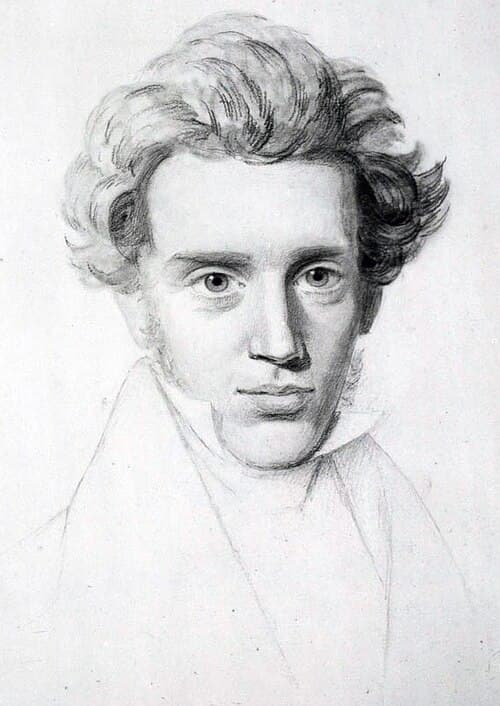
Søren Kierkegaard
Fear and Trembling

The author outlines his intent to explore the dialectical paradox of faith, which begins where rational thought ends and can transform a horrific act into a holy one.

...half days were infinitely longer than the few thousand years which separate me from Abraham. Then I would remind them that, in my opinion, every man dare still turn around ere he begins such an undertaking, and every instant he can repentantly turn back. If one does this, I fear no danger, nor am I afraid of awakening in people an inclination to be tried like Abraham. But if one would dispose of a cheap edition of Abraham, and yet admonish everyone to do likewise, then it is ludicrous.
It is now my intention to draw out from the story of Abraham the dialectical consequences inherent in it, expressing them in the form of problemata, in order to see what a tremendous paradox faith is, a paradox which is capable of transforming a murder into a holy act well-pleasing to God, a paradox which gives Isaac back to Abraham, which no thought can master, because faith begins precisely there where thinking leaves off.
PROBLEM I Is there such a thing as a teleological suspension of the ethical? The ethical as such is the universal, and as the universal it applies to everyone, which may be expressed from another point of view by saying that it applies every instant. It reposes immanently in itself, it has nothing without itself which is its telos, but is itself telos for everything outside it, and when this has been incorporated by the ethical it can go no further. Conceived immediately as physi...
2
1 of 22 in Problem I73 of 175 in work
Now entering Problem I
The Universal's Telos
Søren Kierkegaard
Fear and Trembling

The author defines the ethical as the universal and argues that the individual's moral task is to abolish their particularity to express this universal telos.

...ion to draw out from the story of Abraham the dialectical consequences inherent in it, expressing them in the form of problemata, in order to see what a tremendous paradox faith is, a paradox which is capable of transforming a murder into a holy act well-pleasing to God, a paradox which gives Isaac back to Abraham, which no thought can master, because faith begins precisely there where thinking leaves off. PROBLEM I Is there such a thing as a teleological suspension of the ethical?
The ethical as such is the universal, and as the universal it applies to everyone, which may be expressed from another point of view by saying that it applies every instant. It reposes immanently in itself, it has nothing without itself which is its telos, but is itself telos for everything outside it, and when this has been incorporated by the ethical it can go no further. Conceived immediately as physical and psychical, the particular individual is the individual who has his telos in the universal, and his ethical task is to express himself constantly in it, to abolish his particularity in order to become the universal.
As soon as the individual would assert himself in his particularity over against the universal he sins, and only by recognizing this can he again reconcile himself with the universal. Whenever the individual after he has entered the universal feels an impulse to assert himself as the particular, he is in temptation (Anfechtung), and he can labor himself out of this only by penitently abandoning himself as the particular in the universal. If this be the highest thing that can be said of...
6
2 of 22 in Problem I74 of 175 in work
The Particular Over Universal
Søren Kierkegaard
Fear and Trembling

The author defines faith as a paradox where the individual transcends the universal ethical order to establish a direct, private relationship with the absolute.

...aracterizes man merely as the particular and regards this character as "a moral form of evil" which is to be annulled in the teleology of the moral, so that the individual who remains in this stage is either sinning or subjected to temptation (Anfechtung). On the other hand, Hegel is wrong in talking of faith, wrong in not protesting loudly and clearly against the fact that Abraham enjoys honor and glory as the father of faith, whereas he ought to be prosecuted and convicted of murder.
For faith is this paradox, that the particular is higher than the universal– yet in such a way, be it observed, that the movement repeats itself, and that consequently the individual, after having been in the universal, now as the particular isolates himself as higher than the universal. If this be not faith, then Abraham is lost, then faith has never existed in the world … because it has always existed. For if the ethical (i.e. the moral) is the highest thing, and if nothing incommensurable remains in man in any other way but as the evil (i.e. the particular which has to be expressed in the universal), then one needs no other categories…
This fact Hegel ought not to have concealed, for after all he was acquainted with Greek thought. One not infrequently hears it said by men who for lack of losing themselves in studies are absorbed in phrases that a light shines upon the Christian world whereas a darkness broods over paganism. This utterance has always seemed strange to me, inasmuch as every profound thinker and every serious artist is even in our day rejuvenated by the eternal youth of the Greek race. Such an utterance m...
Continue reading →
2
3 of 22 in Problem I75 of 175 in work
The Paradox of Faith
Søren Kierkegaard
Fear and Trembling

The author concludes that faith must be a paradox where the individual is superior to the universal, otherwise Abraham's actions are merely murder.

...t if with this one is to have said something, one must be a little clearer about what one understands by faith, since otherwise one falls back into such phrases. To explain the whole of existence and faith along with it, without having a conception of what faith is, is easy, and that man does not make the poorest calculation in life who reckons upon admiration when he possesses such an explanation; for, as Boileau says, "un sot trouve toujours un plus sot qui _l'admire.
"_Faith is precisely this paradox, that the individual as the particular is higher than the universal, is justified over against it, is not subordinate but superior–yet in such a way, be it observed, that it is the particular individual who, after he has been subordinated as the particular to the universal, now through the universal becomes the individual who as the particular is superior to the universal, for the fact that the individual as the particular stands in an absolute relation to the absolute. This position cannot be mediated, for all mediation comes about precisely by virtue of the universal; it is and remains to all eternity a…
That for the particular individual this paradox may easily be mistaken for a temptation (Anfechtung) is indeed true, but one ought not for this reason to conceal it. That the whole constitution of many persons may be such that this paradox repels them is indeed true, but one ought not for this reason to make faith something different in order to be able to possess it, but ought rather to admit that one does not possess it, whereas those who possess faith should take care to set up cert...
Continue reading →
2
4 of 22 in Problem I76 of 175 in work
The Paradox of Faith
Søren Kierkegaard
Fear and Trembling

The author posits that Abraham represents a 'teleological suspension of the ethical,' acting by virtue of the absurd where the individual is higher than the universal.

...(Anfechtung) is indeed true, but one ought not for this reason to conceal it. That the whole constitution of many persons may be such that this paradox repels them is indeed true, but one ought not for this reason to make faith something different in order to be able to possess it, but ought rather to admit that one does not possess it, whereas those who possess faith should take care to set up certain criteria so that one might distinguish the paradox from a temptation (Anfechtung).
Now the story of Abraham contains such a teleological suspension of the ethical. There have not been lacking clever pates and profound investigators who have found analogies to it. Their wisdom is derived from the pretty proposition that at bottom everything is the same. If one will look a little more closely, I have not much doubt that in the whole world one will not find a single analogy (except a later instance which proves nothing), if it stands fast that Abraham is the representative of faith, and that faith is normally expressed in him whose life is not merely the most paradoxical that can be thought but so paradoxical that it cannot be…
This paradox cannot be mediated; for as soon as he begins to do this he has to admit that he was in temptation (Anfechtung), and if such was the case, he never gets to the point of sacrificing Isaac, or, if he has sacrificed Isaac, he must turn back repentantly to the universal. By virtue of the absurd he gets Isaac again. Abraham is therefore at no instant a tragic hero but something quite different, either a murderer or a believer. The middle term which saves the tragic hero, Abraham...
Continue reading →
2