The author contrasts the public nature of Greek prophecy with the private nature of faith, noting that the former remains within the realm of the universal and intelligible.
14 of 52 in Problem III131 of 175 in work
Public vs Private Revelation
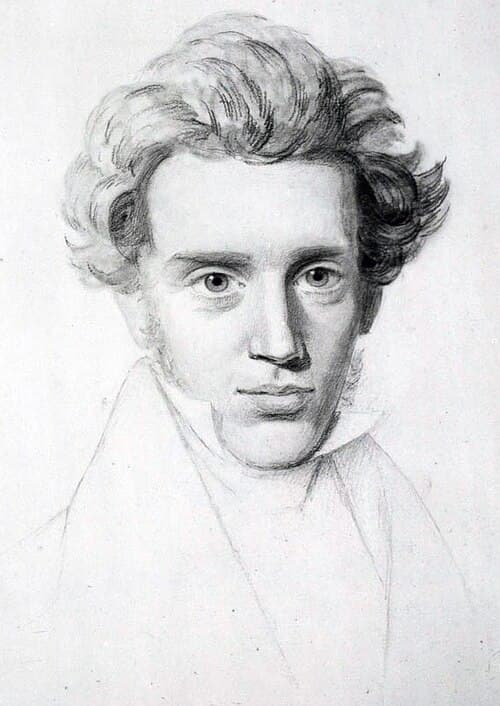
Søren Kierkegaard
Fear and Trembling...s, however, upon the fact that he had had his opportunity [for a genuine love] and annulled it; for if such heroism could be acquired without this, we should have plenty of heroes in our age, in our age which has attained an unparalleled proficiency in forgery and does the highest things by leaping over the intermediate steps. But then why this sketch, since I get no further after all than the tragic hero? Well, because it is at least possible that it might throw light upon the paradox.
Everything depends upon how this man stands related to the utterance of the augurs which is in one way or another decisive for his life. Is this utterance publici juris, or is it a privatissimum? The scene is laid in Greece, the utterance of the augur is intelligible to all. I do not mean merely that the ordinary man is able to understand its content lexically, but that the ordinary man can understand that an augur announces to the individual the decision of heaven. So the utterance of the augur is not intelligible only to the hero but to all, and no private relationship to the deity results from it.
Do what he will, that which is foretold will come to pass, and neither by doing nor by leaving undone does he come into closer relationship with the deity, or become either the object of its grace or of its wrath. The result foretold is a thing which any ordinary man will be just as well able as the hero to understand, and there is no secret writing which is legible to the hero only. Inasmuch as he would speak, he can do so perfectly well, for he is able to make himself intelligible; inas...
6
15 of 52 in Problem III132 of 175 in work
⚖The Individual vs Universal

Søren Kierkegaard
Fear and TremblingThe author explores the paradox of silence, arguing that the individual's absolute relation to the absolute can make communication with the universal impossible.
...s not intelligible only to the hero but to all, and no private relationship to the deity results from it. Do what he will, that which is foretold will come to pass, and neither by doing nor by leaving undone does he come into closer relationship with the deity, or become either the object of its grace or of its wrath. The result foretold is a thing which any ordinary man will be just as well able as the hero to understand, and there is no secret writing which is legible to the hero only.
Inasmuch as he would speak, he can do so perfectly well, for he is able to make himself intelligible; inasmuch as he would keep silent, it is because by virtue of being the individual he would be higher than the universal, would delude himself with all sorts of fantastic notions about how she will soon forget the sorrow, etc. On the other hand, in case the will of heaven had not been announced to him by an augur, in case it had come to his knowledge in an entirely private way, in case it had put itself into an entirely private relationship with him, then we encounter the paradox (supposing there is such a thing–for my reflection takes the…
In this then he would also be able to find repose (as well as I am able to figure it to myself), whereas his magnanimous silence would constantly have been disquieted by the requirements of the ethical. It is very much to be desired that aesthetics would for once essay to begin at the point where for so many years it has ended, with the illusory magnanimity. Once it were to do this it would work directly in the interest of the religious, for religion is the only power which can deliver t...
Continue reading →
3
16 of 52 in Problem III133 of 175 in work
⚖Innocence's Dead Calm

Søren Kierkegaard
Fear and TremblingA metaphorical narrative about a merman and a girl named Agnes, illustrating how absolute innocence and faith can paralyze the power of a seducer.
...time the poet too often confuses himself. I will follow this with a sketch which involves the demoniacal. The legend of Agnes and the Merman will serve my purpose. The merman is a seducer who shoots up from his hiding-place in the abyss, with wild lust grasps and breaks the innocent flower which stood in all its grace on the seashore and pensively inclined its head to listen to the howling of the ocean. This is what the poets hitherto have meant by it. Let us make an alteration.
The merman was a seducer. He had called to Agnes, had by his smooth speech enticed from her the hidden sentiments, she has found in the merman what she sought, what she was gazing after down at the bottom of the sea. Agnes would like to follow him. The merman has lifted her up in his arms, Agnes twines about his neck, with her whole soul she trustingly abandons herself to the stronger one; he already stands upon the brink, he leans over the sea, about to plunge into it with his prey–then Agnes looks at him once more, not timidly, not doubtingly, not proud of her good fortune, not intoxicated by pleasure, but with absolute faith in him, with…
He leads her back again, he explains to her that he only wanted to show her how beautiful the sea is when it is calm, and Agnes believes him.–Then he turns back alone and the sea rages, but despair in the merman rages more wildly. He is able to seduce Agnes, he is able to seduce a hundred Agneses, he is able to infatuate every girl–but Agnes has conquered, and the merman has lost her. Only as a prey can she become his, he cannot belong faithfully to any girl, for in fact he is only a mer...
Continue reading →
2
17 of 52 in Problem III134 of 175 in work
⚖The Merman's Reconciliation

Søren Kierkegaard
Fear and TremblingUsing the legend of Agnes and the merman, the author metaphorically explores how innocence serves as the only true protection against seduction and demonic entanglement.
...conquered, and the merman has lost her. Only as a prey can she become his, he cannot belong faithfully to any girl, for in fact he is only a merman. Here I have taken the liberty of making a little alteration* in the merman; substantially I have also altered Agnes a little, for in the legend Agnes is not entirely without fault–and generally speaking it is nonsense and coquetry and an insult to the feminine sex to imagine a case of seduction where the girl is not the least bit to blame.
In the legend Agnes is (to modernize my expression a little ) a woman who craves "the interesting," and every such woman can always be sure that there is a merrnan in the offing, for with half an eye mermen discover the like of that and steer for it like a shark after its prey. It is therefore very stupid to suppose (or is it a rumor which a merman has spread abroad?) that the so-called culture protects a girl against seduction. No, existence is more righteous and fair: there is only one protection, and that is innocence. We will now bestow upon the merman a human consciousness and suppose that the fact of his being a merman indicates a human…
But at the same instant two powers are striving for possession of him: repentance; and Agnes and repentance. If repentance alone takes possession of him, then he is hidden; if Agnes and repentance take possession of him, then he is revealed. Now in case repentance grips the merman and he remains concealed, he has clearly made Agnes unhappy, for Agnes loved him in all her innocence, she believed that at the instant when even to her he seemed changed, however well he hid it, he was tellin...
Continue reading →
2
18 of 52 in Problem III135 of 175 in work
⚖Repentance's Double Grip

Søren Kierkegaard
Fear and TremblingThe author uses the mythological figure of the merman to metaphorically explore the psychological tension between hidden guilt and the revelation of love.
...ce is more righteous and fair: there is only one protection, and that is innocence. We will now bestow upon the merman a human consciousness and suppose that the fact of his being a merman indicates a human pre- existence in the consequences of which his life is entangled. There is nothing to prevent him from becoming a hero, for the step he now takes is one of reconciliation. He is saved by Agnes, the seducer is crushed, he has bowed to the power of innocence, he can never seduce again.
But at the same instant two powers are striving for possession of him: repentance; and Agnes and repentance. If repentance alone takes possession of him, then he is hidden; if Agnes and repentance take possession of him, then he is revealed. Now in case repentance grips the merman and he remains concealed, he has clearly made Agnes unhappy, for Agnes loved him in all her innocence, she believed that at the instant when even to her he seemed changed, however well he hid it, he was telling the truth in saying that he only wanted to show her the beautiful calmness of the sea. However, with respect to passion the merman himself becomes still more…
The demoniacal element in repentance will now explain to him that this is precisely his punishment [for the faults of his pre-existent state], and that the more it tortures him the better. If he abandons himself to this demoniacal influence, he then perhaps makes still another attempt to save Agnes, in such a way as one can, in a certain sense, save a person by means of the evil. He knows that Agnes loves him. If he could wrest from Agnes this love, then in a way she is saved. But how? T...
Continue reading →
2