9 of 23 in Problem II103 of 175 in work
Christianity's Pitiable Smuggling
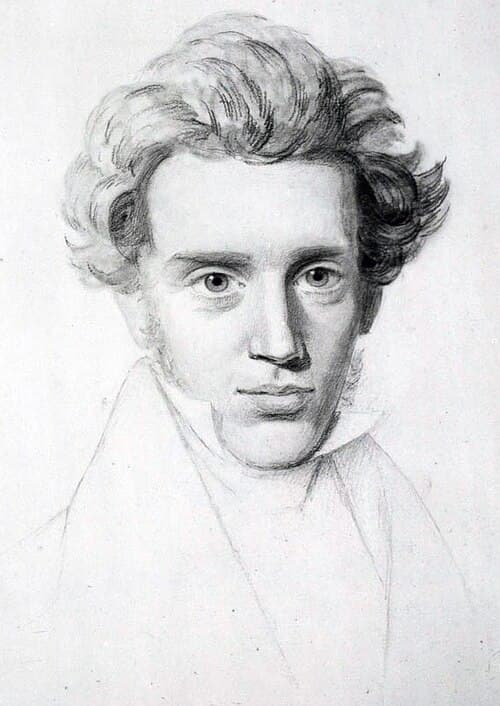
Søren Kierkegaard
Fear and Trembling

The author criticizes theologians who attempt to make Christianity more palatable by softening its radical demands, arguing that such a diluted doctrine is worthless and lacks the power to truly terrify or transform.

...strengthen this tasteful explanation. In the verse immediately following there is a story about a man who desired to build a tower but first sat down to calculate whether he was capable of doing it, lest people might laugh at him afterwards. The close connection of this story with the verse here cited seems precisely to indicate that the words are to be taken in as terrible a sense as possible, to the end that everyone may examine himself as to whether he is able to erect the building.
In case this pious and kindly exegete, who by abating the price thought he could smuggle Christianity into the world, were fortunate enough to convince a man that grammatically, linguistically and kat' a'nalogían [analogically] this was the meaning of that passage, it is to be hoped that the same moment he will be fortunate enough to convince the same man that Christianity is one of the most pitiable things in the world. For the doctrine which in one of its most lyrical outbursts, where the consciousness of its eternal validity swells in it most strongly, has nothing else to say but a noisy word which means nothing but only signifies that…
The words are terrible, yet I fully believe that one can understand them without implying that he who understands them has courage to do them. One must at all events be honest enough to acknowledge what stands written and to admit that it is great, even though one has not the courage for it. He who behaves thus will not find himself excluded from having part in that beautiful story which follows, for after all it contains consolation of a sort for the man who had not courage to begin the...
Continue reading →
6
10 of 23 in Problem II104 of 175 in work
Love's Proof Paradox
Søren Kierkegaard
Fear and Trembling

The author argues that true love for God or a spouse does not require becoming indifferent to previous duties, but rather that excellence in one's existing roles proves the capacity for deeper love.

...the courage for it. He who behaves thus will not find himself excluded from having part in that beautiful story which follows, for after all it contains consolation of a sort for the man who had not courage to begin the tower. But we must be honest, and not interpret this lack of courage as humility, since it is really pride, whereas the courage of faith is the only humble courage. One can easily perceive that if there is to be any sense in this passage, it must be understood literally.
God it is who requires absolute love. But he who in demanding a person's love thinks that this love should be proved also by becoming lukewarm to everything which hitherto was dear–that man is not only an egoist but stupid as well, and he who would demand such love signs at the same moment his own death-warrant, supposing that his life was bound up with this coveted love. Thus a husband demands that his wife shall leave father and mother, but if he were to regard it as a proof of her extraordinary love for him that she for his sake became an indolent, lukewarm daughter etc., then he is the stupidest of the stupid. If he had any notion of what…
What therefore in the case of a man one would regard as a sign of egoism and stupidity, that one is to regard by the help of an exegete as a worthy conception of the Deity. But how hate them? I will not recall here the human distinction between loving and hating–not because I have much to object to in it (for after all it is passionate), but because it is egoistic and is not in place here. However, if I regard the problem as a paradox, then I understand it, that is, I understand it in s...
Continue reading →
6
11 of 23 in Problem II105 of 175 in work
Love's Paradoxical Duty
Søren Kierkegaard
Fear and Trembling

The author explains the paradox of faith where the sacrifice is only valid if the father continues to love the son he is commanded to kill, creating a tension between the ethical and the absolute.

...ould regard as a sign of egoism and stupidity, that one is to regard by the help of an exegete as a worthy conception of the Deity. But how hate them? I will not recall here the human distinction between loving and hating–not because I have much to object to in it (for after all it is passionate), but because it is egoistic and is not in place here. However, if I regard the problem as a paradox, then I understand it, that is, I understand it in such a way as one can understand a paradox.
The absolute duty may cause one to do what ethics would forbid, but by no means can it cause the knight of faith to cease to love. This is shown by Abraham. The instant he is ready to sacrifice Isaac the ethical expression for what he does is this: he hates Isaac. But if he really hates Isaac, he can be sure that God does not require this, for Cain and Abraham are not identical. Isaac he must love with his whole soul; when God requires Isaac he must love him if possible even more dearly, and only on this condition can he sacrifice him; for in fact it is this love for Isaac which, by its paradoxical opposition to his love for God, makes his…
But the distress and dread in this paradox is that, humanly speaking, he is entirely unable to make himself intelligible. Only at the moment when his act is in absolute contradiction to his feeling is his act a sacrifice, but the reality of his act is the factor by which he belongs to the universal, and in that aspect he is and remains a murderer. Moreover, the passage in Luke must be understood in such a way as to make it clearly evident that the knight of faith has no higher expression...
Continue reading →
2
12 of 23 in Problem II106 of 175 in work
The Terrible Individual
Søren Kierkegaard
Fear and Trembling

The author challenges the idea that existing as an individual is easy, suggesting it requires more strict self-supervision than living under universal rules.

...in the Church–not even his father and mother etc.–who fails to understand him. On the other hand, he is not a knight of faith, and he has also a different answer from that of Abraham: he does not say that it is a trial or a temptation in which he is tested. People commonly refrain from quoting such a text as this in Luke. They are afraid of giving men a free rein, are afraid that the worst will happen as soon as the individual takes it into his head to comport himself as the individual.
Moreover, they think that to exist as the individual is the easiest thing of all, and that therefore people have to be compelled to become the universal. I cannot share either this fear or this opinion, and both for the same reason. He who has learned that to exist as the individual is the most terrible thing of all will not be fearful of saying that it is great, but then too he will say this in such a way that his words will scarcely be a snare for the bewildered man, but rather will help him into the universal, even though his words do to some extent make room for the great. The man who does not dare to mention such texts will not dare to…
That there may be some who need compulsion, some who, if they were free-footed, would riot in selfish pleasures like unruly beasts, is doubtless true; but a man must prove precisely that he is not of this number by the fact that he knows how to speak with dread and trembling; and out of reverence for the great one is bound to speak, lest it be forgotten for fear of the ill effect, which surely will fail to eventuate when a man talks in such a way that one knows it for the great, knows it...
Continue reading →
4
13 of 23 in Problem II107 of 175 in work
Renouncing the Universal
Søren Kierkegaard
Fear and Trembling

The author contrasts the tragic hero’s self-renunciation for the sake of the universal with the knight of faith’s renunciation of the universal for the sake of the individual.

...-footed, would riot in selfish pleasures like unruly beasts, is doubtless true; but a man must prove precisely that he is not of this number by the fact that he knows how to speak with dread and trembling; and out of reverence for the great one is bound to speak, lest it be forgotten for fear of the ill effect, which surely will fail to eventuate when a man talks in such a way that one knows it for the great, knows its terror–and apart from the terror one does not know the great at all.
Let us consider a little more closely the distress and dread in the paradox of faith. The tragic hero renounces himself in order to express the universal, the knight of faith renounces the universal in order to become the individual. As has been said, everything depends upon how one is placed.
He who believes that it is easy enough to be the individual can always be sure that he is not a knight of faith, for vagabonds and roving geniuses are not men of faith. The knight of faith knows, on the other hand, that it is glorious to belong to the universal. He knows that it is beautiful and salutary to be the individual who translates himself into the universal, who edits as it were a pure and elegant edition of himself, as free from errors as possible and which everyone can read. He...
2