The author contrasts the tragic hero, who is understood and admired by society, with Abraham, whose faith makes him unintelligible to others but known to God.
52 of 52 in Problem III169 of 175 in work
Abraham's Incomprehensible Love
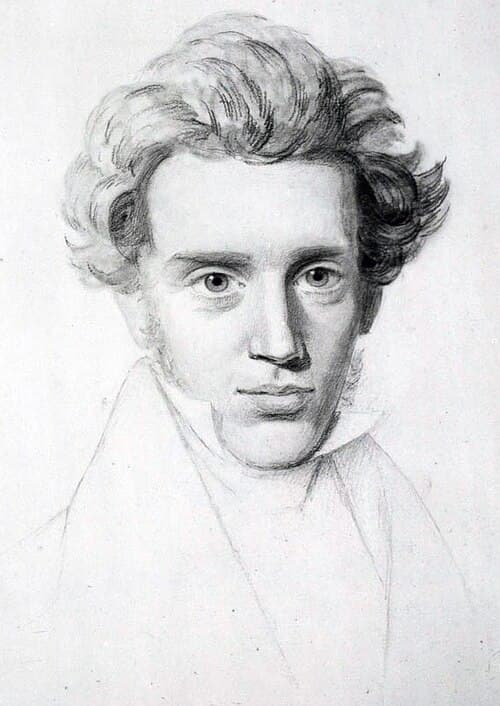
Søren Kierkegaard
Fear and Trembling...les. But such a hesitator is a sheer parody of a knight of faith. Here again it appears that one may have an understanding of Abraham, but can understand him only in the same way as one understands the paradox. For my part I can in a way understand Abraham, but at the same time I apprehend that I have not the courage to speak, and still less to act as he did–but by this I do not by any means intend to say that what he did was insignificant, for on the contrary it is the one only marvel.
And what did the contemporary age think of the tragic hero? They thought that he was great, and they admired him. And that honorable assembly of nobles, the jury which every generation impanels to pass judgment upon the foregoing generation, passed the same judgment upon him. But as for Abraham there was no one who could understand him. And yet think what he attained! He remained true to his love. But he who loves God has no need of tears, no need of admiration, in his love he forgets his suffering, yea, so completely has he forgotten it that afterwards there would not even be the least inkling of his pain if God Himself did not recall it,…
So either there is a paradox, that the individual as the individual stands in an absolute relation to the absolute/or Abraham is lost. EPILOGUE One time in Holland when the market was rather dull for spices the merchants had several cargoes dumped into the sea to peg up prices. This was a pardonable, perhaps a necessary device for deluding people. Is it something like that we need now in the world of spirit? Are we so thoroughly convinced that we have attained the highest point that th...
Continue reading →
1
1 of 6 in Epilogue170 of 175 in work
Now entering Epilogue
⚖Manufactured Spiritual Scarcity

Søren Kierkegaard
Fear and TremblingUsing a metaphor of Dutch spice merchants, the author questions whether the current generation is deceiving itself into thinking it has already mastered faith.
...his love. But he who loves God has no need of tears, no need of admiration, in his love he forgets his suffering, yea, so completely has he forgotten it that afterwards there would not even be the least inkling of his pain if God Himself did not recall it, for God sees in secret and knows the distress and counts the tears and forgets nothing. So either there is a paradox, that the individual as the individual stands in an absolute relation to the absolute/or Abraham is lost. EPILOGUE
One time in Holland when the market was rather dull for spices the merchants had several cargoes dumped into the sea to peg up prices. This was a pardonable, perhaps a necessary device for deluding people. Is it something like that we need now in the world of spirit? Are we so thoroughly convinced that we have attained the highest point that there is nothing left for us but to make ourselves believe piously that we have not got so far–just for the sake of having something left to occupy our time? Is it such a self-deception the present generation has need of, does it need to be trained to virtuosity in self-deception, or is it not rather…
Or rather is not the thing most needed an honest seriousness which dauntlessly and incorruptibly points to the tasks, an honest seriousness which lovingly watches over the tasks, which does not frighten men into being over hasty in getting the highest tasks accomplished, but keeps the tasks young and beautiful and charming to look upon and yet difficult withal and appealing to noble minds. For the enthusiasm of noble natures is aroused only by difficulties. Whatever the one generation ma...
Continue reading →
4
2 of 6 in Epilogue171 of 175 in work
⚖Each Generation's Primitive Start

Søren Kierkegaard
Fear and TremblingThe text asserts that every generation must begin from the same starting point regarding human passion and love, as these essential experiences cannot be inherited or bypassed.
...n the art of deceiving itself? Or rather is not the thing most needed an honest seriousness which dauntlessly and incorruptibly points to the tasks, an honest seriousness which lovingly watches over the tasks, which does not frighten men into being over hasty in getting the highest tasks accomplished, but keeps the tasks young and beautiful and charming to look upon and yet difficult withal and appealing to noble minds. For the enthusiasm of noble natures is aroused only by difficulties.
Whatever the one generation may learn from the other, that which is genuinely human no generation learns from the foregoing. In this respect every generation begins primitively, has no different task from that of every previous generation, nor does it get further, except in so far as the preceding generation shirked its task and deluded itself. This authentically human factor is passion, in which also the one generation perfectly understands the other and understands itself. Thus no generation has learned from another to love, no generation begins at any other point than at the beginning, no generation has a shorter task assigned to it than…
But the highest passion in a man is faith, and here no generation begins at any other point than did the preceding generation, every generation begins all over again, the subsequent generation gets no further than the foregoing–in so far as this remained faithful to its task and did not leave it in the lurch. That this should be wearisome is of course something the generation cannot say, for the generation has in fact the task to perform and has nothing to do with the consideration that...
Continue reading →
6
3 of 6 in Epilogue172 of 175 in work
⚖Faith's Eternal Beginning

Søren Kierkegaard
Fear and TremblingThe text reiterates that faith is the highest human passion and that every individual must undertake the task of faith for themselves, regardless of the progress of previous generations.
...ask and deluded itself. This authentically human factor is passion, in which also the one generation perfectly understands the other and understands itself. Thus no generation has learned from another to love, no generation begins at any other point than at the beginning, no generation has a shorter task assigned to it than had the preceding generation, and if here one is not willing like the previous generations to stop with love but would go further, this is but idle and foolish talk.
But the highest passion in a man is faith, and here no generation begins at any other point than did the preceding generation, every generation begins all over again, the subsequent generation gets no further than the foregoing–in so far as this remained faithful to its task and did not leave it in the lurch. That this should be wearisome is of course something the generation cannot say, for the generation has in fact the task to perform and has nothing to do with the consideration that the foregoing generation had the same task–unless the particular generation or the particular individuals within it were presumptuous enough to assume the…
If the generation begins that sort of thing, it is upside down, and what wonder then that the whole of existence seems to it upside down, for there surely is no one who has found the world so upside down as did the tailor in the fairy tale who went up in his lifetime to heaven and from that standpoint contemplated the world. If the generation would only concern itself about its task, which is the highest thing it can do, it cannot grow weary, for the task is always sufficient for a human...
Continue reading →
5
4 of 6 in Epilogue173 of 175 in work
⚖Faith's Highest Passion

Søren Kierkegaard
Fear and TremblingThe author identifies faith as the highest human passion and admits his own personal struggle to reach it, refusing to belittle faith just because he finds it difficult to attain.
...n a holiday have already got through playing all their games before the clock strikes twelve and say impatiently, "Is there nobody can think of a new game?" does this prove that these children are more developed and more advanced than the children of the same generation or of a previous one who could stretch out the familiar games, to last the whole day long? Or does it not prove rather that these children lack what I would call the lovable seriousness which belongs essentially to play?
Faith is the highest passion in a man. There are perhaps many in every generation who do not even reach it, but no one gets further. Whether there be many in our age who do not discover it, I will not decide, I dare only appeal to myself as a witness who makes no secret that the prospects for him are not the best, without for all that wanting to delude himself and to betray the great thing which is faith by reducing it to an insignificance, to an ailment of childhood which one must wish to get over as soon as possible.
But for the man also who does not so much as reach faith life has tasks enough, and if one loves them sincerely, life will by no means be wasted, even though it never is comparable to the life of those who sensed and grasped the highest. But he who reached faith (it makes no difference whether he be a man of distinguished talents or a simple man) does not remain standing at faith, yea, he would be offended if anyone were to say this of him, just as the lover would be indignant if one said...
2