2 of 4 in Section XII, Part II189 of 198 in work
Reason's Profound Darkness
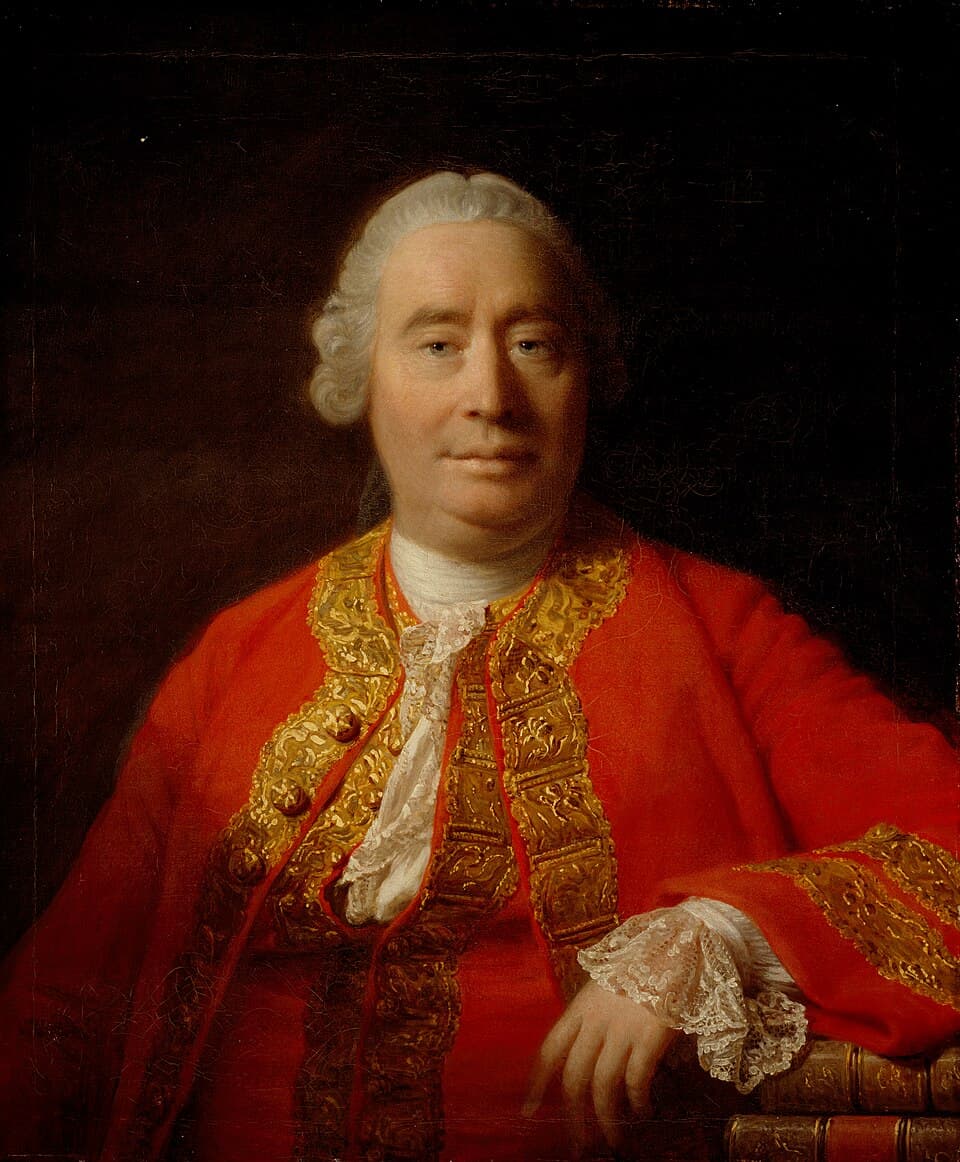
David Hume
An Enquiry Concerning Human Understanding

The author personifies Reason as being in a state of amazement and suspense, caught between the light of certainty and the darkness of the unknown.

...circle in infinitum, this angle of contact becomes still less, even in infinitum, and that the angle of contact between other curves and their tangents may be infinitely less than those between any circle and its tangent, and so on, in infinitum? The demonstration of these principles seems as unexceptionable as that which proves the three angles of a triangle to be equal to two right ones, though the latter opinion be natural and easy, and the former big with contradiction and absurdity.
Reason here seems to be thrown into a kind of amazement and suspence, which, without the suggestions of any sceptic, gives her a diffidence of herself, and of the ground on which she treads. She sees a full light, which illuminates certain places; but that light borders upon the most profound darkness. And between these she is so dazzled and confounded, that she scarcely can pronounce with certainty and assurance concerning any one object. Whatever disputes there may be about mathematical points, we must allow that there are physical points; that is, parts of extension, which cannot be divided or lessened, either by the eye or imagination.
These images, then, which are present to the fancy or senses, are absolutely indivisible, and consequently must be allowed by mathematicians to be infinitely less than any real part of extension; and yet nothing appears more certain to reason, than that an infinite number of them composes an infinite extension. How much more an infinite number of those infinitely small parts of extension, which are still supposed infinitely divisible. 125. The absurdity of these bol...
2
3 of 4 in Section XII, Part II190 of 198 in work
Time's Impossible Measure
David Hume
An Enquiry Concerning Human Understanding

The author expresses the intellectual restlessness and anxiety caused by the contradictions found in abstract concepts of time and space, which the human mind cannot fully reconcile.

...the eye or imagination. These images, then, which are present to the fancy or senses, are absolutely indivisible, and consequently must be allowed by mathematicians to be infinitely less than any real part of extension; and yet nothing appears more certain to reason, than that an infinite number of them composes an infinite extension. How much more an infinite number of those infinitely small parts of extension, which are still supposed infinitely divisible. 125.
The absurdity of these bold determinations of the abstract sciences seems to become, if possible, still more palpable with regard to time than extension. An infinite number of real parts of time, passing in succession, and exhausted one after another, appears so evident a contradiction, that no man, one should think, whose judgement is not corrupted, instead of being improved, by the sciences, would ever be able to admit of it. Yet still reason must remain restless, and unquiet, even with regard to that scepticism, to which she is driven by these seeming absurdities and contradictions. How any clear, distinct idea can contain circumstances,…
So that nothing can be more sceptical, or more full of doubt and hesitation, than this scepticism itself, which arises from some of the paradoxical conclusions of geometry or the science of quantity.[33] [33] It seems to me not impossible to avoid these absurdities and contradictions, if it be admitted, that there is no such thing as abstract or general ideas, properly speaking; but that all general ideas are, in reality, particular ones, attached to a general term, which r...
Continue reading →
2
4 of 4 in Section XII, Part II191 of 198 in work
Skepticism's Social Collapse
David Hume
An Enquiry Concerning Human Understanding

Hume offers a grim metaphorical insight into Pyrrhonian skepticism, suggesting its universal application would lead to the total cessation of human life.

...chief and most confounding objection to excessive scepticism, that no durable good can ever result from it; while it remains in its full force and vigour. We need only ask such a sceptic, What his meaning is? And what he proposes by all these curious researches? He is immediately at a loss, and knows not what to answer. A Copernican or Ptolemaic, who supports each his different system of astronomy, may hope to produce a conviction, which will remain constant and durable, with his audience.
A Stoic or Epicurean displays principles, which may not be durable, but which have an effect on conduct and behaviour. But a Pyrrhonian cannot expect, that his philosophy will have any constant influence on the mind: or if it had, that its influence would be beneficial to society. On the contrary, he must acknowledge, if he will acknowledge anything, that all human life must perish, were his principles universally and steadily to prevail. All discourse, all action would immediately cease; and men remain in a total lethargy, till the necessities of nature, unsatisfied, put an end to their miserable existence.
It is true; so fatal an event is very little to be dreaded. Nature is always too strong for principle. And though a Pyrrhonian may throw himself or others into a momentary amazement and confusion by his profound reasonings; the first and most trivial event in life will put to flight all his doubts and scruples, and leave him the same, in every point of action and speculation, with the philosophers of every other sect, or with those who never concerned themselves in any philosophical researches....
2
1 of 7 in Section XII, Part III192 of 198 in work
Now entering Section XII, Part III
Dogmatism's Impatient Certainty
David Hume
An Enquiry Concerning Human Understanding

The author observes the human tendency toward dogmatism and the psychological discomfort people feel when faced with hesitation or balanced arguments.

...gh they are not able, by their most diligent enquiry, to satisfy themselves concerning the foundation of these operations, or to remove the objections, which may be raised against them. PART III. 129. There is, indeed, a more mitigated scepticism or academical philosophy, which may be both durable and useful, and which may, in part, be the result of this Pyrrhonism, or excessive scepticism, when its undistinguished doubts are, in some measure, corrected by common sense and reflection.
The greater part of mankind are naturally apt to be affirmative and dogmatical in their opinions; and while they see objects only on one side, and have no idea of any counterpoising argument, they throw themselves precipitately into the principles, to which they are inclined; nor have they any indulgence for those who entertain opposite sentiments. To hesitate or balance perplexes their understanding, checks their passion, and suspends their action. They are, therefore, impatient till they escape from a state, which to them is so uneasy: and they think, that they could never remove themselves far enough from it, by the violence of their affirmations and obstinacy of their belief.
But could such dogmatical reasoners become sensible of the strange infirmities of human understanding, even in its most perfect state, and when most accurate and cautious in its determinations; such a reflection would naturally inspire them with more modesty and reserve, and diminish their fond opinion of themselves, and their prejudice against antagonists. The illiterate may reflect on the disposition of the learned, who, amidst all the advantages of study and reflection, are commonly still di...
2
2 of 7 in Section XII, Part III193 of 198 in work
Imagination vs Judgment
David Hume
An Enquiry Concerning Human Understanding

The author contrasts the wandering nature of the imagination with the disciplined method of judgment, which restricts itself to the realm of common life and experience.

...l perplexity and confusion, which is inherent in human nature. In general, there is a degree of doubt, and caution, and modesty, which, in all kinds of scrutiny and decision, ought for ever to accompany a just reasoner. 130. Another species of mitigated scepticism which may be of advantage to mankind, and which may be the natural result of the Pyrrhonian doubts and scruples, is the limitation of our enquiries to such subjects as are best adapted to the narrow capacity of human understanding.
The imagination of man is naturally sublime, delighted with whatever is remote and extraordinary, and running, without control, into the most distant parts of space and time in order to avoid the objects, which custom has rendered too familiar to it. A correct Judgement observes a contrary method, and avoiding all distant and high enquiries, confines itself to common life, and to such subjects as fall under daily practice and experience; leaving the more sublime topics to the embellishment of poets and orators, or to the arts of priests and politicians.
To bring us to so salutary a determination, nothing can be more serviceable, than to be once thoroughly convinced of the force of the Pyrrhonian doubt, and of the impossibility, that anything, but the strong power of natural instinct, could free us from it. Those who have a propensity to philosophy, will still continue their researches; because they reflect, that, besides the immediate pleasure, attending such an occupation, philosophical decisions are nothing but the reflections of common life...
6