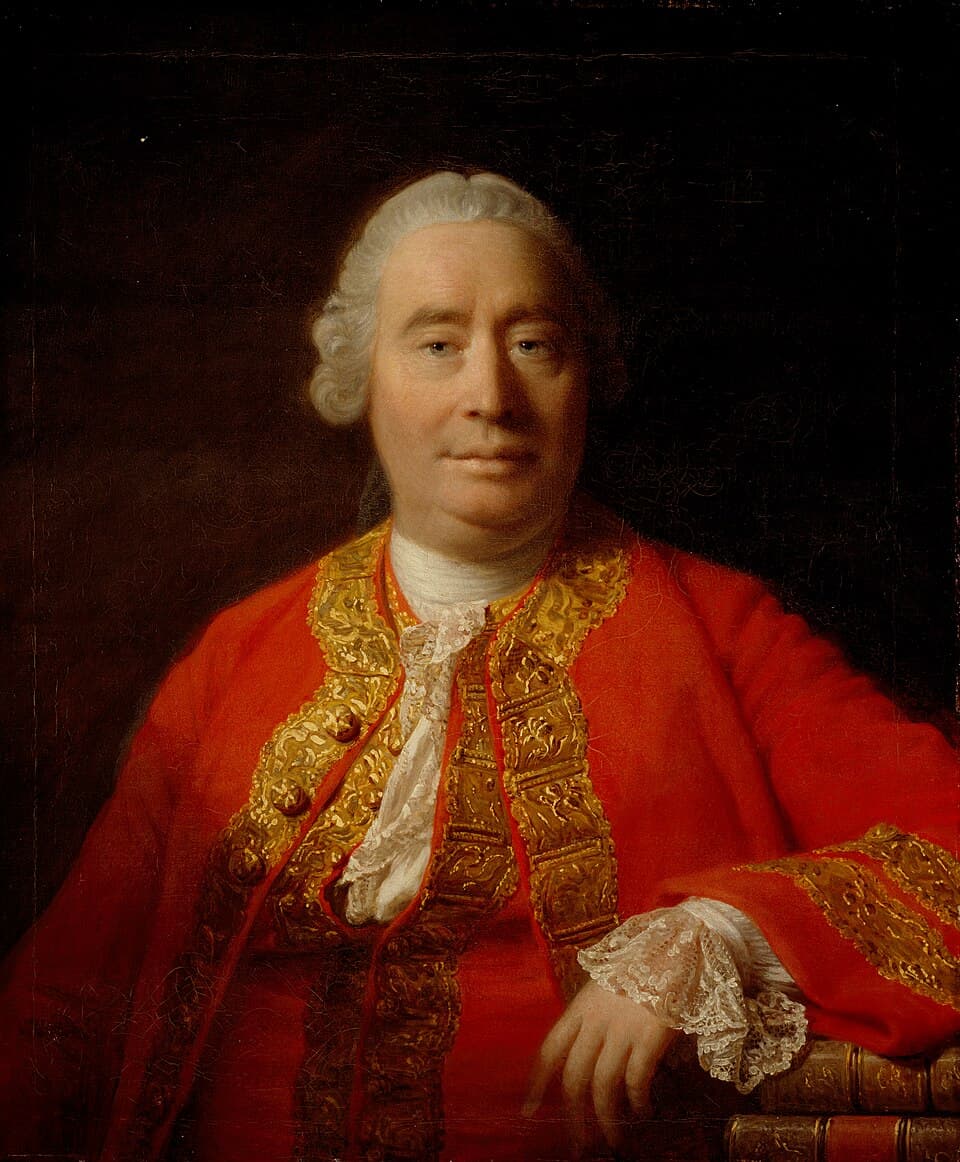
Hume defines belief in matters of fact as an instinctive operation of the mind caused by the customary conjunction of objects, rather than a purely rational deduction.
12 of 12 in Section V, Part I55 of 198 in work
Belief from Custom
David Hume
An Enquiry Concerning Human Understanding...ny particular matter of fact, which you relate, you must tell me some reason; and this reason will be some other fact, connected with it. But as you cannot proceed after this manner, in infinitum, you must at last terminate in some fact, which is present to your memory or senses; or must allow that your belief is entirely without foundation. 38. What, then, is the conclusion of the whole matter? A simple one; though, it must be confessed, pretty remote from the common theories of philosophy.
All belief of matter of fact or real existence is derived merely from some object, present to the memory or senses, and a customary conjunction between that and some other object. Or in other words; having found, in many instances, that any two kinds of objects--flame and heat, snow and cold--have always been conjoined together; if flame or snow be presented anew to the senses, the mind is carried by custom to expect heat or cold, and to believe that such a quality does exist, and will discover itself upon a nearer approach. This belief is the necessary result of placing the mind in such circumstances. It is an operation of the soul, when…
All these operations are a species of natural instincts, which no reasoning or process of the thought and understanding is able either to produce or to prevent. At this point, it would be very allowable for us to stop our philosophical researches. In most questions we can never make a single step farther; and in all questions we must terminate here at last, after our most restless and curious enquiries. But still our curiosity will be pardonable, perhaps commendable, if it carry us on to still...
Continue reading →
2
1 of 13 in Section V, Part II56 of 198 in work
Now entering Section V, Part II
⚖Belief's Elusive Difference

David Hume
An Enquiry Concerning Human UnderstandingThe author explores the limits of the imagination, noting that while it can freely combine ideas, it cannot account for the distinct feeling of belief.
...e customary conjunction, whence it is derived. By this means we may meet with some explications and analogies that will give satisfaction; at least to such as love the abstract sciences, and can be entertained with speculations, which, however accurate, may still retain a degree of doubt and uncertainty. As to readers of a different taste; the remaining part of this section is not calculated for them, and the following enquiries may well be understood, though it be neglected. PART II. 39.
Nothing is more free than the imagination of man; and though it cannot exceed that original stock of ideas furnished by the internal and external senses, it has unlimited power of mixing, compounding, separating, and dividing these ideas, in all the varieties of fiction and vision. It can feign a train of events, with all the appearance of reality, ascribe to them a particular time and place, conceive them as existent, and paint them out to itself with every circumstance, that belongs to any historical fact, which it believes with the greatest certainty. Wherein, therefore, consists the difference between such a fiction and belief? It lies…
We can, in our conception, join the head of a man to the body of a horse; but it is not in our power to believe that such an animal has ever really existed. It follows, therefore, that the difference between fiction and belief lies in some sentiment or feeling, which is annexed to the latter, not to the former, and which depends not on the will, nor can be commanded at pleasure. It must be excited by nature, like all other sentiments; and must arise from the particular situation, in which...
Continue reading →
4
2 of 13 in Section V, Part II57 of 198 in work
⚖Belief's Unwilled Feeling

David Hume
An Enquiry Concerning Human UnderstandingThe author defines belief as a specific sentiment or feeling triggered by custom that distinguishes real perceptions from mere imaginative fictions.
...ny peculiar idea, which is annexed to such a conception as commands our assent, and which is wanting to every known fiction. For as the mind has authority over all its ideas, it could voluntarily annex this particular idea to any fiction, and consequently be able to believe whatever it pleases; contrary to what we find by daily experience. We can, in our conception, join the head of a man to the body of a horse; but it is not in our power to believe that such an animal has ever really existed.
It follows, therefore, that the difference between fiction and belief lies in some sentiment or feeling, which is annexed to the latter, not to the former, and which depends not on the will, nor can be commanded at pleasure. It must be excited by nature, like all other sentiments; and must arise from the particular situation, in which the mind is placed at any particular juncture. Whenever any object is presented to the memory or senses, it immediately, by the force of custom, carries the imagination to conceive that object, which is usually conjoined to it; and this conception is attended with a feeling or sentiment, different from the…
For as there is no matter of fact which we believe so firmly that we cannot conceive the contrary, there would be no difference between the conception assented to and that which is rejected, were it not for some sentiment which distinguishes the one from the other. If I see a billiard-ball moving towards another, on a smooth table, I can easily conceive it to stop upon contact. This conception implies no contradiction; but still it feels very differently from that conception by which I represen...
Continue reading →
4
3 of 13 in Section V, Part II58 of 198 in work
⚖Belief as Vivid Conception

David Hume
An Enquiry Concerning Human UnderstandingThe author defines belief as a vivid and steady conception of an object that differs from fiction only in the manner of its feeling to the mind.
...r to define the feeling of cold or passion of anger, to a creature who never had any experience of these sentiments. Belief is the true and proper name of this feeling; and no one is ever at a loss to know the meaning of that term; because every man is every moment conscious of the sentiment represented by it. It may not, however, be improper to attempt a description of this sentiment; in hopes we may, by that means, arrive at some analogies, which may afford a more perfect explication of it.
I say, then, that belief is nothing but a more vivid, lively, forcible, firm, steady conception of an object, than what the imagination alone is ever able to attain. This variety of terms, which may seem so unphilosophical, is intended only to express that act of the mind, which renders realities, or what is taken for such, more present to us than fictions, causes them to weigh more in the thought, and gives them a superior influence on the passions and imagination. Provided we agree about the thing, it is needless to dispute about the terms. The imagination has the command over all its ideas, and can join and mix and vary them, in all the…
I confess, that it is impossible perfectly to explain this feeling or manner of conception. We may make use of words which express something near it. But its true and proper name, as we observed before, is belief; which is a term that every one sufficiently understands in common life. And in philosophy, we can go no farther than assert, that belief is something felt by the mind, which distinguishes the ideas of the judgement from the fictions of the imagination. It gives them more weight an...
Continue reading →
4
4 of 13 in Section V, Part II59 of 198 in work
⚖Belief's Governing Weight

David Hume
An Enquiry Concerning Human UnderstandingHume describes belief as a specific feeling or sentiment in the mind that distinguishes real judgments from mere imagination, giving them greater weight and emotional impact.
...lty of imagination can ever, of itself, reach belief, it is evident that belief consists not in the peculiar nature or order of ideas, but in the manner of their conception, and in their feeling to the mind. I confess, that it is impossible perfectly to explain this feeling or manner of conception. We may make use of words which express something near it. But its true and proper name, as we observed before, is belief; which is a term that every one sufficiently understands in common life.
And in philosophy, we can go no farther than assert, that belief is something felt by the mind, which distinguishes the ideas of the judgement from the fictions of the imagination. It gives them more weight and influence; makes them appear of greater importance; enforces them in the mind; and renders them the governing principle of our actions. I hear at present, for instance, a person's voice, with whom I am acquainted; and the sound comes as from the next room. This impression of my senses immediately conveys my thought to the person, together with all the surrounding objects. I paint them out to myself as existing at present, with the…
Let us, then, take in the whole compass of this doctrine, and allow, that the sentiment of belief is nothing but a conception more intense and steady than what attends the mere fictions of the imagination, and that this manner of conception arises from a customary conjunction of the object with something present to the memory or senses: I believe that it will not be difficult, upon these suppositions, to find other operations of the mind analogous to it, and to trace up these phenomena to pr...
Continue reading →
2