The author reflects on the inherent limitations of human inquiry, noting how quickly nature forces us to acknowledge our ignorance regarding ultimate causes.
2 of 16 in Section VII, Part I70 of 198 in work
Nature's Bar to Inquiry
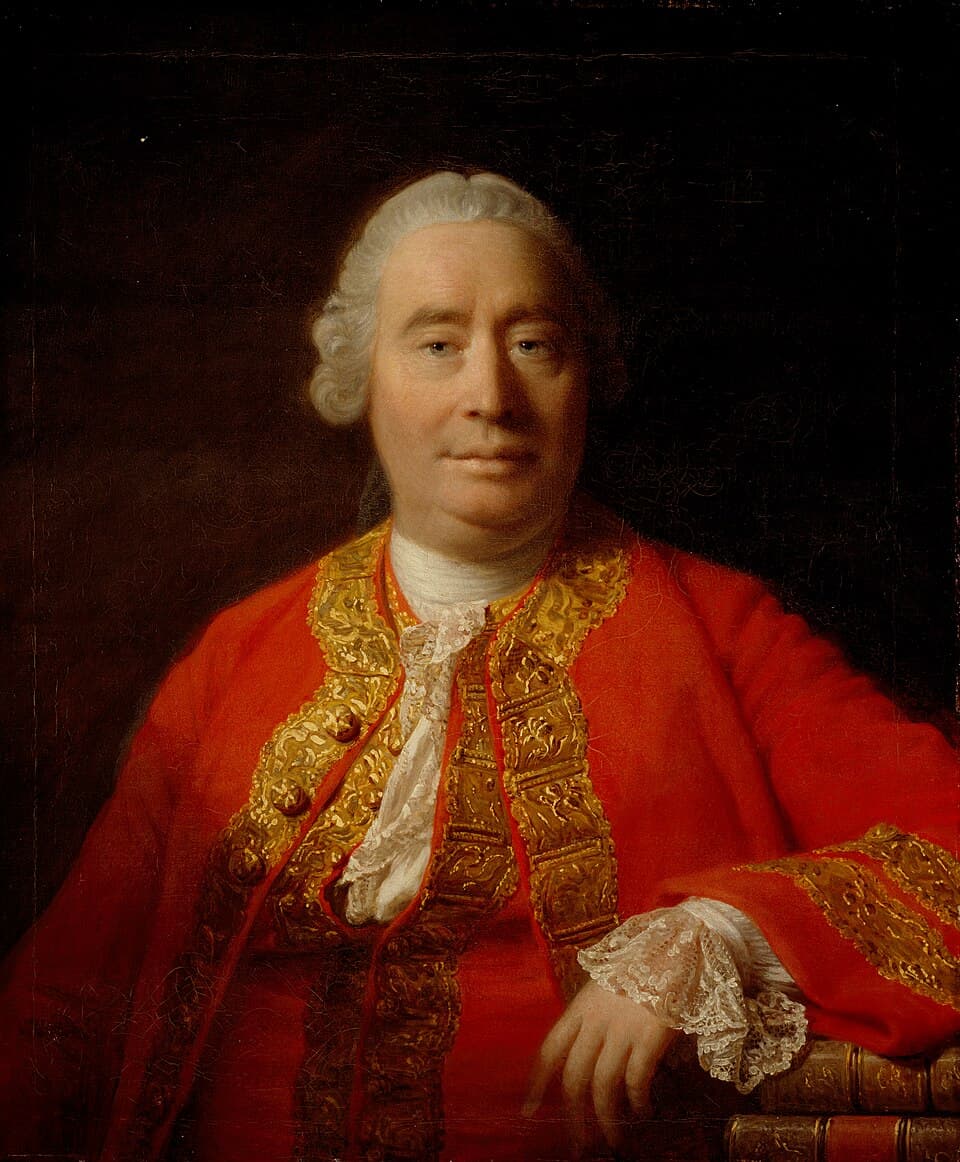
David Hume
An Enquiry Concerning Human Understanding...y reflection; nor is it in our power to recal the original object, as often as we have occasion to contemplate it. Ambiguity, by this means, is gradually introduced into our reasonings: Similar objects are readily taken to be the same: And the conclusion becomes at last very wide of the premises. One may safely, however, affirm, that, if we consider these sciences in a proper light, their advantages and disadvantages nearly compensate each other, and reduce both of them to a state of equality.
If the mind, with greater facility, retains the ideas of geometry clear and determinate, it must carry on a much longer and more intricate chain of reasoning, and compare ideas much wider of each other, in order to reach the abstruser truths of that science. And if moral ideas are apt, without extreme care, to fall into obscurity and confusion, the inferences are always much shorter in these disquisitions, and the intermediate steps, which lead to the conclusion, much fewer than in the sciences which treat of quantity and number. In reality, there is scarcely a proposition in Euclid so simple, as not to consist of more parts, than are to be…
The chief obstacle, therefore, to our improvement in the moral or metaphysical sciences is the obscurity of the ideas, and ambiguity of the terms. The principal difficulty in the mathematics is the length of inferences and compass of thought, requisite to the forming of any conclusion. And, perhaps, our progress in natural philosophy is chiefly retarded by the want of proper experiments and phaenomena, which are often discovered by chance, and cannot always be found, when requisite, even by the...
Continue reading →
2
3 of 16 in Section VII, Part I71 of 198 in work
⚖Ideas from Impressions

David Hume
An Enquiry Concerning Human UnderstandingThe author provides a methodological rule: to clarify obscure philosophical ideas, one must trace them back to the original impressions from which they were copied.
...rmer, require superior care and capacity to be surmounted. 49. There are no ideas, which occur in metaphysics, more obscure and uncertain, than those of power, force, energy or necessary connexion, of which it is every moment necessary for us to treat in all our disquisitions. We shall, therefore, endeavour, in this section, to fix, if possible, the precise meaning of these terms, and thereby remove some part of that obscurity, which is so much complained of in this species of philosophy.
It seems a proposition, which will not admit of much dispute, that all our ideas are nothing but copies of our impressions, or, in other words, that it is impossible for us to think of any thing, which we have not antecedently felt, either by our external or internal senses. I have endeavoured to explain and prove this proposition, and have expressed my hopes, that, by a proper application of it, men may reach a greater clearness and precision in philosophical reasonings, than what they have hitherto been able to attain. Complex ideas may, perhaps, be well known by definition, which is nothing but an enumeration of those parts or simple…
These impressions are all strong and sensible. They admit not of ambiguity. They are not only placed in a full light themselves, but may throw light on their correspondent ideas, which lie in obscurity. And by this means, we may, perhaps, attain a new microscope or species of optics, by which, in the moral sciences, the most minute, and most simple ideas may be so enlarged as to fall readily under our apprehension, and be equally known with the grossest and most sensible ideas, that can be the...
Continue reading →
2
4 of 16 in Section VII, Part I72 of 198 in work
⚖Causality's Hidden Mechanism

David Hume
An Enquiry Concerning Human UnderstandingThe author reiterates that our senses only observe the succession of events, never the underlying power or 'tie' that supposedly connects a cause to its effect.
...oral sciences, the most minute, and most simple ideas may be so enlarged as to fall readily under our apprehension, and be equally known with the grossest and most sensible ideas, that can be the object of our enquiry. [10] Section II. 50. To be fully acquainted, therefore, with the idea of power or necessary connexion, let us examine its impression; and in order to find the impression with greater certainty, let us search for it in all the sources, from which it may possibly be derived.
When we look about us towards external objects, and consider the operation of causes, we are never able, in a single instance, to discover any power or necessary connexion; any quality, which binds the effect to the cause, and renders the one an infallible consequence of the other. We only find, that the one does actually, in fact, follow the other. The impulse of one billiard-ball is attended with motion in the second. This is the whole that appears to the outward senses. The mind feels no sentiment or inward impression from this succession of objects: Consequently, there is not, in any single, particular instance of cause and effect,…
From the first appearance of an object, we never can conjecture what effect will result from it. But were the power or energy of any cause discoverable by the mind, we could foresee the effect, even without experience; and might, at first, pronounce with certainty concerning it, by mere dint of thought and reasoning. In reality, there is no part of matter, that does ever, by its sensible qualities, discover any power or energy, or give us ground to imagine, that it could produce any thing, or...
Continue reading →
2
5 of 16 in Section VII, Part I73 of 198 in work
⚖The Hidden Power

David Hume
An Enquiry Concerning Human UnderstandingThe author maintains that the actual power or force connecting causes to effects is entirely concealed from our senses and cannot be discovered in the objects themselves.
...s succession of objects: Consequently, there is not, in any single, particular instance of cause and effect, any thing which can suggest the idea of power or necessary connexion. From the first appearance of an object, we never can conjecture what effect will result from it. But were the power or energy of any cause discoverable by the mind, we could foresee the effect, even without experience; and might, at first, pronounce with certainty concerning it, by mere dint of thought and reasoning.
In reality, there is no part of matter, that does ever, by its sensible qualities, discover any power or energy, or give us ground to imagine, that it could produce any thing, or be followed by any other object, which we could denominate its effect. Solidity, extension, motion; these qualities are all complete in themselves, and never point out any other event which may result from them. The scenes of the universe are continually shifting, and one object follows another in an uninterrupted succession; but the power of force, which actuates the whole machine, is entirely concealed from us, and never discovers itself in any of the sensible…
Locke, in his chapter of power, says that, finding from experience, that there are several new productions in nature, and concluding that there must somewhere be a power capable of producing them, we arrive at last by this reasoning at the idea of power. But no reasoning can ever give us a new, original, simple idea; as this philosopher himself confesses. This, therefore, can never be the origin of that idea. 51. Since, therefore, external objects as they appear to the...
Continue reading →
2
6 of 16 in Section VII, Part I74 of 198 in work
⚖Will's Mysterious Power

David Hume
An Enquiry Concerning Human UnderstandingHume reflects on the mysterious and incomprehensible nature of the connection between the spiritual will and the material body, likening it to a magical power.
...hich is exercised by will, both over the organs of the body and faculties of the soul. 52. We shall proceed to examine this pretension; and first with regard to the influence of volition over the organs of the body. This influence, we may observe, is a fact, which, like all other natural events, can be known only by experience, and can never be foreseen from any apparent energy or power in the cause, which connects it with the effect, and renders the one an infallible consequence of the other.
The motion of our body follows upon the command of our will. Of this we are every moment conscious. But the means, by which this is effected; the energy, by which the will performs so extraordinary an operation; of this we are so far from being immediately conscious, that it must for ever escape our most diligent enquiry. For first; is there any principle in all nature more mysterious than the union of soul with body; by which a supposed spiritual substance acquires such an influence over a material one, that the most refined thought is able to actuate the grossest matter? Were we empowered, by a secret wish, to remove mountains, or control…
But if by consciousness we perceived any power or energy in the will, we must know this power; we must know its connexion with the effect; we must know the secret union of soul and body, and the nature of both these substances; by which the one is able to operate, in so many instances, upon the other. Secondly, We are not able to move all the organs of the body with a like authority; though we cannot assign any reason besides experience, for so remarkable a difference between one and the oth...
Continue reading →
2