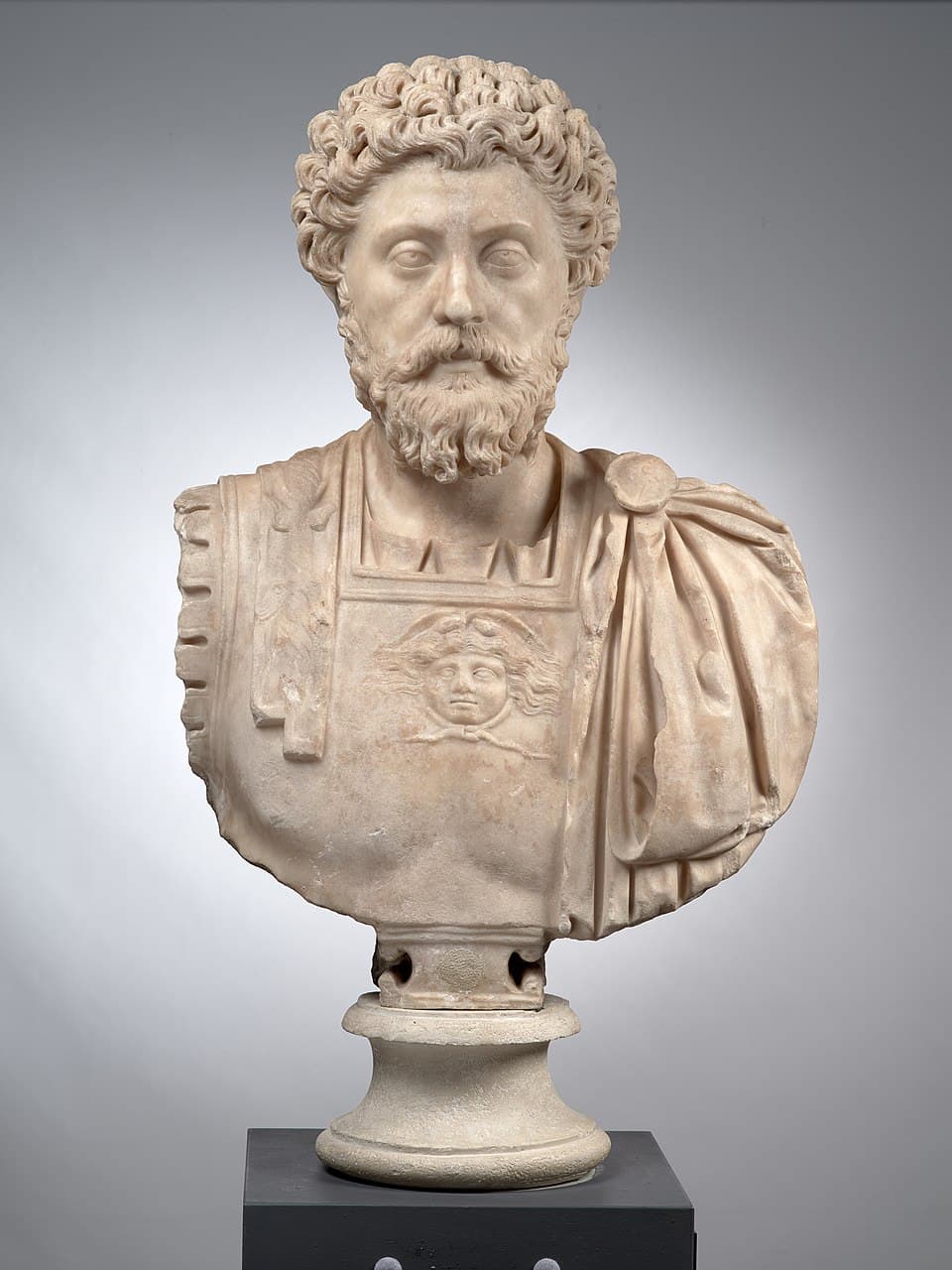
A personal defense of a life lived with integrity, where the author asserts his commitment to truth, generosity, and the cultivation of the mind over material wealth or social flattery.
2 of 6 in APPENDIX305 of 309 in work
A Life of Integrity
Marcus Aurelius
Meditations...d M. Caes., v. 19 [43] iv. 11 [44] De Nepote Amissa [45]'Many such sorrows has fortune visited me with all my life long. To pass by my other afflictions, I have lost five children under the most pitiful conditions possible: for the five I lost one by one when each was my only child, suffering these blows of bereavement in such a manner that each child was born to one already bereaved. Thus I ever lost my children without solace, and got them amidst fresh grief.....' [45] De Nepote Amissa 2
The letter continues with reflections on the nature of death, 'more to be rejoiced at than bewailed, the younger one dies,' and an arraignment of Providence not without dignity, wrung from him as it were by this last culminating misfortune. It concludes with a summing-up of his life in protest against the blow which has fallen on his grey head. 'Through my long life I have committed nothing which might bring dishonour, or disgrace, or shame: no deed of avarice or treachery have I done in all my day's: nay, but much generosity, much kindness, much truth and faithfulness have I shown, often at the risk of my own life. I have lived in amity with…
No one by proving to be ungrateful has made me more slow to bestow promptly all benefits I could give, nor have I ever been harsh to ingratitude. (A fragmentary passage follows, in which he appears to speak of his desire for a peaceful end, and the desolation of his house.) I have suffered long and painful sickness, my beloved Marcus. Then I was visited by pitiful misfortunes: my wife I have lost, my grandson I have lost in Germany:[46] woe is me! I have lost my Decimanus. If I were made of iro...
Continue reading →
2
3 of 6 in APPENDIX306 of 309 in work
⚖The Unbroken Moral Thread

Marcus Aurelius
MeditationsA confession of a life dedicated to public service and personal virtue, emphasizing the author's refusal to be corrupted by avarice, treachery, or the ingratitude of others.
...h child was born to one already bereaved. Thus I ever lost my children without solace, and got them amidst fresh grief.....' [45] De Nepote Amissa 2 The letter continues with reflections on the nature of death, 'more to be rejoiced at than bewailed, the younger one dies,' and an arraignment of Providence not without dignity, wrung from him as it were by this last culminating misfortune. It concludes with a summing-up of his life in protest against the blow which has fallen on his grey head.
'Through my long life I have committed nothing which might bring dishonour, or disgrace, or shame: no deed of avarice or treachery have I done in all my day's: nay, but much generosity, much kindness, much truth and faithfulness have I shown, often at the risk of my own life. I have lived in amity with my good brother, whom I rejoice to see in possession of the highest office by your father's goodness, and by your friendship at peace and perfect rest. The offices which I have myself obtained I never strove for by any underhand means. I have cultivated my mind rather than my body; the pursuit of learning I have preferred to increasing my…
(A fragmentary passage follows, in which he appears to speak of his desire for a peaceful end, and the desolation of his house.) I have suffered long and painful sickness, my beloved Marcus. Then I was visited by pitiful misfortunes: my wife I have lost, my grandson I have lost in Germany:[46] woe is me! I have lost my Decimanus. If I were made of iron, at this tine I could write no more.' [46] In the war against the Catti. It is noteworthy that in his Meditations Marcus Aurelius mentions F...
Continue reading →
2
4 of 6 in APPENDIX307 of 309 in work
⚖Virtue vs Vice

Marcus Aurelius
MeditationsA summary of Cynic philosophy which identifies virtue as the only good, while noting their rejection of social norms in favor of a crude state of nature.
.... of Attica. Comedy, ancient; a term applied to the Attic comedy of Aristophanes and his time, which criticised persons and politics, like a modern comic journal, such as Punck. See New Comedy. Compendious, short. Conceit, opinion. Contentation, contentment. Crates, a Cynic philosopher of the 4th century B.C. Crœsus, King of Lydia, proverbial for wealth; he reigned 560-546 B.C. Cynics, a school of philosophers, founded by Antisthenes. Their texts were a kind of caricature of Socraticism.
Nothing was good but virtue, nothing bad but vice. The Cynics repudiated all civil and social claims, and attempted to return to what they called a state of nature. Many of them were very disgusting in their manners.
DEMETRIUS of Phalerum, an Athenian orator, statesman, philosopher, and poet. Born 345 B.C. Democritus of Abdera (460-361 B.C.), celebrated as the 'laughing philosopher,' whose constant thought was 'What fools these mortals be.' He invented the Atomic Theory. Dio of Syracuse, a disciple of Plato, and afterwards tyrant of Syracuse. Murdered 353 B.C. Diogenes, the Cynic, born about 412 B.C., renowned for his rudeness and hardihood. Diognetus, a painter. Dispense with, put up with. Dogmata,...
6
5 of 6 in APPENDIX308 of 309 in work
⚖Suspension of Judgment

Marcus Aurelius
MeditationsAn overview of Scepticism as founded by Pyrrho, highlighting the doctrine of suspending judgment due to the relativity of knowledge.
...ntist, and moralist of the 6th century B.C. QUADI, a tribe of S. Germany. M. Aurelius carried on war against them, and part of this book was written in the field. RICTUS, gape, jaws. Rusticus, Q. Junius, or Stoic philosopher, twice made consul by M. Aurelius. SACRARY, shrine. Salaminius, Book 7, XXXVII. Leon of Sala-mis. Socrates was ordered by the Thirty Tyrants to fetch him before them, and Socrates, at his own peril, refused. Sarmatae, a tribe dwelling in Poland. Sceletum, skeleton.
Sceptics, a school of philosophy founded by Pyrrho (4th century B.C.). He advocated "suspension of judgment," and taught the relativity of knowledge and impossibility of proof. The school is not unlike the Agnostic school.
Scipio, the name of two great soldiers, P. Corn. Scipio Africanus, conqueror of Hannibal, and P. Corn. Sc. Afr. Minor, who came into the family by adoption, who destroyed Carthage. Secutoriani (a word coined by C.), the Sececutores, light-armed gladiators, who were pitted against others with net and trident. Sextus of Chaeronea, a Stoic philosopher, nephew of Plutarch. Silly, simple, common. Sinuessa, a town in Latium. Socrates, an Athenian philosopher (469-399 B.C.), founder of the dial...
6
6 of 6 in APPENDIX309 of 309 in work
⚖The Stoic Self-Sufficiency

Marcus Aurelius
MeditationsA summary of Stoic philosophy, defining its goal as living according to nature and emphasizing that virtue is the only good, while external circumstances are ultimately indifferent.
...or, who came into the family by adoption, who destroyed Carthage. Secutoriani (a word coined by C.), the Sececutores, light-armed gladiators, who were pitted against others with net and trident. Sextus of Chaeronea, a Stoic philosopher, nephew of Plutarch. Silly, simple, common. Sinuessa, a town in Latium. Socrates, an Athenian philosopher (469-399 B.C.), founder of the dialectic method. Put to death on a trumped-up charge by his countrymen. Stint, limit (without implying niggardliness).
Stoics, a philosophic system founded by Zeno (4th century B.C.), and systematised by Chrysippus (3rd century B.C.). Their physical theory was a pantheistic materialism, their summum bonum "to live according to nature." Their wise man needs nothing, he is sufficient to himself; virtue is good, vice bad, external things indifferent.
THEOPHRASTUS, a philosopher, pupil of Aristotle, and his successor as president of the Lyceum. He wrote a large number of works on philosophy and natural history. Died 287 B.C. Thrasea, P. Thrasea Pactus, a senator and Stoic philosopher, a noble and courageous man. He was condemned to death by Nero. Tiberius, 2nd Roman Emperor (14-31 AD.). He spent the latter part of his life at Capreae (Capri), off Naples, in luxury or debauchery, neglecting his imperial duties. To-torn, torn to pieces. T...
6