The author explains the metaphysical relationship between formless matter and time, arguing that while matter is logically prior to form, it does not necessarily precede it in a temporal sense.
34 of 35 in Book XII372 of 415 in work
Formless Matter's Paradox
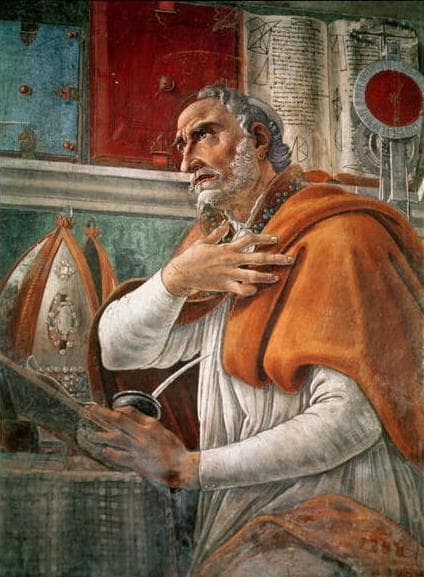
Augustine of Hippo
Confessions...re, through any power it hath to make it a tune; for a sound is no way the workmaster of the tune; but is something corporeal, subjected to the soul which singeth, whereof to make a tune. Nor is it first in time; for it is given forth together with the tune; nor first in choice, for a sound is not better than a tune, a tune being not only a sound, but a beautiful sound. But it is first in original, because a tune receives not form to become a sound, but a sound receives a form to become a tune.
By this example, let him that is able, understand how the matter of things was first made, and called heaven and earth, because heaven and earth were made out of it. Yet was it not made first in time; because the forms of things give rise to time; but that was without form, but now is, in time, an object of sense together with its form. And yet nothing can be related of that matter, but as though prior in time, whereas in value it is last (because things formed are superior to things without form) and is preceded by the Eternity of the Creator: that so there might be out of nothing, whereof somewhat might be created.
In this diversity of the true opinions, let Truth herself produce concord. And our God have mercy upon us, that we may use the law lawfully, the end of the commandment, pure charity. By this if man demands of me, "which of these was the meaning of Thy servant Moses"; this were not the language of my Confessions, should I not confess unto Thee, "I know not"; and yet I know that those senses are true, those carnal ones excepted, of which I have spoken what seemed necessary. And even those hopefu...
5
35 of 35 in Book XII373 of 415 in work
⚖The Multiplicity of Truth

Augustine of Hippo
ConfessionsThe author argues for a pluralistic interpretation of Scripture, suggesting that a single text can contain multiple true meanings intended by God.
...h few words a copious meaning. And all we who, I confess, see and express the truth delivered in those words, let us love one another, and jointly love Thee our God, the fountain of truth, if we are athirst for it, and not for vanities; yea, let us so honour this Thy servant, the dispenser of this Scripture, full of Thy Spirit, as to believe that, when by Thy revelation he wrote these things, he intended that, which among them chiefly excels both for light of truth, and fruitfulness of profit.
So when one says, "Moses meant as I do"; and another, "Nay, but as I do," I suppose that I speak more reverently, "Why not rather as both, if both be true?" And if there be a third, or a fourth, yea if any other seeth any other truth in those words, why may not he be believed to have seen all these, through whom the One God hath tempered the holy Scriptures to the senses of many, who should see therein things true but divers? For I certainly (and fearlessly I speak it from my heart), that were I to indite any thing to have supreme authority, I should prefer so to write, that whatever truth any could apprehend on those matters, might be…
I will not therefore, O my God, be so rash, as not to believe, that Thou vouchsafedst as much to that great man. He without doubt, when he wrote those words, perceived and thought on what truth soever we have been able to find, yea and whatsoever we have not been able, nor yet are, but which may be found in them. Lastly, O Lord, who art God and not flesh and blood, if man did see less, could any thing be concealed from Thy good Spirit (who shall lead me into the land of uprightness), which Tho...
Continue reading →
5
1 of 42 in Book XIII374 of 415 in work
Now entering Book XIII
⚖God's Non-Needy Creation

Augustine of Hippo
ConfessionsThe author argues that God's creation of man was not due to any divine need or lack, but rather an act of fullness so that man might receive well-being from his Creator.
..., and be converted, and call upon Thee, that calledst after me; for Thou, Lord, blottedst out all my evil deservings, so as not to repay into my hands, wherewith I fell from Thee; and Thou hast prevented all my well deservings, so as to repay the work of Thy hands wherewith Thou madest me; because before I was, Thou wert; nor was I any thing, to which Thou mightest grant to be; and yet behold, I am, out of Thy goodness, preventing all this which Thou hast made me, and whereof Thou hast made me.
For neither hadst Thou need of me, nor am I any such good, as to be helpful unto Thee, my Lord and God; not in serving Thee, as though Thou wouldest tire in working; or lest Thy power might be less, if lacking my service: nor cultivating Thy service, as a land, that must remain uncultivated, unless I cultivated Thee: but serving and worshipping Thee, that I might receive a well-being from Thee, from whom it comes, that I have a being capable of well-being. For of the fulness of Thy goodness, doth Thy creature subsist, that so a good, which could no ways profit Thee, nor was of Thee (lest so it should be equal to Thee), might yet be since it…
For what did heaven and earth, which Thou madest in the Beginning, deserve of Thee? Let those spiritual and corporeal natures which Thou madest in Thy Wisdom, say wherein they deserved of Thee, to depend thereon (even in that their several inchoate and formless state, whether spiritual or corporeal, ready to fall away into an immoderate liberty and far-distant unlikeliness unto Thee;--the spiritual, though without form, superior to the corporeal though formed, and the corporeal though without f...
Continue reading →
3
2 of 42 in Book XIII375 of 415 in work
⚖The Turn from Light

Augustine of Hippo
ConfessionsThe author argues that for a created spirit, existence is distinct from wisdom, necessitating a constant turning toward God to avoid spiritual darkness.
...r deserve of Thee, to be even invisible and without form? seeing it were not even this, but that Thou madest it, and therefore because it was not, could not deserve of Thee to be made. Or how could the inchoate spiritual creature deserve of Thee, even to ebb and flow darksomely like the deep,--unlike Thee, unless it had been by the same Word turned to that, by Whom it was created, and by Him so enlightened, become light; though not equally, yet conformably to that Form which is equal unto Thee?
For as in a body, to be, is not one with being beautiful, else could it not be deformed; so likewise to a created spirit to live, is not one with living wisely; else should it be wise unchangeably. But good it is for it always to hold fast to Thee; lest what light it hath obtained by turning to Thee, it lose by turning from Thee, and relapse into life resembling the darksome deep. For we ourselves also, who as to the soul are a spiritual creature, turned away from Thee our light, were in that life sometimes darkness; and still labour amidst the relics of our darkness, until in Thy Only One we become Thy righteousness, like the mountains of…
For we have been Thy judgments, which are like the great deep. That which Thou saidst in the beginning of the creation, Let there be light, and there was light; I do, not unsuitably, understand of the spiritual creature: because there was already a sort of life, which Thou mightest illuminate. But as it had no claim on Thee for a life, which could be enlightened, so neither now that it was, had it any, to be enlightened. For neither could its formless estate be pleasing unto Thee, unless it be...
Continue reading →
4
3 of 42 in Book XIII376 of 415 in work
⚖Grace's Transforming Light

Augustine of Hippo
ConfessionsThe author explores the nature of God's grace and self-sufficiency, arguing that God's goodness and joy are complete in themselves and not dependent on the creation of other beings.
...l in Thy Only One we become Thy righteousness, like the mountains of God. For we have been Thy judgments, which are like the great deep. That which Thou saidst in the beginning of the creation, Let there be light, and there was light; I do, not unsuitably, understand of the spiritual creature: because there was already a sort of life, which Thou mightest illuminate. But as it had no claim on Thee for a life, which could be enlightened, so neither now that it was, had it any, to be enlightened.
For neither could its formless estate be pleasing unto Thee, unless it became light, and that not by existing simply, but by beholding the illuminating light, and cleaving to it; so that, that it lived, and lived happily, it owes to nothing but Thy grace, being turned by a better change unto That which cannot be changed into worse or better; which Thou alone art, because Thou alone simply art; unto Thee it being not one thing to live, another to live blessedly, seeing Thyself art Thine own Blessedness. What then could be wanting unto Thy good, which Thou Thyself art, although these things had either never been, or remained without form; which…
For to Thee being perfect, is their imperfection displeasing, and hence were they perfected by Thee, and please Thee; not as wert Thou imperfect, and by their perfecting wert also to be perfected. For Thy good Spirit indeed was borne over the waters, not borne up by them, as if He rested upon them. For those, on whom Thy good Spirit is said to rest, He causes to rest in Himself. But Thy incorruptible and unchangeable will, in itself all-sufficient for itself, was borne upon that life which Thou...
Continue reading →
2