14 of 21 in Book VI134 of 415 in work
Stuck in Tomorrow's Hope
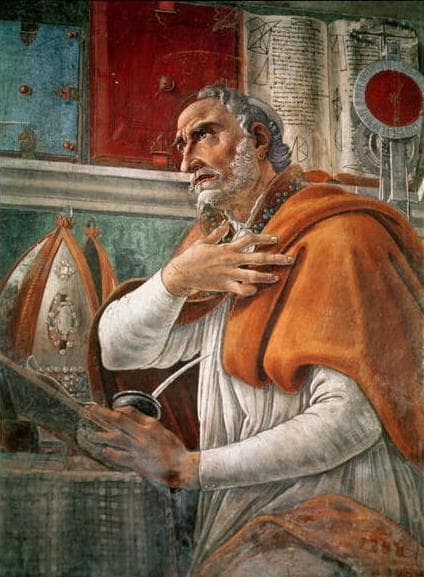
Augustine of Hippo
Confessions

A reflection on a decade of searching for wisdom while remaining stuck in worldly desires and the uncertainty of various philosophical schools.

...indigent persons, sighing out their wants one to another, and waiting upon Thee that Thou mightest give them their meat in due season. And in all the bitterness which by Thy mercy followed our worldly affairs, as we looked towards the end, why we should suffer all this, darkness met us; and we turned away groaning, and saying, How long shall these things be? This too we often said; and so saying forsook them not, for as yet there dawned nothing certain, which these forsaken, we might embrace.
And I, viewing and reviewing things, most wondered at the length of time from that my nineteenth year, wherein I had begun to kindle with the desire of wisdom, settling when I had found her, to abandon all the empty hopes and lying frenzies of vain desires. And lo, I was now in my thirtieth year, sticking in the same mire, greedy of enjoying things present, which passed away and wasted my soul; while I said to myself, "Tomorrow I shall find it; it will appear manifestly and I shall grasp it; lo, Faustus the Manichee will come, and clear every thing! O you great men, ye Academicians, it is true then, that no certainty can be attained for the…
Lo, things in the ecclesiastical books are not absurd to us now, which sometimes seemed absurd, and may be otherwise taken, and in a good sense. I will take my stand, where, as a child, my parents placed me, until the clear truth be found out. But where shall it be sought or when? Ambrose has no leisure; we have no leisure to read; where shall we find even the books? Whence, or when procure them? from whom borrow them? Let set times be appointed, and certain hours be ordered for the health of o...
Continue reading →
2
15 of 21 in Book VI135 of 415 in work
The Urgency of Truth
Augustine of Hippo
Confessions

The author urges the abandonment of worldly vanities and the pursuit of truth, arguing that the certainty of death and the hope of the soul's immortality necessitate a total commitment to God.

...he Catholic Faith teaches not what we thought, and vainly accused it of; her instructed members hold it profane to believe God to be bounded by the figure of a human body: and do we doubt to 'knock,' that the rest 'may be opened'? The forenoons our scholars take up; what do we during the rest? Why not this? But when then pay we court to our great friends, whose favour we need? When compose what we may sell to scholars? When refresh ourselves, unbending our minds from this intenseness of care?
"Perish every thing, dismiss we these empty vanities, and betake ourselves to the one search for truth! Life is vain, death uncertain; if it steals upon us on a sudden, in what state shall we depart hence? and where shall we learn what here we have neglected? and shall we not rather suffer the punishment of this negligence? What, if death itself cut off and end all care and feeling? Then must this be ascertained. But God forbid this! It is no vain and empty thing, that the excellent dignity of the authority of the Christian Faith hath overspread the whole world. Never would such and so great things be by God wrought for us, if with the death…
But wait! Even those things are pleasant; they have some, and no small sweetness. We must not lightly abandon them, for it were a shame to return again to them. See, it is no great matter now to obtain some station, and then what should we more wish for? We have store of powerful friends; if nothing else offer, and we be in much haste, at least a presidentship may be given us: and a wife with some money, that she increase not our charges: and this shall be the bound of desire. Many great men, a...
Continue reading →
4
16 of 21 in Book VI136 of 415 in work
Fleeing from Happiness
Augustine of Hippo
Confessions

The author reflects on his internal procrastination and the paradox of fearing the very happiness he was seeking.

...abandon them, for it were a shame to return again to them. See, it is no great matter now to obtain some station, and then what should we more wish for? We have store of powerful friends; if nothing else offer, and we be in much haste, at least a presidentship may be given us: and a wife with some money, that she increase not our charges: and this shall be the bound of desire. Many great men, and most worthy of imitation, have given themselves to the study of wisdom in the state of marriage."
While I went over these things, and these winds shifted and drove my heart this way and that, time passed on, but I delayed to turn to the Lord; and from day to day deferred to live in Thee, and deferred not daily to die in myself. Loving a happy life, I feared it in its own abode, and sought it, by fleeing from it.
I thought I should be too miserable, unless folded in female arms; and of the medicine of Thy mercy to cure that infirmity I thought not, not having tried it. As for continency, I supposed it to be in our own power (though in myself I did not find that power), being so foolish as not to know what is written, None can be continent unless Thou give it; and that Thou wouldest give it, if with inward groanings I did knock at Thine ears, and with a settled faith did cast my care on Thee. Alypius in...
2
17 of 21 in Book VI137 of 415 in work
Continency's Divine Source
Augustine of Hippo
Confessions

The author argues that human self-control is not an inherent power but a gift from God that must be requested through faith.

...e state of marriage." While I went over these things, and these winds shifted and drove my heart this way and that, time passed on, but I delayed to turn to the Lord; and from day to day deferred to live in Thee, and deferred not daily to die in myself. Loving a happy life, I feared it in its own abode, and sought it, by fleeing from it. I thought I should be too miserable, unless folded in female arms; and of the medicine of Thy mercy to cure that infirmity I thought not, not having tried it.
As for continency, I supposed it to be in our own power (though in myself I did not find that power), being so foolish as not to know what is written, None can be continent unless Thou give it; and that Thou wouldest give it, if with inward groanings I did knock at Thine ears, and with a settled faith did cast my care on Thee.
Alypius indeed kept me from marrying; alleging that so could we by no means with undistracted leisure live together in the love of wisdom, as we had long desired. For himself was even then most pure in this point, so that it was wonderful; and that the more, since in the outset of his youth he had entered into that course, but had not stuck fast therein; rather had he felt remorse and revolting at it, living thenceforth until now most continently. But I opposed him with the examples of those w...
3
18 of 21 in Book VI138 of 415 in work
The Sweet Chain
Augustine of Hippo
Confessions

The author describes his psychological resistance to spiritual liberation, comparing his attachment to vice to a chain and a wound he feared to have healed.

...he love of wisdom, as we had long desired. For himself was even then most pure in this point, so that it was wonderful; and that the more, since in the outset of his youth he had entered into that course, but had not stuck fast therein; rather had he felt remorse and revolting at it, living thenceforth until now most continently. But I opposed him with the examples of those who as married men had cherished wisdom, and served God acceptably, and retained their friends, and loved them faithfully.
Of whose greatness of spirit I was far short; and bound with the disease of the flesh, and its deadly sweetness, drew along my chain, dreading to be loosed, and as if my wound had been fretted, put back his good persuasions, as it were the hand of one that would unchain me.
Moreover, by me did the serpent speak unto Alypius himself, by my tongue weaving and laying in his path pleasurable snares, wherein his virtuous and free feet might be entangled. For when he wondered that I, whom he esteemed not slightly, should stick so fast in the birdlime of that pleasure, as to protest (so oft as we discussed it) that I could never lead a single life; and urged in my defence when I saw him wonder, that there was great difference between his momentary and scarce-remembered...
2