24 of 25 in Book I24 of 415 in work
Sins' Mature Transfer
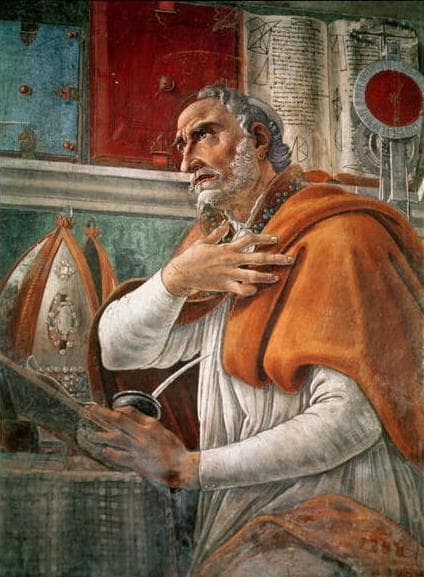
Augustine of Hippo
Confessions

Augustine reflects on the transition from childhood sins to adult vices, while thanking God for the inherent instincts and senses granted to him in his youth.

...that I might have to give to boys, who sold me their play, which all the while they liked no less than I. In this play, too, I often sought unfair conquests, conquered myself meanwhile by vain desire of preeminence. And what could I so ill endure, or, when I detected it, upbraided I so fiercely, as that I was doing to others? and for which if, detected, I was upbraided, I chose rather to quarrel than to yield. And is this the innocence of boyhood? Not so, Lord, not so; I cry Thy mercy, my God.
For these very sins, as riper years succeed, these very sins are transferred from tutors and masters, from nuts and balls and sparrows, to magistrates and kings, to gold and manors and slaves, just as severer punishments displace the cane. It was the low stature then of childhood which Thou our King didst commend as an emblem of lowliness, when Thou saidst, Of such is the kingdom of heaven. Yet, Lord, to Thee, the Creator and Governor of the universe, most excellent and most good, thanks were due to Thee our God, even hadst Thou destined for me boyhood only. For even then I was, I lived, and felt; and had an implanted providence over my…
In so small a creature, what was not wonderful, not admirable? But all are gifts of my God: it was not I who gave them me; and good these are, and these together are myself. Good, then, is He that made me, and He is my good; and before Him will I exult for every good which of a boy I had. For it was my sin, that not in Him, but in His creatures--myself and others--I sought for pleasures, sublimities, truths, and so fell headlong into sorrows, confusions, errors. Thanks be to Thee, my joy and my...
Continue reading →
2
25 of 25 in Book I25 of 415 in work
Gifts from God
Augustine of Hippo
Confessions

Augustine expresses gratitude for his innate faculties while admitting the sin of seeking fulfillment in worldly pleasures rather than in God.

...to Thee our God, even hadst Thou destined for me boyhood only. For even then I was, I lived, and felt; and had an implanted providence over my well-being--a trace of that mysterious Unity whence I was derived; I guarded by the inward sense the entireness of my senses, and in these minute pursuits, and in my thoughts on things minute, I learnt to delight in truth, I hated to be deceived, had a vigorous memory, was gifted with speech, was soothed by friendship, avoided pain, baseness, ignorance.
In so small a creature, what was not wonderful, not admirable? But all are gifts of my God: it was not I who gave them me; and good these are, and these together are myself. Good, then, is He that made me, and He is my good; and before Him will I exult for every good which of a boy I had. For it was my sin, that not in Him, but in His creatures--myself and others--I sought for pleasures, sublimities, truths, and so fell headlong into sorrows, confusions, errors. Thanks be to Thee, my joy and my glory and my confidence, my God, thanks be to Thee for Thy gifts; but do Thou preserve them to me.
For so wilt Thou preserve me, and those things shall be enlarged and perfected which Thou hast given me, and I myself shall be with Thee, since even to be Thou hast given me. BOOK II I will now call to mind my past foulness, and the carnal corruptions of my soul; not because I love them, but that I may love Thee, O my God. For love of Thy love I do it; reviewing my most wicked ways in the very bitterness of my remembrance, that Thou mayest grow sweet unto me (Thou sweetness never failing,...
2
1 of 17 in Book II26 of 415 in work
Now entering Book II
Love Through Memory
Augustine of Hippo
Confessions

Augustine explains that he recalls his past sins not out of love for them, but as a way to heighten his love for God and find unity after being 'torn piecemeal' by worldly things.

.... For it was my sin, that not in Him, but in His creatures--myself and others--I sought for pleasures, sublimities, truths, and so fell headlong into sorrows, confusions, errors. Thanks be to Thee, my joy and my glory and my confidence, my God, thanks be to Thee for Thy gifts; but do Thou preserve them to me. For so wilt Thou preserve me, and those things shall be enlarged and perfected which Thou hast given me, and I myself shall be with Thee, since even to be Thou hast given me. BOOK II
I will now call to mind my past foulness, and the carnal corruptions of my soul; not because I love them, but that I may love Thee, O my God. For love of Thy love I do it; reviewing my most wicked ways in the very bitterness of my remembrance, that Thou mayest grow sweet unto me (Thou sweetness never failing, Thou blissful and assured sweetness); and gathering me again out of that my dissipation, wherein I was torn piecemeal, while turned from Thee, the One Good, I lost myself among a multiplicity of things.
For I even burnt in my youth heretofore, to be satiated in things below; and I dared to grow wild again, with these various and shadowy loves: my beauty consumed away, and I stank in Thine eyes; pleasing myself, and desirous to please in the eyes of men. And what was it that I delighted in, but to love, and be loved? but I kept not the measure of love, of mind to mind, friendship's bright boundary: but out of the muddy concupiscence of the flesh, and the bubblings of youth, mists fumed up whic...
2
2 of 17 in Book II27 of 415 in work
Love's Clouded Boundary
Augustine of Hippo
Confessions

The author laments his youthful inability to distinguish between virtuous love and lustful desire, describing his past state as a 'gulf of flagitiousnesses'.

...t unto me (Thou sweetness never failing, Thou blissful and assured sweetness); and gathering me again out of that my dissipation, wherein I was torn piecemeal, while turned from Thee, the One Good, I lost myself among a multiplicity of things. For I even burnt in my youth heretofore, to be satiated in things below; and I dared to grow wild again, with these various and shadowy loves: my beauty consumed away, and I stank in Thine eyes; pleasing myself, and desirous to please in the eyes of men.
And what was it that I delighted in, but to love, and be loved? but I kept not the measure of love, of mind to mind, friendship's bright boundary: but out of the muddy concupiscence of the flesh, and the bubblings of youth, mists fumed up which beclouded and overcast my heart, that I could not discern the clear brightness of love from the fog of lustfulness. Both did confusedly boil in me, and hurried my unstayed youth over the precipice of unholy desires, and sunk me in a gulf of flagitiousnesses. Thy wrath had gathered over me, and I knew it not.
I was grown deaf by the clanking of the chain of my mortality, the punishment of the pride of my soul, and I strayed further from Thee, and Thou lettest me alone, and I was tossed about, and wasted, and dissipated, and I boiled over in my fornications, and Thou heldest Thy peace, O Thou my tardy joy! Thou then heldest Thy peace, and I wandered further and further from Thee, into more and more fruitless seed-plots of sorrows, with a proud dejectedness, and a restless weariness. Oh! that some on...
2
3 of 17 in Book II28 of 415 in work
Sorrow's Healing Wound
Augustine of Hippo
Confessions

The author uses the metaphor of bitter alloys and healing wounds to describe how God uses suffering to redirect the soul toward pure pleasure.

...at is unmarried thinketh of the things of the Lord, how he may please the Lord; but he that is married careth for the things of this world, how he may please his wife. To these words I should have listened more attentively, and being severed for the kingdom of heaven's sake, had more happily awaited Thy embraces; but I, poor wretch, foamed like a troubled sea, following the rushing of my own tide, forsaking Thee, and exceeded all Thy limits; yet I escaped not Thy scourges. For what mortal can?
For Thou wert ever with me mercifully rigorous, and besprinkling with most bitter alloy all my unlawful pleasures: that I might seek pleasures without alloy. But where to find such, I could not discover, save in Thee, O Lord, who teachest by sorrow, and woundest us, to heal; and killest us, lest we die from Thee.
Where was I, and how far was I exiled from the delights of Thy house, in that sixteenth year of the age of my flesh, when the madness of lust (to which human shamelessness giveth free licence, though unlicensed by Thy laws) took the rule over me, and I resigned myself wholly to it? My friends meanwhile took no care by marriage to save my fall; their only care was that I should learn to speak excellently, and be a persuasive orator. For that year were my studies intermitted: whilst after my ret...
1