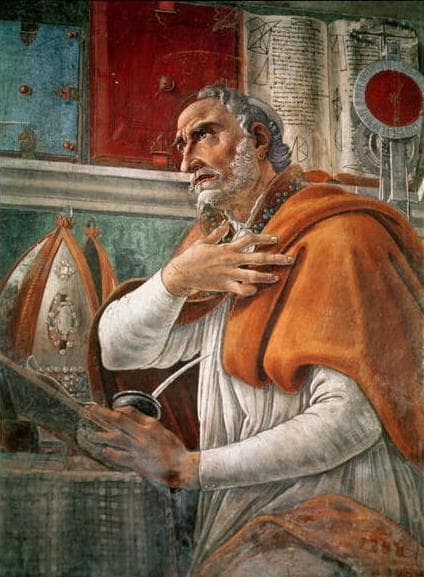
A metaphysical claim that created things possess a middle state of being, existing only because they come from God, who is the only truly unchangeable reality.
16 of 28 in Book VII157 of 415 in work
Being from God
Augustine of Hippo
Confessions...shalt be converted into Me." And I learned, that Thou for iniquity chastenest man, and Thou madest my soul to consume away like a spider. And I said, "Is Truth therefore nothing because it is not diffused through space finite or infinite?" And Thou criedst to me from afar: "Yet verily, I AM that I AM." And I heard, as the heart heareth, nor had I room to doubt, and I should sooner doubt that I live than that Truth is not, which is clearly seen, being understood by those things which are made.
And I beheld the other things below Thee, and I perceived that they neither altogether are, nor altogether are not, for they are, since they are from Thee, but are not, because they are not what Thou art. For that truly is which remains unchangeably. It is good then for me to hold fast unto God; for if I remain not in Him, I cannot in myself; but He remaining in Himself, reneweth all things. And Thou art the Lord my God, since Thou standest not in need of my goodness.
And it was manifested unto me, that those things be good which yet are corrupted; which neither were they sovereignly good, nor unless they were good could be corrupted: for if sovereignly good, they were incorruptible, if not good at all, there were nothing in them to be corrupted. For corruption injures, but unless it diminished goodness, it could not injure. Either then corruption injures not, which cannot be; or which is most certain, all which is corrupted is deprived of good. But if they...
2
17 of 28 in Book VII158 of 415 in work
⚖Corruption as Deprivation

Augustine of Hippo
ConfessionsThe author presents a logical proof regarding the nature of evil, arguing that for something to be corrupted it must first be good, and that total deprivation of good results in non-existence.
...e things which are made. And I beheld the other things below Thee, and I perceived that they neither altogether are, nor altogether are not, for they are, since they are from Thee, but are not, because they are not what Thou art. For that truly is which remains unchangeably. It is good then for me to hold fast unto God; for if I remain not in Him, I cannot in myself; but He remaining in Himself, reneweth all things. And Thou art the Lord my God, since Thou standest not in need of my goodness.
And it was manifested unto me, that those things be good which yet are corrupted; which neither were they sovereignly good, nor unless they were good could be corrupted: for if sovereignly good, they were incorruptible, if not good at all, there were nothing in them to be corrupted. For corruption injures, but unless it diminished goodness, it could not injure. Either then corruption injures not, which cannot be; or which is most certain, all which is corrupted is deprived of good. But if they be deprived of all good, they shall cease to be. For if they shall be, and can now no longer be corrupted, they shall be better than before, because they shall abide incorruptibly.
And what more monstrous than to affirm things to become better by losing all their good? Therefore, if they shall be deprived of all good, they shall no longer be. So long therefore as they are, they are good: therefore whatsoever is, is good. That evil then which I sought, whence it is, is not any substance: for were it a substance, it should be good. For either it should be an incorruptible substance, and so a chief good: or a corruptible substance; which unless it were good, could not be cor...
6
18 of 28 in Book VII159 of 415 in work
⚖Evil's Non-Substance

Augustine of Hippo
ConfessionsThe author argues that evil is not a substance but a privation, asserting that all created substances are inherently good because they were made by God.
...h is most certain, all which is corrupted is deprived of good. But if they be deprived of all good, they shall cease to be. For if they shall be, and can now no longer be corrupted, they shall be better than before, because they shall abide incorruptibly. And what more monstrous than to affirm things to become better by losing all their good? Therefore, if they shall be deprived of all good, they shall no longer be. So long therefore as they are, they are good: therefore whatsoever is, is good.
That evil then which I sought, whence it is, is not any substance: for were it a substance, it should be good. For either it should be an incorruptible substance, and so a chief good: or a corruptible substance; which unless it were good, could not be corrupted. I perceived therefore, and it was manifested to me that Thou madest all things good, nor is there any substance at all, which Thou madest not; and for that Thou madest not all things equal, therefore are all things; because each is good, and altogether very good, because our God made all things very good.
And to Thee is nothing whatsoever evil: yea, not only to Thee, but also to Thy creation as a whole, because there is nothing without, which may break in, and corrupt that order which Thou hast appointed it. But in the parts thereof some things, because unharmonising with other some, are accounted evil: whereas those very things harmonise with others, and are good; and in themselves are good. And all these things which harmonise not together, do yet with the inferior part, which we call Earth,...
2
19 of 28 in Book VII160 of 415 in work
⚖Creation's Displeasure

Augustine of Hippo
ConfessionsThe author describes his past errors in conceiving God as a physical substance and his eventual spiritual awakening to God's true infinite nature.
...men and maidens, old men and young, praise Thy Name. But when, from heaven, these praise Thee, praise Thee, our God, in the heights all Thy angels, all Thy hosts, sun and moon, all the stars and light, the Heaven of heavens, and the waters that be above the heavens, praise Thy Name; I did not now long for things better, because I conceived of all: and with a sounder judgment I apprehended that the things above were better than these below, but altogether better than those above by themselves.
There is no soundness in them, whom aught of Thy creation displeaseth: as neither in me, when much which Thou hast made, displeased me. And because my soul durst not be displeased at my God, it would fain not account that Thine, which displeased it. Hence it had gone into the opinion of two substances, and had no rest, but talked idly. And returning thence, it had made to itself a God, through infinite measures of all space; and thought it to be Thee, and placed it in its heart; and had again become the temple of its own idol, to Thee abominable. But after Thou hadst soothed my head, unknown to me, and closed mine eyes that they should not…
And I looked back on other things; and I saw that they owed their being to Thee; and were all bounded in Thee: but in a different way; not as being in space; but because Thou containest all things in Thine hand in Thy Truth; and all things are true so far as they nor is there any falsehood, unless when that is thought to be, which is not. And I saw that all things did harmonise, not with their places only, but with their seasons. And that Thou, who only art Eternal, didst not begin to work aft...
Continue reading →
2
20 of 28 in Book VII161 of 415 in work
⚖Perception's Relativity

Augustine of Hippo
ConfessionsThe author posits that the perceived 'evil' in God's creation is actually a matter of subjective unfitness or the observer's own spiritual sickness.
...u containest all things in Thine hand in Thy Truth; and all things are true so far as they nor is there any falsehood, unless when that is thought to be, which is not. And I saw that all things did harmonise, not with their places only, but with their seasons. And that Thou, who only art Eternal, didst not begin to work after innumerable spaces of times spent; for that all spaces of times, both which have passed, and which shall pass, neither go nor come, but through Thee, working and abiding.
And I perceived and found it nothing strange, that bread which is pleasant to a healthy palate is loathsome to one distempered: and to sore eyes light is offensive, which to the sound is delightful. And Thy righteousness displeaseth the wicked; much more the viper and reptiles, which Thou hast created good, fitting in with the inferior portions of Thy Creation, with which the very wicked also fit in; and that the more, by how much they be unlike Thee; but with the superior creatures, by how much they become more like to Thee.
And I enquired what iniquity was, and found it to be no substance, but the perversion of the will, turned aside from Thee, O God, the Supreme, towards these lower things, and casting out its bowels, and puffed up outwardly. And I wondered that I now loved Thee, and no phantasm for Thee. And yet did I not press on to enjoy my God; but was borne up to Thee by Thy beauty, and soon borne down from Thee by mine own weight, sinking with sorrow into these inferior things. This weight was carnal custo...
4