The author relates the story of Victorinus, who courageously chose to make a public profession of faith despite his high social standing as a rhetorician.
5 of 33 in Book VIII174 of 415 in work
Public vs Private Faith
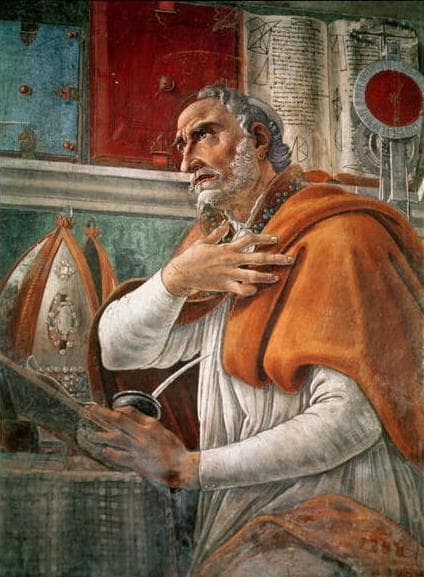
Augustine of Hippo
Confessions...as himself told me), "Go we to the Church; I wish to be made a Christian." But he, not containing himself for joy, went with him. And having been admitted to the first Sacrament and become a Catechumen, not long after he further gave in his name, that he might be regenerated by baptism, Rome wondering, the Church rejoicing. The proud saw, and were wroth; they gnashed with their teeth, and melted away. But the Lord God was the hope of Thy servant, and he regarded not vanities and lying madness.
To conclude, when the hour was come for making profession of his faith (which at Rome they, who are about to approach to Thy grace, deliver, from an elevated place, in the sight of all the faithful, in a set form of words committed to memory), the presbyters, he said, offered Victorinus (as was done to such as seemed likely through bashfulness to be alarmed) to make his profession more privately: but he chose rather to profess his salvation in the presence of the holy multitude. "For it was not salvation that he taught in rhetoric, and yet that he had publicly professed: how much less then ought he, when pronouncing Thy word, to dread Thy…
When, then, he went up to make his profession, all, as they knew him, whispered his name one to another with the voice of congratulation. And who there knew him not? and there ran a low murmur through all the mouths of the rejoicing multitude, Victorinus! Victorinus! Sudden was the burst of rapture, that they saw him; suddenly were they hushed that they might hear him. He pronounced the true faith with an excellent boldness, and all wished to draw him into their very heart; yea by their love a...
Continue reading →
2
6 of 33 in Book VIII175 of 415 in work
⚖Joy in Redemption

Augustine of Hippo
ConfessionsThe author uses the parables of the lost sheep and the prodigal son to illustrate the profound joy found in the salvation of those who were once lost.
...pered his name one to another with the voice of congratulation. And who there knew him not? and there ran a low murmur through all the mouths of the rejoicing multitude, Victorinus! Victorinus! Sudden was the burst of rapture, that they saw him; suddenly were they hushed that they might hear him. He pronounced the true faith with an excellent boldness, and all wished to draw him into their very heart; yea by their love and joy they drew him thither, such were the hands wherewith they drew him.
Good God! what takes place in man, that he should more rejoice at the salvation of a soul despaired of, and freed from greater peril, than if there had always been hope of him, or the danger had been less? For so Thou also, merciful Father, dost more rejoice over one penitent than over ninety-nine just persons that need no repentance. And with much joyfulness do we hear, so often as we hear with what joy the sheep which had strayed is brought back upon the shepherd's shoulder, and the groat is restored to Thy treasury, the neighbours rejoicing with the woman who found it; and the joy of the solemn service of Thy house forceth to tears, when…
For Thou rejoicest in us, and in Thy holy angels, holy through holy charity. For Thou art ever the same; for all things which abide not the same nor for ever, Thou for ever knowest in the same way. What then takes place in the soul, when it is more delighted at finding or recovering the things it loves, than if it had ever had them? yea, and other things witness hereunto; and all things are full of witnesses, crying out, "So is it." The conquering commander triumpheth; yet had he not conquered...
Continue reading →
2
7 of 33 in Book VIII176 of 415 in work
⚖Joy in Recovery

Augustine of Hippo
ConfessionsThe author observes a psychological law where the recovery of a lost good or the end of a trial produces greater joy than continuous possession.
...the shepherd's shoulder, and the groat is restored to Thy treasury, the neighbours rejoicing with the woman who found it; and the joy of the solemn service of Thy house forceth to tears, when in Thy house it is read of Thy younger son, that he was dead, and liveth again; had been lost, and is found. For Thou rejoicest in us, and in Thy holy angels, holy through holy charity. For Thou art ever the same; for all things which abide not the same nor for ever, Thou for ever knowest in the same way.
What then takes place in the soul, when it is more delighted at finding or recovering the things it loves, than if it had ever had them? yea, and other things witness hereunto; and all things are full of witnesses, crying out, "So is it." The conquering commander triumpheth; yet had he not conquered unless he had fought; and the more peril there was in the battle, so much the more joy is there in the triumph. The storm tosses the sailors, threatens shipwreck; all wax pale at approaching death; sky and sea are calmed, and they are exceeding joyed, as having been exceeding afraid. A friend is sick, and his pulse threatens danger; all who long…
Yea, the very pleasures of human life men acquire by difficulties, not those only which fall upon us unlooked for, and against our wills, but even by self-chosen, and pleasure-seeking trouble. Eating and drinking have no pleasure, unless there precede the pinching of hunger and thirst. Men, given to drink, eat certain salt meats, to procure a troublesome heat, which the drink allaying, causes pleasure. It is also ordered that the affianced bride should not at once be given, lest as a husband he...
Continue reading →
4
8 of 33 in Book VIII177 of 415 in work
⚖Pain Before Pleasure

Augustine of Hippo
ConfessionsThe author argues that human joy is systematically preceded by difficulty or pain, claiming this is a universal law governing everything from physical hunger to the highest forms of friendship.
...eril there was in the battle, so much the more joy is there in the triumph. The storm tosses the sailors, threatens shipwreck; all wax pale at approaching death; sky and sea are calmed, and they are exceeding joyed, as having been exceeding afraid. A friend is sick, and his pulse threatens danger; all who long for his recovery are sick in mind with him. He is restored, though as yet he walks not with his former strength; yet there is such joy, as was not, when before he walked sound and strong.
Yea, the very pleasures of human life men acquire by difficulties, not those only which fall upon us unlooked for, and against our wills, but even by self-chosen, and pleasure-seeking trouble. Eating and drinking have no pleasure, unless there precede the pinching of hunger and thirst. Men, given to drink, eat certain salt meats, to procure a troublesome heat, which the drink allaying, causes pleasure. It is also ordered that the affianced bride should not at once be given, lest as a husband he should hold cheap whom, as betrothed, he sighed not after. This law holds in foul and accursed joy; this in permitted and lawful joy; this in the very…
What means this, O Lord my God, whereas Thou art everlastingly joy to Thyself, and some things around Thee evermore rejoice in Thee? What means this, that this portion of things thus ebbs and flows alternately displeased and reconciled? Is this their allotted measure? Is this all Thou hast assigned to them, whereas from the highest heavens to the lowest earth, from the beginning of the world to the end of ages, from the angel to the worm, from the first motion to the last, Thou settest each in...
Continue reading →
6
9 of 33 in Book VIII178 of 415 in work
⚖Joy's Painful Threshold

Augustine of Hippo
ConfessionsThe author reflects on the divine order of the universe, marveling at how God assigns a specific place and season to all things, from angels to worms, amidst the ebb and flow of time.
...nching of hunger and thirst. Men, given to drink, eat certain salt meats, to procure a troublesome heat, which the drink allaying, causes pleasure. It is also ordered that the affianced bride should not at once be given, lest as a husband he should hold cheap whom, as betrothed, he sighed not after. This law holds in foul and accursed joy; this in permitted and lawful joy; this in the very purest perfection of friendship; this, in him who was dead, and lived again; had been lost and was found.
Every where the greater joy is ushered in by the greater pain. What means this, O Lord my God, whereas Thou art everlastingly joy to Thyself, and some things around Thee evermore rejoice in Thee? What means this, that this portion of things thus ebbs and flows alternately displeased and reconciled? Is this their allotted measure? Is this all Thou hast assigned to them, whereas from the highest heavens to the lowest earth, from the beginning of the world to the end of ages, from the angel to the worm, from the first motion to the last, Thou settest each in its place, and realisest each in their season, every thing good after its kind?
Woe is me! how high art Thou in the highest, and how deep in the deepest! and Thou never departest, and we scarcely return to Thee. Up, Lord, and do; stir us up, and recall us; kindle and draw us; inflame, grow sweet unto us, let us now love, let us run. Do not many, out of a deeper hell of blindness than Victorinus, return to Thee, approach, and are enlightened, receiving that Light, which they who receive, receive power from Thee to become Thy sons? But if they be less known to the nations,...
2