Wrong as Deserving Punishment
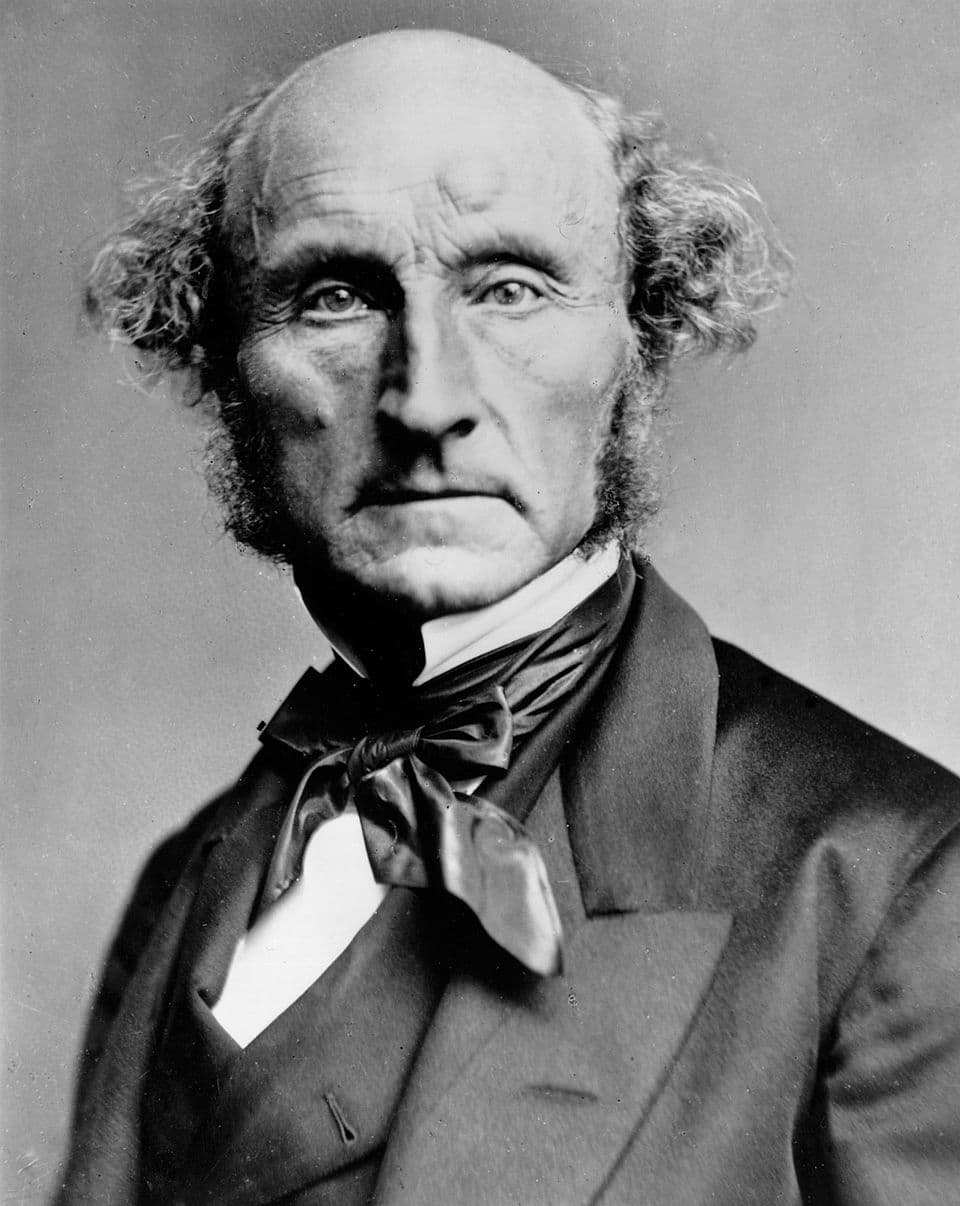
John Stewart Mill
Utilitarianism

The author defines the essence of a moral 'wrong' as an act that deserves punishment, whether by law or conscience, distinguishing morality from simple expediency through this penal sanction.

...ic disapprobation to bear upon the offender. Thus the idea of legal constraint is still the generating idea of the notion of justice, though undergoing several transformations before that notion, as it exists in an advanced state of society, becomes complete. The above is, I think, a true account, as far as it goes, of the origin and progressive growth of the idea of justice. But we must observe, that it contains, as yet, nothing to distinguish that obligation from moral obligation in general.
For the truth is, that the idea of penal sanction, which is the essence of law, enters not only into the conception of injustice, but into that of any kind of wrong. We do not call anything wrong, unless we mean to imply that a person ought to be punished in some way or other for doing it; if not by law, by the opinion of his fellow creatures; if not by opinion, by the reproaches of his own conscience. This seems the real turning point of the distinction between morality and simple expediency.
It is a part of the notion of Duty in every one of its forms, that a person may rightfully be compelled to fulfil it. Duty is a thing which may be exacted from a person, as one exacts a debt. Unless we think that it might be exacted from him, we do not call it his duty. Reasons of prudence, or the interest of other people, may militate against actually exacting it; but the person himself, it is clearly understood, would not be entitled to complain. There are other things, on the contrary, whi...
6

John Stewart Mill

Utilitarianism

Duty as Enforceable Debt

This excerpt extends the parent's claim by explicitly connecting the concept of duty to compulsion and exaction, reinforcing that moral obligations involve a sanction that can be rightfully enforced, much like a debt. It directly echoes the idea that the distinction between morality and expediency lies in the presence of a penal sanction.

...it contains, as yet, nothing to distinguish that obligation from moral obligation in general. For the truth is, that the idea of penal sanction, which is the essence of law, enters not only into the conception of injustice, but into that of any kind of wrong. We do not call anything wrong, unless we mean to imply that a person ought to be punished in some way or other for doing it; if not by law, by the opinion of his fellow creatures; if not by opinion, by the reproaches of his own conscience.
This seems the real turning point of the distinction between morality and simple expediency. It is a part of the notion of Duty in every one of its forms, that a person may rightfully be compelled to fulfil it. Duty is a thing which may be exacted from a person, as one exacts a debt. Unless we think that it might be exacted from him, we do not call it his duty.
Reasons of prudence, or the interest of other people, may militate against actually exacting it; but the person himself, it is clearly understood, would not be entitled to complain. There are other things, on the contrary, which we wish that people should do, which we like or admire them for doing, perhaps dislike or despise them for not doing, but yet admit that they are not bound to do; it is not a case of moral obligation; we do not blame them, that is, we do not think that they are proper o...

Friedrich Nietzsche

Beyond Good and Evil

Society's Self-Betrayal

This excerpt challenges the parent's assertion by presenting a societal perspective where punishment itself is viewed as unfair and alarming. It suggests that the idea of penal sanction is not an essential component of wrongness but rather a potentially harmful societal practice that can be questioned when the criminal is rendered harmless.

...ant, unassuming, self-adapting, self-equalizing disposition, the MEDIOCRITY of desires, attains to moral distinction and honour. Finally, under very peaceful circumstances, there is always less opportunity and necessity for training the feelings to severity and rigour, and now every form of severity, even in justice, begins to disturb the conscience, a lofty and rigorous nobleness and self-responsibility almost offends, and awakens distrust, "the lamb," and still more "the sheep," wins respect.
There is a point of diseased mellowness and effeminacy in the history of society, at which society itself takes the part of him who injures it, the part of the CRIMINAL, and does so, in fact, seriously and honestly. To punish, appears to it to be somehow unfair--it is certain that the idea of "punishment" and "the obligation to punish" are then painful and alarming to people. "Is it not sufficient if the criminal be rendered HARMLESS? Why should we still punish? Punishment itself is terrible!"--with these questions gregarious morality, the morality of fear, draws its ultimate conclusion.
If one could at all do away with danger, the cause of fear, one would have done away with this morality at the same time, it would no longer be necessary, it WOULD NOT CONSIDER ITSELF any longer necessary!--Whoever examines the conscience of the present-day European, will always elicit the same imperative from its thousand moral folds and hidden recesses, the imperative of the timidity of the herd "we wish that some time or other there may be NOTHING MORE TO FEAR!" Some time or other--the will...

David Hume

An Enquiry Concerning Human Understanding

Moral Sentiments from Society

This excerpt explains the psychological and social origins of moral sentiments, proposing that our approval or blame arises naturally from a consideration of what promotes peace and security in society. It provides a causal account for why humans develop the idea of penal sanction in response to actions deemed harmful.

...he affections take a narrower and more natural survey of their object; and by an economy, more suitable to the infirmity of human minds, regard alone the beings around us, and are actuated by such events as appear good or ill to the private system. 80. The case is the same with moral as with physical ill. It cannot reasonably be supposed, that those remote considerations, which are found of so little efficacy with regard to one, will have a more powerful influence with regard to the other.
The mind of man is so formed by nature that, upon the appearance of certain characters, dispositions, and actions, it immediately feels the sentiment of approbation or blame; nor are there any emotions more essential to its frame and constitution. The characters which engage our approbation are chiefly such as contribute to the peace and security of human society; as the characters which excite blame are chiefly such as tend to public detriment and disturbance: Whence it may reasonably be presumed, that the moral sentiments arise, either mediately or immediately, from a reflection of these opp...
A man who is robbed of a considerable sum; does he find his vexation for the loss anywise diminished by these sublime reflections? Why then should his moral resentment against the crime be supposed incompatible with them? Or why should not the acknowledgment of a real distinction between vice and virtue be reconcileable to all speculative systems of philosophy, as well as that of a real distinction between personal beauty and deformity? Both these distinctions are founded in the natural sentime...

Blaise Pascal

Pensees

Justice's Geographic Whims

This excerpt reframes the discussion by highlighting the variability of justice across different cultures and times, arguing that what is considered just or punishable is often a matter of geographical and historical accident rather than an inherent quality of actions.

...his maxim, the most general of all that obtain among men, that each should follow the custom of his own country. The glory of true equity would have brought all nations under subjection, and legislators would not have taken as their model the fancies and caprice of Persians and Germans instead of this unchanging justice. We should have seen it set up in all the States on earth and in all times; whereas we see neither justice nor injustice which does not change its nature with change in climate.
Three degrees of latitude reverse all jurisprudence; a meridian decides the truth. Fundamental laws change after a few years of possession; right has its epochs; the entry of Saturn into the Lion marks to us the origin of such and such a crime. A strange justice that is bounded by a river! Truth on this side of the Pyrenees, error on the other side. Men admit that justice does not consist in these customs, but that it resides in natural laws, common to every country. They would certainly maintain it obstinately, if reckless chance which has distributed human laws had encountered even one which...
Can anything be more ridiculous than that a man should have the right to kill me because he lives on the other side of the water, and because his ruler has a quarrel with mine, though I have none with him? Doubtless there are natural laws; but good reason once corrupted has corrupted all. Nihil amplius nostrum est;[110] quod nostrum dicimus, artis est. Ex senatus--consultis et plebiscitis crimina exercentur.[111] Ut olim vitiis, sic nunc legibus laboramus.[112] The result of this confusion...

David Hume

An Enquiry Concerning Human Understanding

Liberty's Moral Essential

This excerpt raises a meta-ethical question about the preconditions for moral judgment, arguing that without liberty, actions cannot be objects of moral sentiment. It questions our ability to assign blame or punishment if free will is lacking, thus probing the foundations of moral distinctions.

...s not the whole character. Again, repentance wipes off every crime, if attended with a reformation of life and manners. How is this to be accounted for? but by asserting that actions render a person criminal merely as they are proofs of criminal principles in the mind; and when, by an alteration of these principles, they cease to be just proofs, they likewise cease to be criminal. But, except upon the doctrine of necessity, they never were just proofs, and consequently never were criminal. 77.
It will be equally easy to prove, and from the same arguments, that liberty, according to that definition above mentioned, in which all men agree, is also essential to morality, and that no human actions, where it is wanting, are susceptible of any moral qualities, or can be the objects either of approbation or dislike. For as actions are objects of our moral sentiment, so far only as they are indications of the internal character, passions, and affections; it is impossible that they can give rise either to praise or blame, where they proceed not from these principles, but are derived altoge...
78. I pretend not to have obviated or removed all objections to this theory, with regard to necessity and liberty. I can foresee other objections, derived from topics which have not here been treated of. It may be said, for instance, that, if voluntary actions be subjected to the same laws of necessity with the operations of matter, there is a continued chain of necessary causes, pre-ordained and pre-determined, reaching from the original cause of all to every single volition of every human cr...

John Stewart Mill

Utilitarianism

Veracity's Social Trust

This excerpt offers practical guidance on the importance of truthfulness, arguing that we should cultivate a sensitive regard for veracity to maintain social trust and well-being. While it addresses a specific moral virtue, it does not directly engage with the parent's thesis about penal sanction as the essence of wrong.

...place. When it means anything better than this, it means that which is expedient for some immediate object, some temporary purpose, but which violates a rule whose observance is expedient in a much higher degree. The Expedient, in this sense, instead of being the same thing with the useful, is a branch of the hurtful. Thus, it would often be expedient, for the purpose of getting over some momentary embarrassment, or attaining some object immediately useful to ourselves or others, to tell a lie.
But inasmuch as the cultivation in ourselves of a sensitive feeling on the subject of veracity, is one of the most useful, and the enfeeblement of that feeling one of the most hurtful, things to which our conduct can be instrumental; and inasmuch as any, even unintentional, deviation from truth, does that much towards weakening the trustworthiness of human assertion, which is not only the principal support of all present social well-being, but the insufficiency of which does more than any one thing that can be named to keep back civilisation, virtue, everything on which human happiness on the...
Yet that even this rule, sacred as it is, admits of possible exceptions, is acknowledged by all moralists; the chief of which is when the withholding of some fact (as of information from a male-factor, or of bad news from a person dangerously ill) would preserve some one (especially a person other than oneself) from great and unmerited evil, and when the withholding can only be effected by denial. But in order that the exception may not extend itself beyond the need, and may have the least poss...