Education as Self-Catching
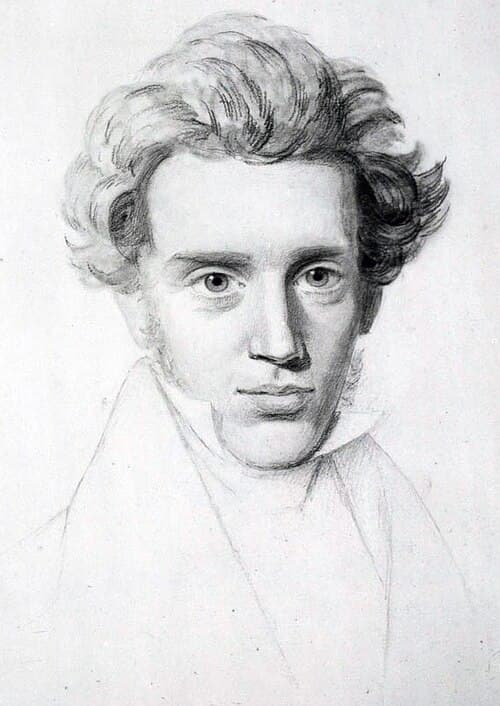
Søren Kierkegaard
Fear and Trembling

The author defines education as the process of self-discovery and argues that 'infinite resignation' is a necessary logical precursor to achieving true faith.

...e death before he actually dies, and that appears to me a crass materialism. However, in our time people concern themselves rather little about making pure movements. In case one who was about to learn to dance were to say, "For centuries now one generation after another has been learning positions, it is high time I drew some advantage out of this and began straightway with the French dances"–then people would laugh at him; but in the world of spirit they find this exceedingly plausible.
What is education? I should suppose that education was the curriculum one had to run through in order to catch up with oneself, and he who will not pass through this curriculum is helped very little by the fact that he was born in the most enlightened age. The infinite resignation is the last stage prior to faith, so that one who has not made this movement has not faith; for only in the infinite resignation do I become clear to myself with respect to my eternal validity, and only then can there be any question of grasping existence by virtue of faith.
Now we will let the knight of faith appear in the role just described. He makes exactly the same movements as the other knight, infinitely renounces claim to the love which is the content of his life, he is reconciled in pain; but then occurs the prodigy, he makes still another movement more wonderful than all, for he says, "I believe nevertheless that I shall get her, in virtue, that is, of the absurd, in virtue of the fact that with God all things are possible." The absurd is not one o...
5

Søren Kierkegaard

Fear and Trembling

The Shirt of Tears

Elaborates on the concept of infinite resignation introduced in the parent text, describing it as a movement one can train oneself to make, which aligns with the idea of education as a curriculum to catch up with oneself.

...if ever the moment were to come which offered to give love its expression in time, then they will be capable of beginning precisely at the point where they would have begun if originally they had been united. He who understands this, be he man or woman, can never be deceived, for it is only the lower natures which imagine they were deceived. No girl who is not so proud really knows how to love; but if she is so proud, then the cunning and shrewdness of all the world cannot deceive her.
In the infinite resignation there is peace and rest; every man who wills it, who has not abased himself by scorning himself (which is still more dreadful than being proud), can train himself to make this movement which in its pain reconciles one with existence. Infinite resignation is that shirt we read about in the old fable. The thread is spun under tears, the cloth bleached with tears, the shirt sewn with tears; but then too it is a better protection than iron and steel. The imperfection in the fable is that a third party can manufacture this shirt. The secret in life is that everyone must...
In the infinite resignation there is peace and rest and comfort in sorrow–that is, if the movement is made normally. It would not be difficult for me, however, to write a whole book, were I to examine the various misunderstandings, the preposterous attitudes, the deceptive movements, which I have encountered in my brief practice. People believe very little in spirit, and yet making this movement depends upon spirit, it depends upon whether this is or is not a one-sided result of a dira...

Friedrich Nietzsche

Beyond Good and Evil

Education as Deception

Challenges the parent's sincere view of education as a personal curriculum, instead arguing that in modern democratic ages, education is essentially an art of deception regarding one's origins and nature.

...ows something of the parents, it is admissible to draw a conclusion about the child: any kind of offensive incontinence, any kind of sordid envy, or of clumsy self-vaunting--the three things which together have constituted the genuine plebeian type in all times--such must pass over to the child, as surely as bad blood; and with the help of the best education and culture one will only succeed in DECEIVING with regard to such heredity.--And what else does education and culture try to do nowadays!
In our very democratic, or rather, very plebeian age, "education" and "culture" MUST be essentially the art of deceiving--deceiving with regard to origin, with regard to the inherited plebeianism in body and soul. An educator who nowadays preached truthfulness above everything else, and called out constantly to his pupils: "Be true! Be natural! Show yourselves as you are!"--even such a virtuous and sincere ass would learn in a short time to have recourse to the FURCA of Horace, NATURAM EXPELLERE: with what results? "Plebeianism" USQUE RECURRET.
[FOOTNOTE: Horace's "Epistles," I. x. 24.] 265. At the risk of displeasing innocent ears, I submit that egoism belongs to the essence of a noble soul, I mean the unalterable belief that to a being such as "we," other beings must naturally be in subjection, and have to sacrifice themselves. The noble soul accepts the fact of his egoism without question, and also without consciousness of harshness, constraint, or arbitrariness therein, but rather as something that may have its basis in the prima...

Søren Kierkegaard

Fear and Trembling

Passion's Reliable Conclusions

Explains that passion is the necessary driver for making the movements of infinite resignation and faith; without sufficient passion, one merely loiters through life and fails to engage in the curriculum of self-catch-up.

...d thereby saved, it is only the aesthetic writer who sees amiss and believes that the girl is the heroine, instead of the man being the hero. So the merman cannot belong to Agnes unless, after having made the infinite movement, the movement of repentance, he makes still one more movement by virtue of the absurd. By his own strength he can make the movement of repentance, but for that he uses up absolutely all his strength and hence he cannot by his own strength return and grasp reality.
If a man has not enough passion to make either the one movement or the other, if he loiters through life, repenting a little, and thinks that the rest will take care of itself, he has once for all renounced the effort to live in the idea–and then he can very easily reach and help others to reach the highest attainments, i.e. delude himself and others with the notion that in the world of spirit everything goes as in a well-known game of cards where everything depends on haphazard. One can therefore divert oneself by reflecting how strange it is that precisely in our age when everyone is able to...
Fortunately existence is in this instance more kindly and more faithful than the wise maintain, for it excludes no man, not even the lowliest, it fools no one, for in the world of spirit only he is fooled who fools himself. It is the opinion of all, and so far as I dare permit myself to pass judgment it is also my opinion, that it is not the highest thing to enter the monastery; but for all that it is by no means my opinion that in our age when nobody enters the monastery everybody is gr...

Friedrich Nietzsche

Beyond Good and Evil

The Unteachable Granite

Questions the very possibility of education as catching up with oneself by positing an unteachable 'granite of spiritual fate' within each individual, suggesting that core aspects of the self are predetermined and not subject to curricular change.

...he enticements of old metaphysical bird-catchers, who have piped to him far too long: "Thou art more! thou art higher! thou hast a different origin!"--this may be a strange and foolish task, but that it is a TASK, who can deny! Why did we choose it, this foolish task? Or, to put the question differently: "Why knowledge at all?" Every one will ask us about this. And thus pressed, we, who have asked ourselves the question a hundred times, have not found and cannot find any better answer.... 231.
Learning alters us, it does what all nourishment does that does not merely "conserve"--as the physiologist knows. But at the bottom of our souls, quite "down below," there is certainly something unteachable, a granite of spiritual fate, of predetermined decision and answer to predetermined, chosen questions. In each cardinal problem there speaks an unchangeable "I am this"; a thinker cannot learn anew about man and woman, for instance, but can only learn fully--he can only follow to the end what is "fixed" about them in himself. Occasionally we find certain solutions of problems which make str...
232. Woman wishes to be independent, and therefore she begins to enlighten men about "woman as she is"--THIS is one of the worst developments of the general UGLIFYING of Europe. For what must these clumsy attempts of feminine scientificality and self-exposure bring to light! Woman has so much cause for shame; in woman there is so much pedantry, superficiality, schoolmasterliness, petty presumption, unbridledness, and indiscretion concealed--study only woman's behaviour towards children!--which...

Blaise Pascal

Pensees

Abate Your Passions

Pascal offers concrete guidance on how to cultivate faith: by abating one's passions and engaging in religious practices, such as taking holy water and having masses said. This practical advice complements Kierkegaard's philosophical discussion of the necessary internal movement of 'infinite resignation' prior to faith, providing a tangible 'what to do' response.

.... This is demonstrable; and if men are capable of any truths, this is one. "I confess it, I admit it. But, still, is there no means of seeing the faces of the cards?"--Yes, Scripture and the rest, etc. "Yes, but I have my hands tied and my mouth closed; I am forced to wager, and am not free. I am not released, and am so made that I cannot believe. What, then, would you have me do?" True. But at least learn your inability to believe, since reason brings you to this, and yet you cannot believe.
Endeavour then to convince yourself, not by increase of proofs of God, but by the abatement of your passions. You would like to attain faith, and do not know the way; you would like to cure yourself of unbelief, and ask the remedy for it. Learn of those who have been bound like you, and who now stake all their possessions. These are people who know the way which you would follow, and who are cured of an ill of which you would be cured. Follow the way by which they began; by acting as if they believed, taking the holy water, having masses said, etc. Even this will naturally make you believe, an...
--And why? What have you to lose? But to show you that this leads you there, it is this which will lessen the passions, which are your stumbling-blocks. The end of this discourse.--Now, what harm will befall you in taking this side? You will be faithful, honest, humble, grateful, generous, a sincere friend, truthful. Certainly you will not have those poisonous pleasures, glory and luxury; but will you not have others? I will tell you that you will thereby gain in this life, and that, at eac...