Manufactured Spiritual Scarcity
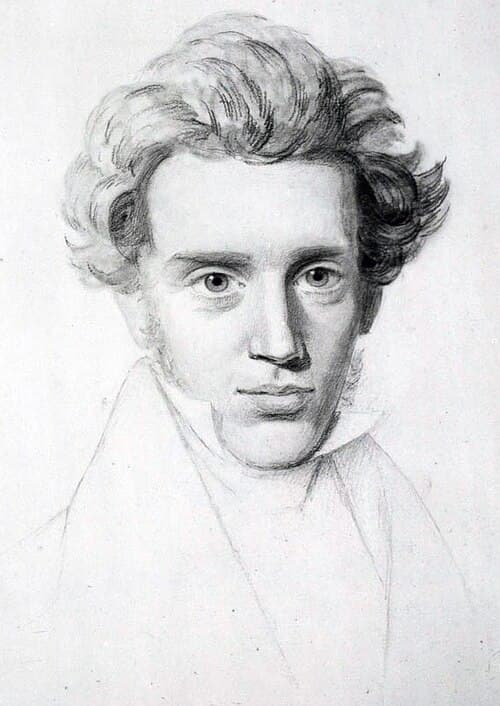
Søren Kierkegaard
Fear and Trembling

Using a metaphor of Dutch spice merchants, the author questions whether the current generation is deceiving itself into thinking it has already mastered faith.

...his love. But he who loves God has no need of tears, no need of admiration, in his love he forgets his suffering, yea, so completely has he forgotten it that afterwards there would not even be the least inkling of his pain if God Himself did not recall it, for God sees in secret and knows the distress and counts the tears and forgets nothing. So either there is a paradox, that the individual as the individual stands in an absolute relation to the absolute/or Abraham is lost. EPILOGUE
One time in Holland when the market was rather dull for spices the merchants had several cargoes dumped into the sea to peg up prices. This was a pardonable, perhaps a necessary device for deluding people. Is it something like that we need now in the world of spirit? Are we so thoroughly convinced that we have attained the highest point that there is nothing left for us but to make ourselves believe piously that we have not got so far–just for the sake of having something left to occupy our time? Is it such a self-deception the present generation has need of, does it need to be trained to virtuosity in self-deception, or is it not rather sufficiently perfected already in the art of deceiving itself?
Or rather is not the thing most needed an honest seriousness which dauntlessly and incorruptibly points to the tasks, an honest seriousness which lovingly watches over the tasks, which does not frighten men into being over hasty in getting the highest tasks accomplished, but keeps the tasks young and beautiful and charming to look upon and yet difficult withal and appealing to noble minds. For the enthusiasm of noble natures is aroused only by difficulties. Whatever the one generation ma...
4

Blaise Pascal

Pensees

Belief Through Custom

Pascal describes a practical technique for belief: immersing oneself in custom and habit until faith becomes natural and effortless. This offers a concrete method for enacting the kind of self-deception Kierkegaard's text contemplates, by using automated routines to instill convictions that might otherwise feel unattainable.

...ince the mind. Custom is the source of our strongest and most believed proofs. It bends the automaton, which persuades the mind without its thinking about the matter. Who has demonstrated that there will be a to-morrow, and that we shall die? And what is more believed? It is, then, custom which persuades us of it; it is custom that makes so many men Christians; custom that makes them Turks, heathens, artisans, soldiers, etc. (Faith in baptism is more received among Christians than among Turks.)
Finally, we must have recourse to it when once the mind has seen where the truth is, in order to quench our thirst, and steep ourselves in that belief, which escapes us at every hour; for always to have proofs ready is too much trouble. We must get an easier belief, which is that of custom, which, without violence, without art, without argument, makes us believe things, and inclines all our powers to this belief, so that out soul falls naturally into it. It is not enough to believe only by force of conviction, when the automaton is inclined to believe the contrary.
Both our parts must be made to believe, the mind by reasons which it is sufficient to have seen once in a lifetime, and the automaton by custom, and by not allowing it to incline to the contrary. Inclina cor meum, Deus.[100] The reason acts slowly, with so many examinations, and on so many principles, which must be always present, that at every hour it falls asleep, or wanders, through want of having all its principles present. Feeling does not act thus; it acts in a moment, and is always re...

Friedrich Nietzsche

Beyond Good and Evil

Truth vs Semblance

Nietzsche challenges the moral prejudice that truth is superior to semblance, arguing that life itself depends on perspective and illusion. This provides a foundational principle for why deliberate deception, like that of the spice merchants, might be a necessary condition for vitality and engagement in the spiritual realm.

...to "bad character," as the being who has hitherto been most befooled on earth--he is now under OBLIGATION to distrustfulness, to the wickedest squinting out of every abyss of suspicion.--Forgive me the joke of this gloomy grimace and turn of expression; for I myself have long ago learned to think and estimate differently with regard to deceiving and being deceived, and I keep at least a couple of pokes in the ribs ready for the blind rage with which philosophers struggle against being deceived.
Why NOT? It is nothing more than a moral prejudice that truth is worth more than semblance; it is, in fact, the worst proved supposition in the world. So much must be conceded: there could have been no life at all except upon the basis of perspective estimates and semblances; and if, with the virtuous enthusiasm and stupidity of many philosophers, one wished to do away altogether with the "seeming world"--well, granted that YOU could do that,--at least nothing of your "truth" would thereby remain! Indeed, what is it that forces us in general to the supposition that there is an essential opposi...
Why might not the world WHICH CONCERNS US--be a fiction? And to any one who suggested: "But to a fiction belongs an originator?"--might it not be bluntly replied: WHY? May not this "belong" also belong to the fiction? Is it not at length permitted to be a little ironical towards the subject, just as towards the predicate and object? Might not the philosopher elevate himself above faith in grammar? All respect to governesses, but is it not time that philosophy should renounce governess-faith? 3...

Friedrich Nietzsche

Beyond Good and Evil

Philosopher's Bad Character

Nietzsche asserts that the philosopher, having been long deceived, now has an obligation to radical distrust and suspicion. This directly challenges the prescription of self-deception, warning that it is precisely such credulity that has led to error, and that the pursuit of truth requires a 'wicked' skepticism.

...equently "the spirit," responsible for the falseness of the world--an honourable exit, which every conscious or unconscious advocatus dei avails himself of--he who regards this world, including space, time, form, and movement, as falsely DEDUCED, would have at least good reason in the end to become distrustful also of all thinking; has it not hitherto been playing upon us the worst of scurvy tricks? and what guarantee would it give that it would not continue to do what it has always been doing?
In all seriousness, the innocence of thinkers has something touching and respect-inspiring in it, which even nowadays permits them to wait upon consciousness with the request that it will give them HONEST answers: for example, whether it be "real" or not, and why it keeps the outer world so resolutely at a distance, and other questions of the same description. The belief in "immediate certainties" is a MORAL NAIVETE which does honour to us philosophers; but--we have now to cease being "MERELY moral" men! Apart from morality, such belief is a folly which does little honour to us! If in middle-c...
--Forgive me the joke of this gloomy grimace and turn of expression; for I myself have long ago learned to think and estimate differently with regard to deceiving and being deceived, and I keep at least a couple of pokes in the ribs ready for the blind rage with which philosophers struggle against being deceived. Why NOT? It is nothing more than a moral prejudice that truth is worth more than semblance; it is, in fact, the worst proved supposition in the world. So much must be conceded: there co...

Julius Evola

Revolt Against the Modern World

The Last Times' Test

Evola suggests that in decadent times, the proper response is not to indulge in deception but to make the perennial values of Truth and Tradition vividly apparent, providing guiding reference points for those who are disoriented. This opposes Kierkegaard's speculative self-deception with a call to clearly illuminate authentic spiritual ideals.

...lost, then the last night would surely fall. Let people of our time talk about these things with condescension as if they were anachronistic and antihistorical; we know that this is an alibi for their defeat. Let us leave modern men to their "truths" and let us only be concerned about one thing: to keep standing amid a world of ruins. Even though today an efficacious, general, and realizing action stands almost no chance at all, the ranks that I mentioned before can still set up inner defenses.
In an ancient ascetical text it is said that while in the beginning the law from above could be implemented, those who came afterward were only capable of half of what had been previously done; in the last times very few works will be done, but for people living in these times the great temptation will arise again; those who will endure during this time will be greater than the people of old who were very rich in works. To make the values of truth, reality, and Tradition highly visible to those who do not want "this" but who confusedly seek something "else," means to offer some reference point...
Finally, we must consider a third possibility. To some the path of acceleration may be the most suitable approach to a solution, considering that given certain conditions, many reactions are the equivalent of those cramps that only prolong agony and by delaying the end also delay the advent of the new principle. Thus, it would be expedient to take on, together with a special inner attitude, the most destructive processes of the modern era in order to use them for liberation; this would be like...