Eternal Love's Reconciliation
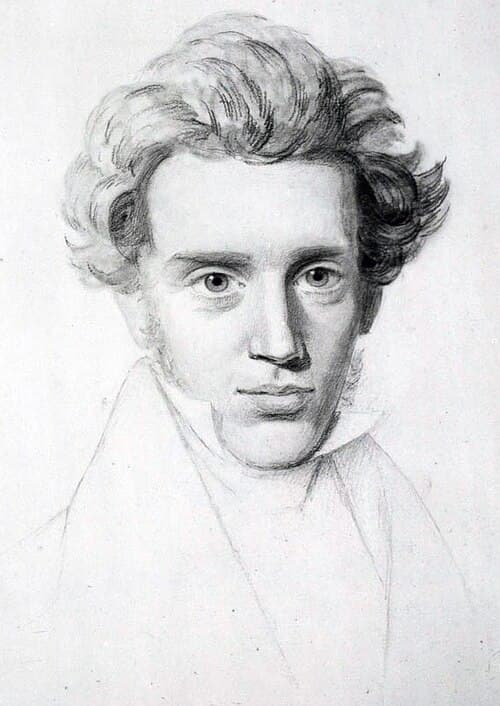
Søren Kierkegaard
Fear and Trembling

The author explains the process of infinite resignation, where a lost earthly love is transfigured into an eternal, religious love that reconciles the individual with existence.

...ed a kind of concentration.) No! For the knight does not contradict himself, and it is a contradiction to forget the whole content of one's life and yet remain the same man. To become another man he feels no inclination, nor does he by any means regard this as greatness. Only the lower natures forget themselves and become something new. Thus the butterfly has entirely forgotten that it was a caterpillar, perhaps it may in turn so entirely forget it was a butterfly that it becomes a fish.
The deeper natures never forget themselves and never become anything else than what they were. So the knight remembers everything, but precisely this remembrance is pain, and yet by the infinite resignation he is reconciled with existence. Love for that princess became for him the expression for an eternal love, assumed a religious character, was transfigured into a love for the Eternal Being, which did to be sure deny him the fulfilment of his love, yet reconciled him again by the eternal consciousness of its validity in the form of eternity, which no reality can take from him.
Fools and young men prate about everything being possible for a man. That, however, is a great error. Spiritually speaking, everything is possible, but in the world of the finite there is much which is not possible. This impossible, however, the knight makes possible by expressing it spiritually, but he expresses it spiritually by waiving his claim to it. The wish which would carry him out into reality, but was wrecked upon the impossibility, is now bent inward, but it is not therefore l...
5

Søren Kierkegaard

Fear and Trembling

The Shirt of Tears

This excerpt directly describes infinite resignation as a movement that brings peace and reconciles one with existence through pain, mirroring the parent's description of the knight's reconciliation.

...if ever the moment were to come which offered to give love its expression in time, then they will be capable of beginning precisely at the point where they would have begun if originally they had been united. He who understands this, be he man or woman, can never be deceived, for it is only the lower natures which imagine they were deceived. No girl who is not so proud really knows how to love; but if she is so proud, then the cunning and shrewdness of all the world cannot deceive her.
In the infinite resignation there is peace and rest; every man who wills it, who has not abased himself by scorning himself (which is still more dreadful than being proud), can train himself to make this movement which in its pain reconciles one with existence. Infinite resignation is that shirt we read about in the old fable. The thread is spun under tears, the cloth bleached with tears, the shirt sewn with tears; but then too it is a better protection than iron and steel. The imperfection in the fable is that a third party can manufacture this shirt. The secret in life is that everyone must...
In the infinite resignation there is peace and rest and comfort in sorrow–that is, if the movement is made normally. It would not be difficult for me, however, to write a whole book, were I to examine the various misunderstandings, the preposterous attitudes, the deceptive movements, which I have encountered in my brief practice. People believe very little in spirit, and yet making this movement depends upon spirit, it depends upon whether this is or is not a one-sided result of a dira...

Friedrich Nietzsche

Beyond Good and Evil

Nobility as Self-Reverence

This passage defines nobility as self-reverence and a fundamental certainty in oneself, opposing the parent's ideal of finding reconciliation through resignation and love for an external Eternal Being.

...efore it has arrived man DENIES--that there are stars there. "How many centuries does a mind require to be understood?"--that is also a standard, one also makes a gradation of rank and an etiquette therewith, such as is necessary for mind and for star. 286. "Here is the prospect free, the mind exalted." [FOOTNOTE: Goethe's "Faust," Part II, Act V. The words of Dr. Marianus.]--But there is a reverse kind of man, who is also upon a height, and has also a free prospect--but looks DOWNWARDS. 287.
What is noble? What does the word "noble" still mean for us nowadays? How does the noble man betray himself, how is he recognized under this heavy overcast sky of the commencing plebeianism, by which everything is rendered opaque and leaden?--It is not his actions which establish his claim--actions are always ambiguous, always inscrutable; neither is it his "works." One finds nowadays among artists and scholars plenty of those who betray by their works that a profound longing for nobleness impels them; but this very NEED of nobleness is radically different from the needs of the noble soul itse...
-- 288. There are men who are unavoidably intellectual, let them turn and twist themselves as they will, and hold their hands before their treacherous eyes--as though the hand were not a betrayer; it always comes out at last that they have something which they hide--namely, intellect. One of the subtlest means of deceiving, at least as long as possible, and of successfully representing oneself to be stupider than one really is--which in everyday life is often as desirable as an umbrella,--is ca...

Søren Kierkegaard

Fear and Trembling

Spiritual Possibility

This excerpt explains the psychological mechanism by which the knight spiritually transforms an impossible wish by waiving his claim to it, detailing how the inward turn described in the parent text occurs.

...resignation he is reconciled with existence. Love for that princess became for him the expression for an eternal love, assumed a religious character, was transfigured into a love for the Eternal Being, which did to be sure deny him the fulfilment of his love, yet reconciled him again by the eternal consciousness of its validity in the form of eternity, which no reality can take from him. Fools and young men prate about everything being possible for a man. That, however, is a great error.
Spiritually speaking, everything is possible, but in the world of the finite there is much which is not possible. This impossible, however, the knight makes possible by expressing it spiritually, but he expresses it spiritually by waiving his claim to it. The wish which would carry him out into reality, but was wrecked upon the impossibility, is now bent inward, but it is not therefore lost, neither is it forgotten. At one moment it is the obscure emotion of the wish within him which awakens recollections, at another moment he awakens them himself; for he is too proud to be willing that what w...
On the other hand, he has no need of the intervention of the finite for the further growth of his love. From the instant he made the movement the princess is lost to him. He has no need of those erotic tinglings in the nerves at the sight of the beloved etc., nor does he need to be constantly taking leave of her in a finite sense, because he recollects her in an eternal sense, and he knows very well that the lovers who are so bent upon seeing "her" yet once again, to say farefell for the...

Julius Evola

Revolt Against the Modern World

Woman as Holy Wisdom

This excerpt reframes the knight's love for the princess as a symbolic pursuit of 'Holy Wisdom' or a transcendent divine principle, shifting the focus from personal resignation to allegorical interpretation.

...s" to which the Hyperborean "Knight of the Swan" belonged. The truth is that behind all this there were esoteric meanings that were not disclosed to the judges of the Inquisition or to ordinary folks; thus, these meanings were often conveyed in the guise of weird customs and of erotic tales. In a number of instances what has been said about the knight's "woman" also applies to the "woman" celebrated by the Ghibelline "Love's Lieges," which points to a uniform and precise traditional symbolism.
The woman to whom a knight swears unconditional faithfulness and to whom even a crusader consecrates himself; the woman who leads to purification, whom the knight considers his reward and who will make him immortal if he ever dies for her—that woman, as it has been documented in the case of the "Worshipers of Love" or "Love's Lieges," is essentially a representation of "Holy Wisdom," or a perceived embodiment, in different degrees, of the "transcendent, divine woman" who represents the power of a transfiguring spirituality and of a life unaffected by death.
This motif, in turn, is part of a complete traditional system; there is, in fact, a vast cycle of sagas and myths in which the "woman" is portrayed according to this value. The same theme runs through the stories of Hebe, a perennial youth who becomes the spouse of the hero Heracles in the Olympian domain; of Idun (whose name means "rejuvenation," "renewal") and of Gunnlöd, holder of the magic potion Odhaerir, who attempt in vain to attain Freya, goddess of light, who is constantly yearned for...

Augustine of Hippo

Confessions

The Soul's Eternal Gaze

This excerpt offers practical guidance: love God as commanded, and He will show Himself and suffice you, leading to a stable contemplation of God—a direct answer to how one should live in light of the parent's turn to eternal love.

...e thing is eternal: but our God is eternal." These things I infer, and put together, and find that my God, the eternal God, hath not upon any new will made any creature, nor doth His knowledge admit of any thing transitory. "What will ye say then, O ye gainsayers? Are these things false?" "No," they say; "What then? Is it false, that every nature already formed, or matter capable of form, is not, but from Him Who is supremely good, because He is supremely?" "Neither do we deny this," say they.
"What then? do you deny this, that there is a certain sublime creature, with so chaste a love cleaving unto the true and truly eternal God, that although not coeternal with Him, yet is it not detached from Him, nor dissolved into the variety and vicissitude of times, but reposeth in the most true contemplation of Him only?" Because Thou, O God, unto him that loveth Thee so much as Thou commandest, dost show Thyself, and sufficest him; and therefore doth he not decline from Thee, nor toward himself. This is the house of God, not of earthly mould, nor of celestial bulk corporeal but spiritual, a...
For Thou hast made it fast for ever and ever, Thou hast given it a law which it shall not pass. Nor yet is it coeternal with Thee, O God, because not without beginning; for it was made. For although we find no time before it, for wisdom was created before all things; not that Wisdom which is altogether equal and coeternal unto Thee, our God, His Father, and by Whom all things were created, and in Whom, as the Beginning, Thou createdst heaven and earth; but that wisdom which is created, that is...