Existence's Corruption
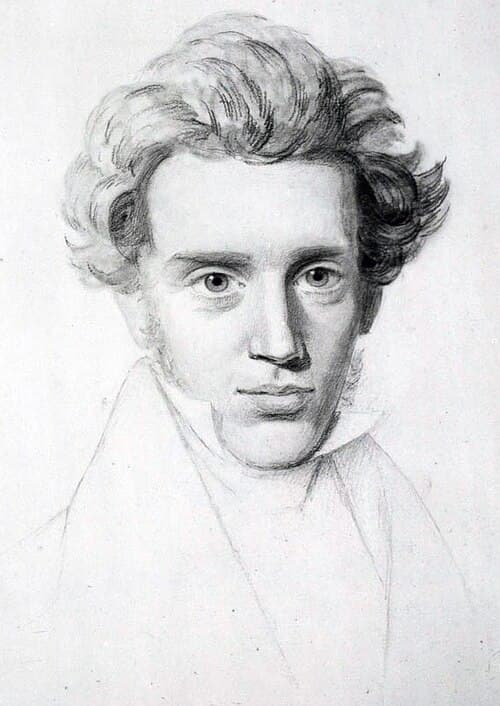
Søren Kierkegaard
Fear and Trembling

The author argues that being excluded from the universal by nature or circumstance creates a 'demoniacal' state for which the individual is not morally responsible.

...d that so lamely and unfashionable That dogs bark at me as I halt by them. Such natures as that of Gloucester one cannot save by mediating them into an idea of society. Ethics in fact only makes game of them, just as it would be a mockery of Sarah if ethics were to say to her, "Why dost thou not express the universal and get married?" Essentially such natures are in the paradox and are no more imperfect than other men, but are either lost in the demoniacal paradox or saved in the divine.
Now from time out of mind people have been pleased to think that witches, hobgoblins, gnomes etc. were deformed, and undeniably every man on seeing a deformed person has at once an inclination to associate this with the notion of moral depravity. What a monstrous injustice! For the situation must rather be inverted, in the sense that existence itself has corrupted them, in the same way that a stepmother makes the children wicked. The fact of being originally set outside of the universal, by nature or by a historical circumstance, is the beginning of the demoniacal, for which the individual himself however is not to blame.
Thus Cumberland's Jew is also a demon notwithstanding he does what is good. Thus too the demoniacal may express itself as contempt for men–a contempt, be it observed, which does not cause a man to behave contemptibly, since on the contrary he counts it his forte that he is better than all who condemn him.–In view of such cases the poets ought to lose no time in sounding the alarm. God knows what books are read now by the younger generation of verse makers! Their study likely consists in...
6

Søren Kierkegaard

Fear and Trembling

Genius's Divine Jealousy

Extends the parent's idea by discussing how genius, like deformity, can disorient one from the universal, leading to a paradoxical relation that may result in demoniacal despair or religious reassurance. This affirms that being set outside the universal is not a moral failing but a condition that may breed the demoniacal.

...ses the poets ought to lose no time in sounding the alarm. God knows what books are read now by the younger generation of verse makers! Their study likely consists in learning rhymes by rote. God knows what significance in existence these men have! At this moment I do not know what use they are except to furnish an edifying proof of the immortality of the soul, for the fact that one can say of them as Baggesen says of the poet of our town, Kildevalle, "If he is immortal, then we all are."–
What has here been said about Sarah, almost as a sort of poetic production and therefore with a fantastic presupposition, acquires its full significance if one with psychological interest will delve deep into the meaning of the old saying: Nullum unquam exstitit magnum ingenium sine aliqua dementia. For this dementia is the suffering allotted to genius in existence, it is the expression, if I may say so, of the divine jealousy, whereas the gift of genius is the expression of the divine favor. So from the start the genius is disoriented in relation to the universal and is brough...
Here are implied psychological topics to which, it seems to me, one might gladly sacrifice a whole life–and yet one so seldom hears a word about them. What relation has madness to genius? Can we construct the one out of the other? In what sense and how far is the genius master of his madness? For it goes without saying that to a certain degree he is master of it, since otherwise he would be actually a madman. For such observations, however, ingenuity in a high degree is requisite, and lo...

Marcus Aurelius

Meditations

The Severed Limb

Challenges the parent's claim that the individual is blameless for being cast out of the universal. It argues that separation from the natural unity is self-inflicted—by taking offense or acting uncharitably—implying personal responsibility rather than external corruption.

...nder, thou mayest he well pleased, and so by this gentle and equanimious conversion of thy mind unto that which may be, instead of that which at first thou didst intend, in the room of that former action there succeedeth another, which agrees as well with this contraction of thy life, that we now speak of. XXXI. Receive temporal blessings without ostentation, when they are sent and thou shalt be able to part with them with all readiness and facility when they are taken from thee again. XXXII.
If ever thou sawest either a hand, or a foot, or a head lying by itself, in some place or other, as cut off from the rest of the body, such must thou conceive him to make himself, as much as in him lieth, that either is offended with anything that is happened, (whatsoever it be) and as it were divides himself from it: or that commits anything against the natural law of mutual correspondence, and society among men: or, he that, commits any act of uncharitableness. Whosoever thou art, thou art such, thou art cast forth I know not whither out of the general unity, which is according to nature.
Thou went born indeed a part, but now thou hast cut thyself off. However, herein is matter of joy and exultation, that thou mayst be united again. God hath not granted it unto any other part, that once separated and cut off, it might be reunited, and come together again. But, behold, that GOODNESS how great and immense it is! which hath so much esteemed MAN. As at first he was so made, that he needed not, except he would himself, have divided himself from the whole; so once divided and cut off,...

David Hume

An Enquiry Concerning Human Understanding

The Marvelous Propensity

Explains the psychological driver behind associating deformity with moral depravity: a universal human propensity for the marvellous, which fuels belief in witches and supernatural beings, especially in less enlightened ages. This tendency persists despite advances in sense and learning.

...mediately join them together. The pleasure of telling a piece of news so interesting, of propagating it, and of being the first reporters of it, spreads the intelligence. And this is so well known, that no man of sense gives attention to these reports, till he find them confirmed by some greater evidence. Do not the same passions, and others still stronger, incline the generality of mankind to believe and report, with the greatest vehemence and assurance, all religious miracles? 94. Thirdly.
It forms a strong presumption against all supernatural and miraculous relations, that they are observed chiefly to abound among ignorant and barbarous nations; or if a civilized people has ever given admission to any of them, that people will be found to have received them from ignorant and barbarous ancestors, who transmitted them with that inviolable sanction and authority, which always attend received opinions. When we peruse the first histories of all nations, we are apt to imagine ourselves transported into some new world; where the whole frame of nature is disjointed, and every element p...
It is strange, a judicious reader is apt to say, upon the perusal of these wonderful historians, that such prodigious events never happen in our days. But it is nothing strange, I hope, that men should lie in all ages. You must surely have seen instances enough of that frailty. You have yourself heard many such marvellous relations started, which, being treated with scorn by all the wise and judicious, have at last been abandoned even by the vulgar. Be assured, that those renowned lies,...

Friedrich Nietzsche

Beyond Good and Evil

The Fear of Elevation

Reframes the issue by arguing that what society labels 'evil' is often what elevates the individual above the herd. Thus, the association of deformity with depravity may reflect herd morality's fear of the exceptional, not an objective moral truth.

..., a condition, an emotion, a disposition, or an endowment--that is now the moral perspective, here again fear is the mother of morals. It is by the loftiest and strongest instincts, when they break out passionately and carry the individual far above and beyond the average, and the low level of the gregarious conscience, that the self-reliance of the community is destroyed, its belief in itself, its backbone, as it were, breaks, consequently these very instincts will be most branded and defamed.
The lofty independent spirituality, the will to stand alone, and even the cogent reason, are felt to be dangers, everything that elevates the individual above the herd, and is a source of fear to the neighbour, is henceforth called EVIL, the tolerant, unassuming, self-adapting, self-equalizing disposition, the MEDIOCRITY of desires, attains to moral distinction and honour.
Finally, under very peaceful circumstances, there is always less opportunity and necessity for training the feelings to severity and rigour, and now every form of severity, even in justice, begins to disturb the conscience, a lofty and rigorous nobleness and self-responsibility almost offends, and awakens distrust, "the lamb," and still more "the sheep," wins respect. There is a point of diseased mellowness and effeminacy in the history of society, at which society itself takes the part of him...

Blaise Pascal

Pensees

Greatness-Wretchedness Loop

Questions our ability to settle the issue by highlighting the paradoxical circularity of human self-knowledge: we deduce wretchedness from greatness and greatness from wretchedness in an endless cycle, suggesting that clear resolution is inherently elusive.

...he nature of the horse and the dog, popularly, by seeing its fleetness, et animum arcendi; and then man is abject and vile. These are the two ways which make us judge of him differently, and which occasion such disputes among philosophers. For one denies the assumption of the other. One says, "He is not born for this end, for all his actions are repugnant to it." The other says, "He forsakes his end, when he does these base actions." 416 For Port-Royal.[158] Greatness and wretchedness.--
Wretchedness being deduced from greatness, and greatness from wretchedness, some have inferred man's wretchedness all the more because they have taken his greatness as a proof of it, and others have inferred his greatness with all the more force, because they have inferred it from his very wretchedness. All that the one party has been able to say in proof of his greatness has only served as an argument of his wretchedness to the others, because the greater our fall, the more wretched we are, and vice versa. The one party is brought back to the other in an endless circle, it being certain tha...
In a word, man knows that he is wretched. He is therefore wretched, because he is so; but he is really great because he knows it. 417 This twofold nature of man is so evident that some have thought that we had two souls. A single subject seemed to them incapable of such sudden variations from unmeasured presumption to a dreadful dejection of heart. 418 It is dangerous to make man see too clearly his equality with the brutes without showing him his greatness. It is also dangerous to make h...

Marcus Aurelius

Meditations

Wickedness's Self-Harm

Offers practical Stoic guidance: recognize that wickedness harms only the offender, and that one can be delivered from it simply by desiring to be so. This advises how to confront one's own potential demoniacal inclinations through self-mastery.

...ost of everything that he doth? LII. Not only now henceforth to have a common breath, or to hold correspondency of breath, with that air, that compasseth us about; but to have a common mind, or to hold correspondency of mind also with that rational substance, which compasseth all things. For, that also is of itself, and of its own nature (if a man can but draw it in as he should) everywhere diffused; and passeth through all things, no less than the air doth, if a man can but suck it in. LIII.
Wickedness in general doth not hurt the world. Particular wickedness doth not hurt any other: only unto him it is hurtful, whosoever he be that offends, unto whom in great favour and mercy it is granted, that whensoever he himself shall but first desire it, he may be presently delivered of it. Unto my free-will my neighbour's free-will, whoever he be, (as his life, or his bode), is altogether indifferent. For though we are all made one for another, yet have our minds and understandings each of them their own proper and limited jurisdiction. For else another man's wickedness might be my evil wh...
LIV. The sun seemeth to be shed abroad. And indeed it is diffused but not effused. For that diffusion of it is a τάσις or an extension. For therefore are the beams of it called ἀκτῖνες from the word ἐκτείνεσθαι to be stretched out and extended. Now what a sunbeam is, thou mayest know if thou observe the light of the sun, when through some narrow hole it pierceth into some room that is dark. For it is always in a direct line. And as by any solid body, that it meets with in the way that is not p...