Happiness Beyond Pleasure
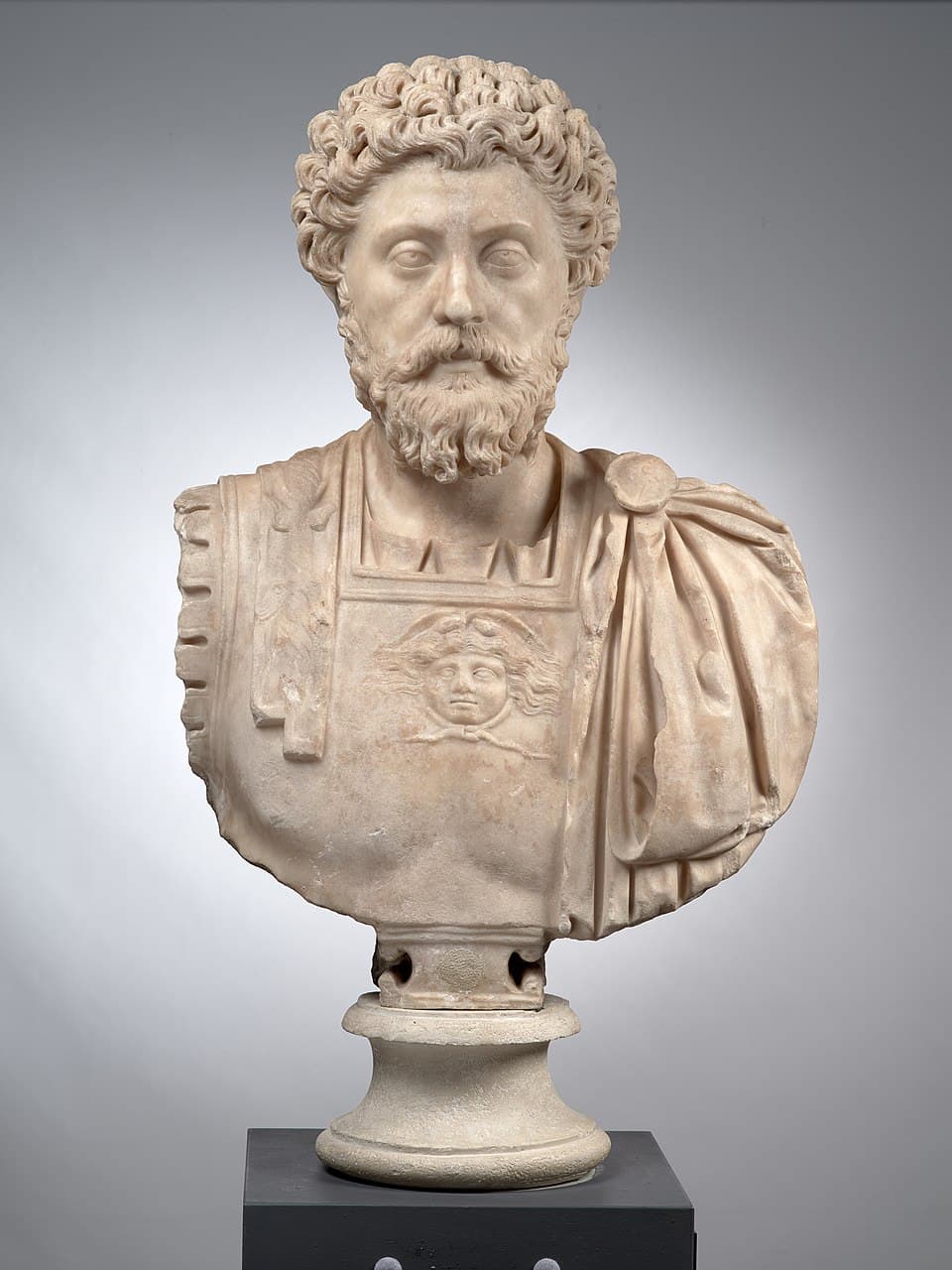
Marcus Aurelius
Meditations

A thesis asserting that true happiness consists of good inclinations and actions of the soul rather than the carnal pleasures enjoyed by the wicked.

...ood on the side of righteousness, they were concerned with the act more than with the intent. But Marcus Aurelius knows that what the heart is full of, the man will do. 'Such as thy thoughts and ordinary cogitations are,' he says, 'such will thy mind be in time.' And every page of the book shows us that he knew thought was sure to issue in act. He drills his soul, as it were, in right principles, that when the time comes, it may be guided by them. To wait until the emergency is to be too late.
He sees also the true essence of happiness. 'If happiness did consist in pleasure, how came notorious robbers, impure abominable livers, parricides, and tyrants, in so large a measure to have their part of pleasures?' He who had all the world's pleasures at command can write thus 'A happy lot and portion is, good inclinations of the soul, good desires, good actions.'
By the irony of fate this man, so gentle and good, so desirous of quiet joys and a mind free from care, was set at the head of the Roman Empire when great dangers threatened from east and west. For several years he himself commanded his armies in chief. In camp before the Quadi he dates the first book of his Meditations, and shows how he could retire within himself amid the coarse clangour of arms. The pomps and glories which he despised were all his; what to most men is an ambition or a dr...
6

Marcus Aurelius

Meditations

Happiness as Self-Creation

The candidate explicitly defines happiness as 'good inclinations of the soul, good desires, good actions,' directly echoing and reinforcing the parent's conclusion.

...old foster-father in the comedy, being now to take his leave doth with a great deal of ceremony, require his foster-child's rhombus, or rattle-top, remembering nevertheless that it is but a rhombus; so here also do thou likewise. For indeed what is all this pleading and public bawling for at the courts? O man, hast thou forgotten what those things are! yea but they are things that others much care for, and highly esteem of. Wilt thou therefore be a fool too? Once I was; let that suffice. XXX.
Let death surprise me when it will, and where it will, I may be εὔμοιρος, or a happy man, nevertheless. For he is a happy man, who in his lifetime dealeth unto himself a happy lot and portion. A happy lot and portion is, good inclinations of the soul, good desires, good actions.
THE SIXTH BOOK I. The matter itself, of which the universe doth consist, is of itself very tractable and pliable. That rational essence that doth govern it, hath in itself no cause to do evil. It hath no evil in itself; neither can it do anything that is evil: neither can anything be hurt by it. And all things are done and determined according to its will and prescript. II. Be it all one unto thee, whether half frozen or well warm; whether only slumbering, or after a full sleep; whether...

Aristotle

Nicomachean Ethics

Happiness as Unimpeded Working

The candidate argues that pleasure may be the Chief Good, directly contradicting the parent's claim that happiness does not consist in pleasure.

...must be a good. The attempted answer of Speusippus, “that Pleasure may be opposed and yet not contrary to Pain, just as the greater portion of any magnitude is contrary to the less but only opposed to the exact half,” will not hold: for he cannot say that Pleasure is identical with evil of any kind. Again. Granting that some Pleasures are low, there is no reason why some particular Pleasure may not be very good, just as some particular Science may be although there are some which are low.
Perhaps it even follows, since each state may have active working unimpeded, whether the active workings of all be Happiness or that of some one of them, that this active working, if it be unimpeded, must be choice-worthy: now Pleasure is exactly this. So that the Chief Good may be Pleasure of some kind, though most Pleasures be (let us assume) low per se. And for this reason all men think the happy life is pleasant, and interweave Pleasure with Happiness. Reasonably enough: because Happiness is perfect, but no impeded active working is perfect; and therefore the happy man needs as an additi...
As for those who say that he who is being tortured on the wheel, or falls into great misfortunes is happy provided only he be good, they talk nonsense, whether they mean to do so or not. On the other hand, because fortune is needed as an addition, some hold good fortune to be identical with Happiness: which it is not, for even this in excess is a hindrance, and perhaps then has no right to be called good fortune since it is good only in so far as it contributes to Happiness. The fact that all...

Augustine of Hippo

Confessions

Pain Before Pleasure

The candidate explains that pleasure is inherently preceded by pain or difficulty, suggesting why pleasure is an unstable and dependent foundation for happiness compared to virtuous actions.

...eril there was in the battle, so much the more joy is there in the triumph. The storm tosses the sailors, threatens shipwreck; all wax pale at approaching death; sky and sea are calmed, and they are exceeding joyed, as having been exceeding afraid. A friend is sick, and his pulse threatens danger; all who long for his recovery are sick in mind with him. He is restored, though as yet he walks not with his former strength; yet there is such joy, as was not, when before he walked sound and strong.
Yea, the very pleasures of human life men acquire by difficulties, not those only which fall upon us unlooked for, and against our wills, but even by self-chosen, and pleasure-seeking trouble. Eating and drinking have no pleasure, unless there precede the pinching of hunger and thirst. Men, given to drink, eat certain salt meats, to procure a troublesome heat, which the drink allaying, causes pleasure. It is also ordered that the affianced bride should not at once be given, lest as a husband he should hold cheap whom, as betrothed, he sighed not after. This law holds in foul and accursed joy;...
What means this, O Lord my God, whereas Thou art everlastingly joy to Thyself, and some things around Thee evermore rejoice in Thee? What means this, that this portion of things thus ebbs and flows alternately displeased and reconciled? Is this their allotted measure? Is this all Thou hast assigned to them, whereas from the highest heavens to the lowest earth, from the beginning of the world to the end of ages, from the angel to the worm, from the first motion to the last, Thou settest each in...

Aristotle

Nicomachean Ethics

Happiness with Moderation

The candidate reframes happiness as consisting primarily in contemplative speculation rather than moral action, shifting the standard for evaluating the good life.

...such Working. To the Gods then all their life is blessed; and to men in so far as there is in it some copy of such Working, but of the other animals none is happy because it in no way shares in Contemplative Speculation. Happiness then is co-extensive with this Contemplative Speculation, and in proportion as people have the act of Contemplation so far have they also the being happy, not incidentally, but in the way of Contemplative Speculation because it is in itself precious. Chapter VII.
So Happiness must be a kind of Contemplative Speculation; but since it is Man we are speaking of he will need likewise External Prosperity, because his Nature is not by itself sufficient for Speculation, but there must be health of body, and nourishment, and tendance of all kinds. However, it must not be thought, because without external goods a man cannot enjoy high Happiness, that therefore he will require many and great goods in order to be happy: for neither Self-sufficiency, nor Action, stand in Excess, and it is quite possible to act nobly without being ruler of sea and land, since even...
And this may be clearly seen in that men in private stations are thought to act justly, not merely no less than men in power but even more: it will be quite enough that just so much should belong to a man as is necessary, for his life will be happy who works in accordance with Virtue. Solon perhaps drew a fair picture of the Happy, when he said that they are men moderately supplied with external goods, and who have achieved the most noble deeds, as he thought, and who have lived with perfect...

Blaise Pascal

Pensees

Reason's Sovereign Good

The candidate questions whether human reason can definitively determine the sovereign good, listing conflicting views and implying inherent uncertainty in settling the issue.

...very thing we least understand. Man is to himself the most wonderful object in nature; for he cannot conceive what the body is, still less what the mind is, and least of all how a body should be united to a mind. This is the consummation of his difficulties, and yet it is his very being. Modus quo corporibus adhærent spiritus comprehendi ab hominibus non potest, et hoc tamen homo est.[35] Finally, to complete the proof of our weakness, I shall conclude with these two considerations.... 73
[But perhaps this subject goes beyond the capacity of reason. Let us therefore examine her solutions to problems within her powers. If there be anything to which her own interest must have made her apply herself most seriously, it is the inquiry into her own sovereign good. Let us see, then, wherein these strong and clear-sighted souls have placed it, and whether they agree. One says that the sovereign good consists in virtue, another in pleasure, another in the knowledge of nature, another in truth, Felix qui potuit rerum cognoscere causas, another in total ignorance, another in indolence,...
We are well satisfied. To transpose after the laws to the following title. We must see if this fine philosophy have gained nothing certain from so long and so intent study; perhaps at least the soul will know itself. Let us hear the rulers of the world on this subject. What have they thought of her substance? 394.[38] Have they been more fortunate in locating her? 395.[39] What have they found out about her origin, duration, and departure? 399.[40] Is then the soul too noble a subject for...

Marcus Aurelius

Meditations

Man's Proper Joy

The candidate gives concrete guidance on how to live: do what properly belongs to a man, including being kindly affected, contemning sensual appetites, rightly discerning fancies, and contemplating the universe in three relations.

...and Eudaemon, and others like unto those. They were all but for one day; all dead and gone long since. Some of them no sooner dead, than forgotten. Others soon turned into fables. Of others, even that which was fabulous, is now long since forgotten. This thereafter thou must remember, that whatsoever thou art compounded of, shall soon be dispersed, and that thy life and breath, or thy soul, shall either be no more or shall ranslated (sp.), and appointed to some certain place and station. XXV.
The true joy of a man, is to do that which properly belongs unto a man. That which is most proper unto a man, is, first, to be kindly affected towards them that are of the same kind and nature as he is himself to contemn all sensual motions and appetites, to discern rightly all plausible fancies and imaginations, to contemplate the nature of the universe; both it, and things that are done in it. In which kind of contemplation three several relations are to be observed The first, to the apparent secondary cause. The Second to the first original cause, God, from whom originally proceeds whatsoev...
XXVI. If pain be an evil, either it is in regard of the body; (and that cannot be, because the body of itself is altogether insensible:) or in regard of the soul But it is in the power of the soul, to preserve her own peace and tranquillity, and not to suppose that pain is evil. For all judgment and deliberation; all prosecution, or aversation is from within, whither the sense of evil (except it be let in by opinion) cannot penetrate. XXVII. Wipe off all idle fancies, and say unto thyself inc...