Each Generation's Primitive Start
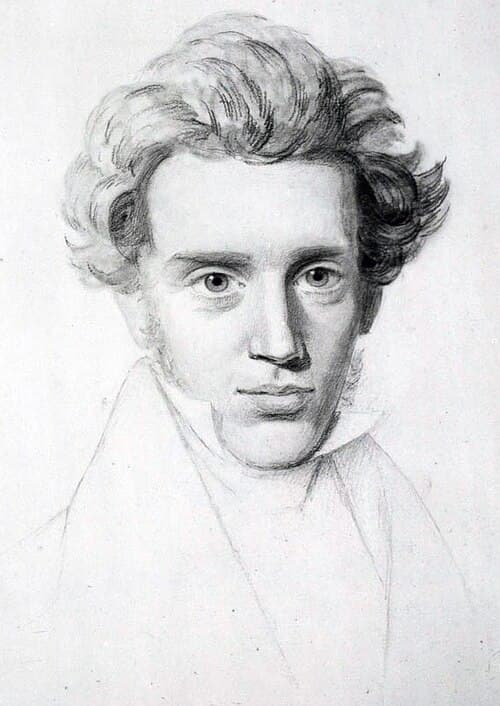
Søren Kierkegaard
Fear and Trembling

The text asserts that every generation must begin from the same starting point regarding human passion and love, as these essential experiences cannot be inherited or bypassed.

...n the art of deceiving itself? Or rather is not the thing most needed an honest seriousness which dauntlessly and incorruptibly points to the tasks, an honest seriousness which lovingly watches over the tasks, which does not frighten men into being over hasty in getting the highest tasks accomplished, but keeps the tasks young and beautiful and charming to look upon and yet difficult withal and appealing to noble minds. For the enthusiasm of noble natures is aroused only by difficulties.
Whatever the one generation may learn from the other, that which is genuinely human no generation learns from the foregoing. In this respect every generation begins primitively, has no different task from that of every previous generation, nor does it get further, except in so far as the preceding generation shirked its task and deluded itself. This authentically human factor is passion, in which also the one generation perfectly understands the other and understands itself. Thus no generation has learned from another to love, no generation begins at any other point than at the beginning, no generation has a shorter task assigned to it than had the preceding generation, and if here one is not willing like the previous generations to stop with love but would go further, this is but idle and foolish talk.
But the highest passion in a man is faith, and here no generation begins at any other point than did the preceding generation, every generation begins all over again, the subsequent generation gets no further than the foregoing–in so far as this remained faithful to its task and did not leave it in the lurch. That this should be wearisome is of course something the generation cannot say, for the generation has in fact the task to perform and has nothing to do with the consideration that...
6

Søren Kierkegaard

Fear and Trembling

Faith's Eternal Beginning

Extends the parent's claim by identifying faith as the highest passion and reiterating that each generation begins anew in this passion, with no generation getting further if the previous was faithful. This agrees and deepens the focus on passion as the authentic human factor.

...ask and deluded itself. This authentically human factor is passion, in which also the one generation perfectly understands the other and understands itself. Thus no generation has learned from another to love, no generation begins at any other point than at the beginning, no generation has a shorter task assigned to it than had the preceding generation, and if here one is not willing like the previous generations to stop with love but would go further, this is but idle and foolish talk.
But the highest passion in a man is faith, and here no generation begins at any other point than did the preceding generation, every generation begins all over again, the subsequent generation gets no further than the foregoing–in so far as this remained faithful to its task and did not leave it in the lurch. That this should be wearisome is of course something the generation cannot say, for the generation has in fact the task to perform and has nothing to do with the consideration that the foregoing generation had the same task–unless the particular generation or the particular individuals wi...
If the generation begins that sort of thing, it is upside down, and what wonder then that the whole of existence seems to it upside down, for there surely is no one who has found the world so upside down as did the tailor in the fairy tale who went up in his lifetime to heaven and from that standpoint contemplated the world. If the generation would only concern itself about its task, which is the highest thing it can do, it cannot grow weary, for the task is always sufficient for a human...

Friedrich Nietzsche

Beyond Good and Evil

Ancestral Predilections

Challenges the parent's idea that each generation begins primitively, arguing instead that ancestral actions and predispositions are indelibly embedded in the soul. This implies that generations inherit and carry forward traits, rather than starting afresh.

...On the contrary, in the so-called cultured classes, the believers in "modern ideas," nothing is perhaps so repulsive as their lack of shame, the easy insolence of eye and hand with which they touch, taste, and finger everything; and it is possible that even yet there is more RELATIVE nobility of taste, and more tact for reverence among the people, among the lower classes of the people, especially among peasants, than among the newspaper-reading DEMIMONDE of intellect, the cultured class. 264.
It cannot be effaced from a man's soul what his ancestors have preferably and most constantly done: whether they were perhaps diligent economizers attached to a desk and a cash-box, modest and citizen-like in their desires, modest also in their virtues; or whether they were accustomed to commanding from morning till night, fond of rude pleasures and probably of still ruder duties and responsibilities; or whether, finally, at one time or another, they have sacrificed old privileges of birth and possession, in order to live wholly for their faith--for their "God,"--as men of an inexorable and se...
Granted that one knows something of the parents, it is admissible to draw a conclusion about the child: any kind of offensive incontinence, any kind of sordid envy, or of clumsy self-vaunting--the three things which together have constituted the genuine plebeian type in all times--such must pass over to the child, as surely as bad blood; and with the help of the best education and culture one will only succeed in DECEIVING with regard to such heredity.--And what else does education and culture...

Francois de La Rochefoucauld

Maxims

Passions' Perpetual Cycle

Provides a mechanism for the perpetual novelty of passion: in the human heart, passions are constantly regenerated, with the end of one giving rise to another. This explains why passion cannot be learned from others and must be experienced anew by each generation.

In the human heart there is a perpetual generation of passions; so that the ruin of one is almost always the foundation of another.

Friedrich Nietzsche

Thus Spake Zarathustra

Earthquake of New Peoples

Reframes the generational task from simply beginning again to actively seeking new origins for the future. Instead of seeing each generation as repeating the same primitive start, it presents the task as an opportunity to create new fountains and new peoples.

...h other: let us SEE TO IT that we maintain our love! Or shall our pledging be blundering?” —“Give us a set term and a small marriage, that we may see if we are fit for the great marriage! It is a great matter always to be twain.” Thus do I counsel all honest ones; and what would be my love to the Superman, and to all that is to come, if I should counsel and speak otherwise! Not only to propagate yourselves onwards but UPWARDS—thereto, O my brethren, may the garden of marriage help you! 25.
He who hath grown wise concerning old origins, lo, he will at last seek after the fountains of the future and new origins.— O my brethren, not long will it be until NEW PEOPLES shall arise and new fountains shall rush down into new depths. For the earthquake—it choketh up many wells, it causeth much languishing: but it bringeth also to light inner powers and secrets. The earthquake discloseth new fountains. In the earthquake of old peoples new fountains burst forth. And whoever calleth out: “Lo, here is a well for many thirsty ones, one heart for many longing ones, one will for many instrument...
And NO “contract”! Destroy, I pray you, destroy that word of the soft-hearted and half-and-half! 26. O my brethren! With whom lieth the greatest danger to the whole human future? Is it not with the good and just?— —As those who say and feel in their hearts: “We already know what is good and just, we possess it also; woe to those who still seek thereafter!” And whatever harm the wicked may do, the harm of the good is the harmfulest harm! And whatever harm the world-maligners may do, the har...

Julius Evola

Revolt Against the Modern World

Remembering Nonhuman Truths

Questions the very possibility of learning or discussing the truths that matter, stating that they either are or are not, and can only be remembered from a nonhuman perspective. This casts doubt on whether any generation can truly 'learn' from another, even at a fundamental level.

...pproach are well known: "Arbitrary!" "Subjective!" "Preposterous!" In my perspective there is no arbitrariness, subjectivity, or fantasy, just like there is no objectivity and scientific causality the way modern men understand them. All these notions are unreal; all these notions are outside Tradition. Tradition begins wherever it is possible to rise above these notions by achieving a superindividual and nonhuman perspective; thus, I will have a minimal concern for debating and "demonstrating."
The truths that may reveal the world of Tradition are not those that can be "learned" or "discussed"; either they are or they are not. It is only possible to remember them, and this happens when one becomes free of the obstacles represented by various human constructions, first among which are all the results and the methods of specialized researchers; in other words, one becomes free of these encumbrances when the capacity for seeing from that nonhuman perspective, which is the same as the traditional perspective, has been attained. This is one of the essential "protests" that should be made...
Universality is typical of this world; the axiom, " quod ubique, quad ab omnibus et quod semper " characterizes it. Inherent to the idea of "traditional civilization" is the idea of an equivalence or homology of its various forms realized in space and time. The correspondences may not be noticeable from the outside; one may be taken aback by the diversity of several possible and yet equivalent expressions; in some case the correspondences are respected in the spirit, in other cases only formall...

Søren Kierkegaard

Fear and Trembling

Faith's Tremendous Paradox

Offers practical guidance: rather than dismissing Abraham as irrelevant, we should confront the paradox of his faith to understand how our own age can find joy through faith. This answers 'what to do' in light of the primacy of passion and the need for each generation to discover it anew.

...No miracle occurs. The whole of life is a trial." In proportion as the orator proceeds with his outpouring, he would get more and more excited, would become more and more delighted with himself, and whereas he had noticed no congestion of the blood while he talked about Abraham, he now felt how the vein swelled in his forehead. Perhaps he would have lost his breath as well as his tongue if the sinner had answered calmly and with dignity, "But it was about this you preached last Sunday.
"Let us then either consign Abraham to oblivion, or let us learn to be dismayed by the tremendous paradox which constitutes the significance of Abraham's life, that we may understand that our age, like every age, can be joyful if it has faith. In case Abraham is not a nullity, a phantom, a show one employs for a pastime, then the fault can never consist in the fact that the sinner wants to do likewise, but the point is to see how great a thing it was that Abraham did, in order that man may judge for himself whether he has the call and the courage to be subjected to such a test.
The comic contradiction in the behavior of the orator is that he reduced Abraham to an insignificance, and yet would admonish the other to behave in the same way. Should not one dare then to talk about Abraham? I think one should. If I were to talk about him, I would first depict the pain of his trial. To that end I would like a leech suck all the dread and distress and torture out of a father's sufferings, so that I might describe what Abraham suffered, whereas all the while he neverth...