Doubt Transformed to Guilt
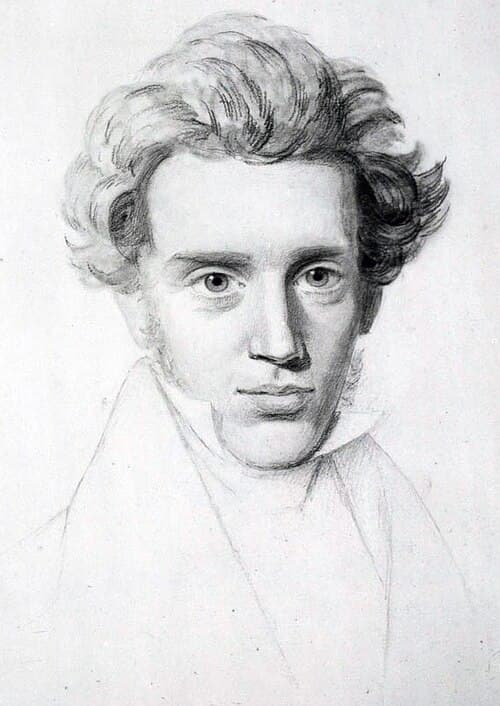
Søren Kierkegaard
Fear and Trembling

The author suggests that a doubter can find a warrant for silence by transforming doubt into guilt and entering into an absolute relation with the absolute.

...ur, he does not get to know it till afterwards, and the upshot cannot help a man either at the moment of action or with regard to his responsibility. If he keeps silent on his own responsibility, he may indeed be acting magnanimously, but to his other pains he adds a little temptation (Anfechtung), for the universal will constantly torture him and say, "You ought to have talked. Where will you find the certainty that it was not after all a hidden pride which governed your resolution?
"If on the other hand the doubter is able to become the particular individual who as the individual stands in an absolute relation to the absolute, then he can get a warrant forhis silence. In this case he must transform his doubt into guilt. In this case he is within the paradox, but in this case his doubt is cured, even though he may get another doubt. Even the New Testament would approve of such a silence.
There are even passages in the New Testament which commend irony–if only it is used to conceal something good. This movement, however, is as properly a movement of irony as is any other which has its ground in the fact that subjectivity is higher than reality. In our age people want to hear nothing about this, generally they want to know no more about irony than Hegel has said about it–who strangely enough had not much understanding of it, and bore a grudge against it, which our age has...
4

Francois de La Rochefoucauld

Maxims

Silence as Shield

La Rochefoucauld offers a different rule for silence: it is best for those who distrust themselves. This contrasts with Kierkegaard's prescription, which justifies silence through an absolute relation to the absolute, not self-doubt.

Silence is the best resolve for him who distrusts himself.

Friedrich Nietzsche

Beyond Good and Evil

The Despairing Certainty

Nietzsche warns that an absolute commitment to a 'sure nothing'—a will to truth that rejects all uncertainty—is actually nihilism and a sign of despair. This challenges the prescription by suggesting that such a stance may be born of weariness rather than faith.

...t cannot do otherwise; philosophy is this tyrannical impulse itself, the most spiritual Will to Power, the will to "creation of the world," the will to the causa prima. 10. The eagerness and subtlety, I should even say craftiness, with which the problem of "the real and the apparent world" is dealt with at present throughout Europe, furnishes food for thought and attention; and he who hears only a "Will to Truth" in the background, and nothing else, cannot certainly boast of the sharpest ears.
In rare and isolated cases, it may really have happened that such a Will to Truth--a certain extravagant and adventurous pluck, a metaphysician's ambition of the forlorn hope--has participated therein: that which in the end always prefers a handful of "certainty" to a whole cartload of beautiful possibilities; there may even be puritanical fanatics of conscience, who prefer to put their last trust in a sure nothing, rather than in an uncertain something. But that is Nihilism, and the sign of a despairing, mortally wearied soul, notwithstanding the courageous bearing such a virtue may display.
It seems, however, to be otherwise with stronger and livelier thinkers who are still eager for life. In that they side AGAINST appearance, and speak superciliously of "perspective," in that they rank the credibility of their own bodies about as low as the credibility of the ocular evidence that "the earth stands still," and thus, apparently, allowing with complacency their securest possession to escape (for what does one at present believe in more firmly than in one's body?),--who knows if they...

Søren Kierkegaard

Fear and Trembling

Silence's Double Edge

This excerpt grounds the prescription in the nature of inwardness and the divine relationship: silence is great because it is characteristic of inwardness and constitutes a mutual understanding between the individual and the Deity.

...moved by nothing yet are touched by tears. In the play Iphigenia had leave to weep, really she ought to have been allowed like Jephthah's daughter two months for weeping, not in solitude but at her father's feet, allowed to employ all her art "which is but tears," and to twine about his knees instead of presenting the olive branch of the suppliant. Aesthetics required revelation but helped itself out by a chance; ethics required revelation and found in the tragic hero its satisfaction.
In spite of the severity with which ethics requires revelation, it cannot be denied that secrecy and silence really make a man great precisely because they are characteristics of inwardness. When Amor leaves Psyche he says to her, "Thou shalt give birth to a child which will be a divine infant if thou dost keep silence, but a human being if thou dost reveal the secret." The tragic hero who is the favorite of ethics is the purely human, and him I can understand, and all he does is in the light of the revealed. If I go further, then I stumble upon the paradox, either the divine or the demoniac,...
Before going on to the story of Abraham, however, I would call before the curtain several poetic personages. By the power of dialectic I keep them upon tiptoe, and by wielding over them the scourge of despair I shall surely keep them from standing still, in order that in their dread they may reveal one thing and another.* In his Poetics Aristotle relates a story of a political disturbance at Delphi which was provoked by a question of marriage. The bridegroom, when the _augurs...

Søren Kierkegaard

Fear and Trembling

Faith's Paradoxical Inwardness

This excerpt provides a concrete method: first make the movement of infinite resignation (giving up the universal), then, by virtue of the absurd, take the leap of faith. This is the process by which one becomes the individual in absolute relation to the absolute.

...is the paradox that inwardness is higher than outwardness–or, to recall an expression used above, the uneven number is higher than the even. In the ethical way of regarding life it is therefore the task of the individual to divest himself of the inward determinants and express them in an outward way. Whenever he shrinks from this, whenever he is inclined to persist in or to slip back again into the inward determinants of feeling, mood, etc., he sins, he is in a temptation (Anfechtung).
The paradox of faith is this, that there is an inwardness which is incommensurable for the outward, an inwardness, be it observed, which is not identical with the first but is a new inwardness. This must not be overlooked. Modern philosophy has permitted itself without further ado to substitute in place of "faith" the immediate. When one does that it is ridiculous to deny that faith has existed in all ages. In that way faith comes into rather simple company along with feeling, mood, idiosyncrasy, vapors, etc. To this extent philosophy may be right in saying that one ought not to stop there. Bu...
This I can well understand without maintaining on that account that I have faith. If faith is nothing but what philosophy makes it out to be, then Socrates already went further, much further, whereas the contrary is true, that he never reached it. In an intellectual respect he made the movement of infinity. His ignorance is infinite resignation. This task in itself is a match for human powers, even though people in our time disdain it; but only after it is done, only when the individual...