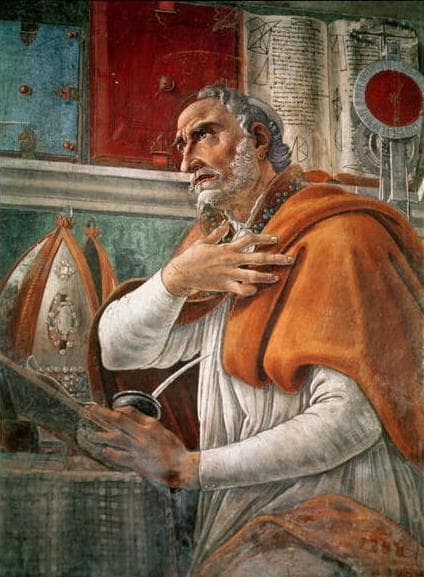
The Fear Paradox
Augustine of Hippo
Confessions

The author explores the ontological status of evil, questioning whether it is a substance or merely the psychological reality of fear itself.

...and on every side, through unmeasured space, one only boundless sea, and it contained within it some sponge, huge, but bounded; that sponge must needs, in all its parts, be filled from that unmeasurable sea: so conceived I Thy creation, itself finite, full of Thee, the Infinite; and I said, Behold God, and behold what God hath created; and God is good, yea, most mightily and incomparably better than all these: but yet He, the Good, created them good; and see how He environeth and fulfils them.
Where is evil then, and whence, and how crept it in hither? What is its root, and what its seed? Or hath it no being? Why then fear we and avoid what is not? Or if we fear it idly, then is that very fear evil, whereby the soul is thus idly goaded and racked. Yea, and so much a greater evil, as we have nothing to fear, and yet do fear. Therefore either is that evil which we fear, or else evil is, that we fear.
Whence is it then? seeing God, the Good, hath created all these things good. He indeed, the greater and chiefest Good, hath created these lesser goods; still both Creator and created, all are good. Whence is evil? Or, was there some evil matter of which He made, and formed, and ordered it, yet left something in it which He did not convert into good? Why so then? Had He no might to turn and change the whole, so that no evil should remain in it, seeing He is All-mighty? Lastly, why would He make...
6

Augustine of Hippo

Confessions

Evil's Non-Substance

This excerpt directly extends Augustine's inquiry by asserting that evil is not a substance but a privation of good, clarifying that all things created are good. It reinforces the parent's exploration of evil's nature and aligns with the idea that fear may be misplaced if evil lacks substantial being.

...h is most certain, all which is corrupted is deprived of good. But if they be deprived of all good, they shall cease to be. For if they shall be, and can now no longer be corrupted, they shall be better than before, because they shall abide incorruptibly. And what more monstrous than to affirm things to become better by losing all their good? Therefore, if they shall be deprived of all good, they shall no longer be. So long therefore as they are, they are good: therefore whatsoever is, is good.
That evil then which I sought, whence it is, is not any substance: for were it a substance, it should be good. For either it should be an incorruptible substance, and so a chief good: or a corruptible substance; which unless it were good, could not be corrupted. I perceived therefore, and it was manifested to me that Thou madest all things good, nor is there any substance at all, which Thou madest not; and for that Thou madest not all things equal, therefore are all things; because each is good, and altogether very good, because our God made all things very good.
And to Thee is nothing whatsoever evil: yea, not only to Thee, but also to Thy creation as a whole, because there is nothing without, which may break in, and corrupt that order which Thou hast appointed it. But in the parts thereof some things, because unharmonising with other some, are accounted evil: whereas those very things harmonise with others, and are good; and in themselves are good. And all these things which harmonise not together, do yet with the inferior part, which we call Earth,...

Friedrich Nietzsche

Thus Spake Zarathustra

Roots in Darkness

Nietzsche challenges Augustine's framework by presenting evil not as an absence or illusion but as an inherent, necessary part of growth and striving. This opposes the parent's premise that evil is either a non-being or a cause of idle fear, suggesting instead that engaging with 'the dark and deep' is essential for ascent.

...ing leaning against a tree, and gazing with wearied look into the valley. Zarathustra thereupon laid hold of the tree beside which the youth sat, and spake thus: “If I wished to shake this tree with my hands, I should not be able to do so. But the wind, which we see not, troubleth and bendeth it as it listeth. We are sorest bent and troubled by invisible hands.” Thereupon the youth arose disconcerted, and said: “I hear Zarathustra, and just now was I thinking of him!” Zarathustra answered:
“Why art thou frightened on that account?—But it is the same with man as with the tree. The more he seeketh to rise into the height and light, the more vigorously do his roots struggle earthward, downward, into the dark and deep—into the evil.”
“Yea, into the evil!” cried the youth. “How is it possible that thou hast discovered my soul?” Zarathustra smiled, and said: “Many a soul one will never discover, unless one first invent it.” “Yea, into the evil!” cried the youth once more. “Thou saidst the truth, Zarathustra. I trust myself no longer since I sought to rise into the height, and nobody trusteth me any longer; how doth that happen? I change too quickly: my to-day refuteth my yesterday. I often overleap the steps when I clam...

Blaise Pascal

Pensees

True vs False Fear

Pascal explains the psychological mechanism behind fear, distinguishing between 'evil fear' born of doubt about God's existence and 'true fear' arising from faith. This addresses the parent's question about why we fear and whether fear itself can be evil, providing a causal account rooted in belief or its absence.

...either believe, or deny, or doubt. Shall we then have no rule? We judge that animals do well what they do. Is there no rule whereby to judge men? To deny, to believe, and to doubt well, are to a man what the race is to a horse. Punishment of those who sin, error. 261 Those who do not love the truth take as a pretext that it is disputed, and that a multitude deny it. And so their error arises only from this, that they do not love either truth or charity. Thus they are without excuse. 262
Superstition and lust. Scruples, evil desires. Evil fear; fear, not such as comes from a belief in God, but such as comes from a doubt whether He exists or not. True fear comes from faith; false fear comes from doubt. True fear is joined to hope, because it is born of faith, and because men hope in the God in whom they believe. False fear is joined to despair, because men fear the God in whom they have no belief. The former fear to lose Him; the latter fear to find Him.
263 "A miracle," says one, "would strengthen my faith." He says so when he does not see one. Reasons, seen from afar, appear to limit our view; but when they are reached, we begin to see beyond. Nothing stops the nimbleness of our mind. There is no rule, say we, which has not some exceptions, no truth so general which has not some aspect in which it fails. It is sufficient that it be not absolutely universal to give us a pretext for applying the exceptions to the present subject, and for say...

Aristotle

Nicomachean Ethics

Fear's Proper Objects

Aristotle reframes the discussion from the ontology of evil to the ethics of fear, shifting the lens to what objects of fear are noble or base. He redirects the question from 'what is evil?' to 'what should we fear?', evaluating fear in terms of virtue and courage rather than metaphysical status.

...will resume the particular discussion of the Moral Virtues, and say what they are, what is their object-matter, and how they stand respectively related to it: of course their number will be thereby shown. First, then, of Courage. Now that it is a mean state, in respect of fear and boldness, has been already said: further, the objects of our fears are obviously things fearful or, in a general way of statement, evils; which accounts for the common definition of fear, viz. “expectation of evil.”
Of course we fear evils of all kinds: disgrace, for instance, poverty, disease, desolateness, death; but not all these seem to be the object-matter of the Brave man, because there are things which to fear is right and noble, and not to fear is base; disgrace, for example, since he who fears this is a good man and has a sense of honour, and he who does not fear it is shameless (though there are those who call him Brave by analogy, because he somewhat resembles the Brave man who agrees with him in being free from fear); but poverty, perhaps, or disease, and in fact whatever does not proceed from...
Yet we do apply the term[16] in right of the similarity of the cases; for there are men who, though timid in the dangers of war, are liberal men and are stout enough to face loss of wealth. And, again, a man is not a coward for fearing insult to his wife or children, or envy, or any such thing; nor is he a Brave man for being bold when going to be scourged. What kind of fearful things then do constitute the object-matter of the Brave man? first of all, must they not be the greatest, since no...

Augustine of Hippo

Confessions

Evil as Privation

This excerpt questions our ability to understand evil, highlighting the limits of sensory and intellectual perception. It addresses the epistemic challenge implicit in the parent text, suggesting that without spiritual insight, one cannot grasp that evil is merely privation, thus casting doubt on our capacity to settle the issue through reason alone.

...et: she seduced me, because she found my soul dwelling abroad in the eye of my flesh, and ruminating on such food as through it I had devoured. For other than this, that which really is I knew not; and was, as it were through sharpness of wit, persuaded to assent to foolish deceivers, when they asked me, "whence is evil?" "is God bounded by a bodily shape, and has hairs and nails?" "are they to be esteemed righteous who had many wives at once, and did kill men, and sacrifice living creatures?"
At which I, in my ignorance, was much troubled, and departing from the truth, seemed to myself to be making towards it; because as yet I knew not that evil was nothing but a privation of good, until at last a thing ceases altogether to be; which how should I see, the sight of whose eyes reached only to bodies, and of my mind to a phantasm? And I knew not God to be a Spirit, not one who hath parts extended in length and breadth, or whose being was bulk; for every bulk is less in a part than in the whole: and if it be infinite, it must be less in such part as is defined by a certain space, than...
And what that should be in us, by which we were like to God, and might be rightly said to be after the image of God, I was altogether ignorant. Nor knew I that true inward righteousness which judgeth not according to custom, but out of the most rightful law of God Almighty, whereby the ways of places and times were disposed according to those times and places; itself meantime being the same always and every where, not one thing in one place, and another in another; according to which Abraham,...

Marcus Aurelius

Meditations

Will's Proper Jurisdiction

Marcus Aurelius offers practical Stoic guidance: to avoid fear and discontent, one should only judge things within one's own control as good or evil. This answers the parent's concern about idle fear by prescribing a mental discipline that eliminates unnecessary anxiety and refocuses evaluation on the will.

...chance that made and fitted it, be out of sight and gone. But in things natural, that power which hath framed and fitted them, is and abideth within them still: for which reason she ought also the more to be respected, and we are the more obliged (if we may live and pass our time according to her purpose and intention) to think that all is well with us, and according to our own minds. After this manner also, and in this respect it is, that he that is all in all doth enjoy his happiness. XXXVI.
What things soever are not within the proper power and jurisdiction of thine own will either to compass or avoid, if thou shalt propose unto thyself any of those things as either good, or evil; it must needs be that according as thou shalt either fall into that which thou dost think evil, or miss of that which thou dost think good, so wilt thou be ready both to complain of the Gods, and to hate those men, who either shall be so indeed, or shall by thee be suspected as the cause either of thy missing of the one, or falling into the other. And indeed we must needs commit many evils, if we inclin...
XXXVII. We all work to one effect, some willingly, and with a rational apprehension of what we do: others without any such knowledge. As I think Heraclitus in a place speaketh of them that sleep, that even they do work in their kind, and do confer to the general operations of the world. One man therefore doth co-operate after one sort, and another after another sort; but even he that doth murmur, and to his power doth resist and hinder; even he as much as any doth co-operate. For of such also...