The author challenges the idea that existing as an individual is easy, suggesting it requires more strict self-supervision than living under universal rules.
The Terrible Individual
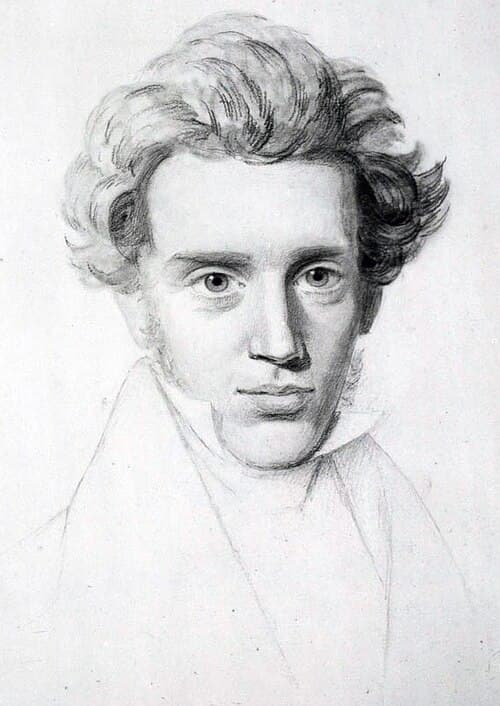
Søren Kierkegaard
Fear and Trembling...in the Church–not even his father and mother etc.–who fails to understand him. On the other hand, he is not a knight of faith, and he has also a different answer from that of Abraham: he does not say that it is a trial or a temptation in which he is tested. People commonly refrain from quoting such a text as this in Luke. They are afraid of giving men a free rein, are afraid that the worst will happen as soon as the individual takes it into his head to comport himself as the individual.
Moreover, they think that to exist as the individual is the easiest thing of all, and that therefore people have to be compelled to become the universal. I cannot share either this fear or this opinion, and both for the same reason. He who has learned that to exist as the individual is the most terrible thing of all will not be fearful of saying that it is great, but then too he will say this in such a way that his words will scarcely be a snare for the bewildered man, but rather will help him into the universal, even though his words do to some extent make room for the great. The man who does not dare to mention such texts will not dare to…
That there may be some who need compulsion, some who, if they were free-footed, would riot in selfish pleasures like unruly beasts, is doubtless true; but a man must prove precisely that he is not of this number by the fact that he knows how to speak with dread and trembling; and out of reverence for the great one is bound to speak, lest it be forgotten for fear of the ill effect, which surely will fail to eventuate when a man talks in such a way that one knows it for the great, knows it...
Continue reading →
4
⚖Ethics Requires Revelation

Søren Kierkegaard
Fear and TremblingThe author explains that the tragic hero expresses the universal through ethical courage and transparency, contrasting this with the silence that might stem from either self-interest or aesthetic illusion.
...fort from any other man, and out of solicitude for the women too he ought to conceal this from them as long as possible. On the other hand, the hero, precisely in order to be a hero, must be tried by dreadful temptations which the tears of Clytemnestra and Iphigenia provide for him. What does aesthetics do? It has an expedient, it has in readiness an old servant who reveals everything to Clytemnestra. Then all is as it should be. Ethics, however, has at hand no chance and no old servant.
The aesthetical idea contradicts itself as soon as it must be carried out in reality. Hence ethics requires revelation. The tragic hero displays his ethical courage precisely by the fact that it is he who, without being ensnared in any aesthetic illusion, himself announces to Iphigenia her fate. If the tragic hero does this, then he is the beloved son of ethics in whom it is well pleased. If he keeps silent, it may be because he thinks thereby to make it easier for others, but it may also be because thereby he makes it easier for himself. However, he knows that he is not influenced by this latter motive. If he keeps silent, he assumes as the…
His heroic action demands courage, but it belongs to this courage that he shall shun no argumentation. Now it is certain that tears are a dreadful argumentum ad hominem, and doubtless there are those who are moved by nothing yet are touched by tears. In the play Iphigenia had leave to weep, really she ought to have been allowed like Jephthah's daughter two months for weeping, not in solitude but at her father's feet, allowed to employ all her art "which is but tears," and to twine...
Continue reading →
2
⚖Speaking as Acknowledgment

Søren Kierkegaard
Fear and TremblingThe author discusses the ethical obligation to speak and acknowledge the universal, warning against those who try to resolve doubt too easily.
...one man a little hint of doubt, from another a little hint of faith, and then turn it to account as best they can, according as the congregation wants to have fine sand or coarse sand.) Faust is too ideal a figure to go about in carpet-slippers. He who has not an infinite passion is not the ideal, and he who has an infinite passion has long ago saved his soul out of such nonsense. He keeps silent and sacrifices himself/or he talks with the consciousness that he will confound everything.
If he keeps silent, ethics condemns him, for it says, "Thou shalt acknowledge the universal, and it is precisely by speaking thou dost acknowledge it, and thou must not have compassion upon the universal." One ought not to forget this consideration when sometimes one judges a doubter severely for talking. I am not inclined to judge such conduct leniently, but in this case as everywhere all depends upon whether the movements occur normally. If worse comes to worst, a doubter, even though by talking he were to bring down all possible misfortune upon the world, is much to be preferred to these miserable sweet-tooths who taste a little of…
If he keeps silent on his own responsibility, he may indeed be acting magnanimously, but to his other pains he adds a little temptation (Anfechtung), for the universal will constantly torture him and say, "You ought to have talked. Where will you find the certainty that it was not after all a hidden pride which governed your resolution?" If on the other hand the doubter is able to become the particular individual who as the individual stands in an absolute relation to the absolute, the...
Continue reading →
4
⚖The Universal's Telos

Søren Kierkegaard
Fear and TremblingThe author defines the ethical as the universal and argues that the individual's moral task is to abolish their particularity to express this universal telos.
...ion to draw out from the story of Abraham the dialectical consequences inherent in it, expressing them in the form of problemata, in order to see what a tremendous paradox faith is, a paradox which is capable of transforming a murder into a holy act well-pleasing to God, a paradox which gives Isaac back to Abraham, which no thought can master, because faith begins precisely there where thinking leaves off. PROBLEM I Is there such a thing as a teleological suspension of the ethical?
The ethical as such is the universal, and as the universal it applies to everyone, which may be expressed from another point of view by saying that it applies every instant. It reposes immanently in itself, it has nothing without itself which is its telos, but is itself telos for everything outside it, and when this has been incorporated by the ethical it can go no further. Conceived immediately as physical and psychical, the particular individual is the individual who has his telos in the universal, and his ethical task is to express himself constantly in it, to abolish his particularity in order to become the universal.
As soon as the individual would assert himself in his particularity over against the universal he sins, and only by recognizing this can he again reconcile himself with the universal. Whenever the individual after he has entered the universal feels an impulse to assert himself as the particular, he is in temptation (Anfechtung), and he can labor himself out of this only by penitently abandoning himself as the particular in the universal. If this be the highest thing that can be said of...
6
⚖Solitary Faith's Terror

Søren Kierkegaard
Fear and TremblingThe author explores the internal struggle and loneliness of the knight of faith, who must treat the desire for universal understanding as a temptation to be resisted.
...is there winds a solitary path, narrow and steep; he knows that it is terrible to be born outside the universal, to walk without meeting a single traveller. He knows very well where he is and how he is related to men. Humanly speaking, he is crazy and cannot make himself intelligible to anyone. And yet it is the mildest expression, to say that he is crazy. If he is not supposed to be that, then he is a hypocrite, and the higher he climbs on this path, the more dreadful a hypocrite he is.
The knight of faith knows that to give up oneself for the universal inspires enthusiasm, and that it requires courage, but he also knows that security is to be found in this, precisely because it is for the universal. He knows that it is glorious to be understood by every noble mind, so glorious that the beholder is ennobled by it, and he feels as if he were bound; he could wish it were this task that had been allotted to him. Thus Abraham could surely have wished now and then that the task were to love Isaac as becomes a father, in a way intelligible to all, memorable throughout all ages; he could wish that the task were to sacrifice Isaac…
Or what did Abraham accomplish for the universal? Let me speak humanly about it, quite humanly. He spent seventy years in getting a son of his old age. What other men get quickly enough and enjoy for a long time he spent seventy years in accomplishing. And why? Because he was tried and put to the test. Is not that crazy? But Abraham believed, and Sarah wavered and got him to take Hagar as a concubine–but therefore he also had to drive her away. He gets Isaac, then he has to be tried again...
Continue reading →
2