The author depicts the agonizing silence of Abraham, who cannot speak a human language or offer comfort because his actions are unintelligible to his loved ones.
Abraham's Silent Agony
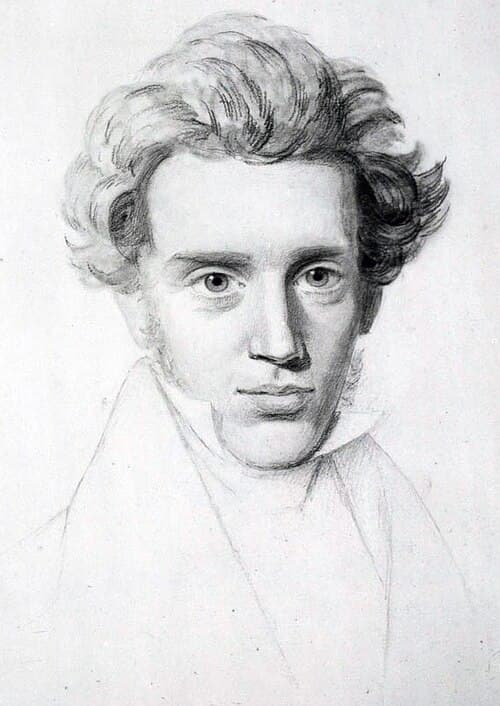
Søren Kierkegaard
Fear and Trembling...gainst him. He can be sure that everything that can be said against him has been said, unsparingly, mercilessly–and to strive against the whole world is a comfort, to strive with oneself is dreadful. He has no reason to fear that he has overlooked anything, so that afterwards he must cry out as did King Edward the Fourth at the news of the death of Clarence: Who su'd to me for him? who, in my wrath, Kneel'd at my feet and bade me be advised? Who spoke of brotherhood? who spoke of love?
The tragic hero does not know the terrible responsibility of solitude. In the next place he has the comfort that he can weep and lament with Clytemnestra and Iphigenia–and tears and cries are assuaging, but unutterable sighs are torture. Agamemnon can quickly collect his soul into the certainty that he will act, and then he still has time to comfort and exhort. This Abraham is unable to do. When his heart is moved, when his words would contain a blessed comfort for the whole world, he does not dare to offer comfort, for would not Sarah, would not Eleazar, would not Isaac say, "Why wilt thou do it? Thou canst refrain?" And if in his distress…
Though he himself understood all the tongues of the world, though his loved ones also understood them, he nevertheless cannot speak–he speaks a divine language … he "speaks with tongues." This distress I can well understand, I can admire Abraham, I am not afraid that anyone might be tempted by this narrative light-heartedly to want to be the individual, but I admit also that I have not the courage for it, and that I renounce gladly any prospect of getting further–if only it were possible...
Continue reading →
1
⚖No Mediated Paradox

Søren Kierkegaard
Fear and TremblingThe author argues that Abraham's act cannot be mediated by logic; he is either a common murderer or a believer, existing in a category that defies standard ethical comprehension.
...a little more closely, I have not much doubt that in the whole world one will not find a single analogy (except a later instance which proves nothing), if it stands fast that Abraham is the representative of faith, and that faith is normally expressed in him whose life is not merely the most paradoxical that can be thought but so paradoxical that it cannot be thought at all. He acts by virtue of the absurd, for it is precisely absurd that he as the particular is higher than the universal.
This paradox cannot be mediated; for as soon as he begins to do this he has to admit that he was in temptation (Anfechtung), and if such was the case, he never gets to the point of sacrificing Isaac, or, if he has sacrificed Isaac, he must turn back repentantly to the universal. By virtue of the absurd he gets Isaac again. Abraham is therefore at no instant a tragic hero but something quite different, either a murderer or a believer. The middle term which saves the tragic hero, Abraham has not. Hence it is that I can understand the tragic hero but cannot understand Abraham, though in a certain crazy sense I admire him more than all other men.
Abraham's relation to Isaac, ethically speaking, is quite simply expressed by saying that a father shall love his son more dearly than himself. Yet within its own compass the ethical has various gradations. Let us see whether in this story there is to be found any higher expression for the ethical such as would ethically explain his conduct, ethically justify him in suspending the ethical obligation toward his son, without in this search going beyond the teleology of the ethical. When a...
2
⚖Striving with Oneself

Søren Kierkegaard
Fear and TremblingThe author describes the psychological comfort of the tragic hero who faces external opposition, contrasting it with the 'dreadful' internal struggle of the knight of faith.
...thing he cannot say, i.e. say it in such a way that another understands it, and so he is not speaking. The relief of speech is that it translates me into the universal. Now Abraham is able to say the most beautiful things any language can express about how he loves Isaac. But it is not this he has at heart to say, it is the profounder thought that he would sacrifice him because it is a trial. This latter thought no one can understand, and hence everyone can only misunderstand the former.
This distress the tragic hero does not know. He has first of all the comfort that every counter-argument has received due consideration, that he has been able to give to Clytemnestra, to Iphigenia, to Achilles, to the chorus, to every living being, to every voice from the heart of humanity, to every cunning, every alarming, every accusing, every compassionate thought, opportunity to stand up against him. He can be sure that everything that can be said against him has been said, unsparingly, mercilessly–and to strive against the whole world is a comfort, to strive with oneself is dreadful.
He has no reason to fear that he has overlooked anything, so that afterwards he must cry out as did King Edward the Fourth at the news of the death of Clarence: Who su'd to me for him? who, in my wrath, Kneel'd at my feet and bade me be advised? Who spoke of brotherhood? who spoke of love? The tragic hero does not know the terrible responsibility of solitude. In the next place he has the comfort that he can weep and lament with Clytemnestra and Iphigenia–and tears and cries are assuagi...
2
⚖Individual vs Universal

Søren Kierkegaard
Fear and TremblingThe text distinguishes between the tragic hero, who aligns with the universal, and the knight of faith, who must paradoxically become an individual above the universal.
...man must prove precisely that he is not of this number by the fact that he knows how to speak with dread and trembling; and out of reverence for the great one is bound to speak, lest it be forgotten for fear of the ill effect, which surely will fail to eventuate when a man talks in such a way that one knows it for the great, knows its terror–and apart from the terror one does not know the great at all. Let us consider a little more closely the distress and dread in the paradox of faith.
The tragic hero renounces himself in order to express the universal, the knight of faith renounces the universal in order to become the individual. As has been said, everything depends upon how one is placed. He who believes that it is easy enough to be the individual can always be sure that he is not a knight of faith, for vagabonds and roving geniuses are not men of faith. The knight of faith knows, on the other hand, that it is glorious to belong to the universal. He knows that it is beautiful and salutary to be the individual who translates himself into the universal, who edits as it were a pure and elegant edition of himself, as free…
He knows that it is refreshing to become intelligible to oneself in the universal so that he understands it and so that every individual who understands him understands through him in turn the universal, and both rejoice in the security of the universal. He knows that it is beautiful to be born as the individual who has the universal as his home, his friendly abiding-place, which at once welcomes him with open arms when he would tarry in it. But he knows also that higher than this there...
Continue reading →
2
⚖Abraham's Divine Attachment

Søren Kierkegaard
Fear and TremblingThe author depicts Abraham's trial as a private, inexplicable burden that makes the knight of faith appear slow and 'creeping' compared to the more understandable tragic hero.
...ose in that, and all would have reposed in the commendation of his deed, as a vowel reposes in its consonant, but that is not the task–he is tried. That Roman general who is celebrated by his name of Cunctator checked the foe by procrastination–but what a procrastinator Abraham is in comparison with him! … yet he did not save the state. This is the content of one hundred and thirty years. Who can bear it? Would not his contemporary age, if we can speak of such a thing, have said of him,
"Abraham is eternally procrastinating. Finally he gets a son. That took long enough. Now he wants to sacrifice him. So is he not mad? And if at least he could explain why he wants to do it–but he always says that it is a trial." Nor could Abraham explain more, for his life is like a book placed under a divine attachment and which never becomes publici juris. This is the terrible thing. He who does not see it can always be sure that he is no knight of faith, but he who sees it will not deny that even the most tried of tragic heroes walks with a dancing step compared with the knight of faith, who comes slowly creeping forward.
And if he has perceived this and assured himself that he has not courage to understand it, he will at least have a presentiment of the marvellous glory this knight attains in the fact that he becomes God's intimate acquaintance, the Lord's friend, and (to speak quite humanly) that he says "Thou" to God in heaven, whereas even the tragic hero only addresses Him in the third person. The tragic hero is soon ready and has soon finished the fight, he makes the infinite movement and then is se...
1