Faith's Fine Dialectic
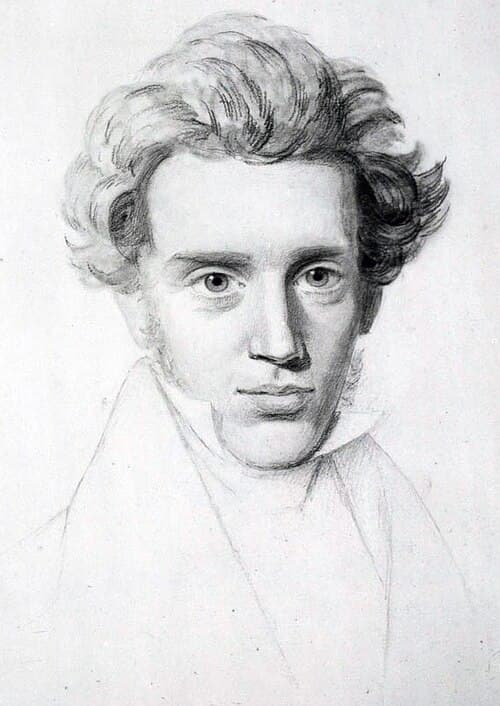
Søren Kierkegaard
Fear and Trembling

The author expresses a sense of awe and personal inadequacy regarding the 'prodigy' of faith, which regains the finite world through the power of the absurd.

...me, but by a double- movement he had reached his first position, and therefore he received Isaac more gladly than the first time. Let us go further. We let Isaac be really sacrificed. Abraham believed. He did not believe that some day he would be blessed in the beyond, but that he would be happy here in the world. God could give him a new Isaac, could recall to life him who had been sacrificed. He believed by virtue of the absurd; for all human reckoning had long since ceased to function.
That sorrow can derange a man's mind, that we see, and it is sad enough. That there is such a thing as strength of will which is able to haul up so exceedingly close to the wind that it saves a man's reason, even though he remains a little queer, that too one sees. I have no intention of disparaging this; but to be able to lose one's reason, and therefore the whole of finiteness of which reason is the broker, and then by virtue of the absurd to gain precisely the same finiteness–that appalls my soul, but I do not for this cause say that it is something lowly, since on the contrary it is the only prodigy. Generally people are of the opinion…
I am able to make from the springboard the great leap whereby I pass into infinity, my back is like that of a tight-rope dancer, having been twisted in my childhood, hence I find this easy; with a one-two-three! I can walk about existence on my head; but the next thing I cannot do, for I cannot perform the miraculous, but can only be astonished by it. Yes, if Abraham the instant he swung his leg over the ass's back had said to himself, "Now, since Isaac is lost, I might just as well sacr...
Continue reading →
2
The Absurd's New Creation
Søren Kierkegaard
Fear and Trembling

A description of the knight of faith who, despite having renounced everything, enjoys the finite world fully through the power of the absurd.

...needed, I dare say I could get it." He lounges at an open window and looks out on the square on which he lives; he is interested in everything that goes on, in a rat which slips under the curb, in the children's play, and this with the nonchalance of a girl of sixteen. And yet he is no genius, for in vain I have sought in him the incommensurability of genius. In the evening he smokes his pipe; to look at him one would swear that it was the grocer over the way vegetating in the twilight.
He lives as carefree as a ne'er-do-well, and yet he buys up the acceptable time at the dearest price, for he does not do the least thing except by virtue of the absurd. And yet, and yet–actually I could become furious over it, for envy if for no other reason–this man has made and every instant is making the movements of infinity. With infinite resignation he has drained the cup of life's profound sadness, he knows the bliss of the infinite, he senses the pain of renouncing everything, the dearest things he possesses in the world, and yet finiteness tastes to him just as good as to one who never knew anything higher, for his continuance in the…
He constantly makes the movements of infinity, but he does this with such correctness and assurance that he constantly gets the finite out of it, and there is not a second when one has a notion of anything else. It is supposed to be the most difficult task for a dancer to leap into a definite posture in such a way that there is not a second when he is grasping after the posture, but by the leap itself he stands fixed in that posture. Perhaps no dancer can do it–that is what this knight d...
Continue reading →
2
The Courage of Absurdity
Søren Kierkegaard
Fear and Trembling

The author contrasts human courage, which renounces the temporal for the eternal, with the courage of faith, which paradoxically reclaims the temporal through the absurd.

...which is assigned to every man, that of being his own censor, which is a far prouder title than that of Censor General to the whole Roman Republic. This movement I make by myself, and what I gain is myself in my eternal consciousness, in blissful agreement with my love for the Eternal Being. By faith I make renunciation of nothing, on the contrary, by faith I acquire everything, precisely in the sense in which it is said that he who has faith like a grain of mustard can remove mountains.
A purely human courage is required to renounce the whole of the temporal to gain the eternal; but this I gain, and to all eternity I cannot renounce it–that is a self- contradiction. But a paradoxical and humble courage is required to grasp the whole of the temporal by virtue of the absurd, and this is the courage of faith. By faith Abraham did not renounce his claim upon Isaac, but by faith he got Isaac. By virtue of resignation that rich young man should have given away everything, but then when he had done that, the knight of faith should have said to him, "By virtue of the absurd thou shalt get every penny back again. Canst thou believe…
And this speech ought by no means to have been indifferent to the aforesaid rich young man, for in case he gave away his goods because he was tired of them, his resignation was not much to boast of. It is about the temporal, the finite, everything turns in this case. I am able by my own strength to renounce everything, and then to find peace and repose in pain. I can stand everything–even though that horrible demon, more dreadful than death, the king of terrors, even though madness were...
Continue reading →
2
Movement of Repentance
Søren Kierkegaard
Fear and Trembling

The author argues that returning to reality after repentance requires a movement of the 'absurd' fueled by passion, without which one merely loiters in spiritual delusion.

...nce he could work Agnes loose, then he finds peace indeed but is lost for this world. If he becomes revealed and allows himself to be saved by Agnes, then he is the greatest man I can picture to myself; for it is only the aesthetic writer who thinks lightmindedly that he extols the power of love by letting the lost man be loved by an innocent girl and thereby saved, it is only the aesthetic writer who sees amiss and believes that the girl is the heroine, instead of the man being the hero.
So the merman cannot belong to Agnes unless, after having made the infinite movement, the movement of repentance, he makes still one more movement by virtue of the absurd. By his own strength he can make the movement of repentance, but for that he uses up absolutely all his strength and hence he cannot by his own strength return and grasp reality. If a man has not enough passion to make either the one movement or the other, if he loiters through life, repenting a little, and thinks that the rest will take care of itself, he has once for all renounced the effort to live in the idea–and then he can very easily reach and help others to reach the…
One can therefore divert oneself by reflecting how strange it is that precisely in our age when everyone is able to accomplish the highest things doubt about the immortality of the soul could be so widespread, for the man who has really made even so much as the movement of infinity is hardly a doubter. The conclusions of passion are the only reliable ones, that is, the only convincing conclusions. Fortunately existence is in this instance more kindly and more faithful than the wise maint...
Continue reading →
2
No Mediated Paradox
Søren Kierkegaard
Fear and Trembling

The author argues that Abraham's act cannot be mediated by logic; he is either a common murderer or a believer, existing in a category that defies standard ethical comprehension.

...a little more closely, I have not much doubt that in the whole world one will not find a single analogy (except a later instance which proves nothing), if it stands fast that Abraham is the representative of faith, and that faith is normally expressed in him whose life is not merely the most paradoxical that can be thought but so paradoxical that it cannot be thought at all. He acts by virtue of the absurd, for it is precisely absurd that he as the particular is higher than the universal.
This paradox cannot be mediated; for as soon as he begins to do this he has to admit that he was in temptation (Anfechtung), and if such was the case, he never gets to the point of sacrificing Isaac, or, if he has sacrificed Isaac, he must turn back repentantly to the universal. By virtue of the absurd he gets Isaac again. Abraham is therefore at no instant a tragic hero but something quite different, either a murderer or a believer. The middle term which saves the tragic hero, Abraham has not. Hence it is that I can understand the tragic hero but cannot understand Abraham, though in a certain crazy sense I admire him more than all other men.
Abraham's relation to Isaac, ethically speaking, is quite simply expressed by saying that a father shall love his son more dearly than himself. Yet within its own compass the ethical has various gradations. Let us see whether in this story there is to be found any higher expression for the ethical such as would ethically explain his conduct, ethically justify him in suspending the ethical obligation toward his son, without in this search going beyond the teleology of the ethical. When a...
2