The passage reflects on the greatness of those who endure paradox and distress, noting that true heroes deserve a specific kind of communal grief and self-examination.
Greatness Through Suffering
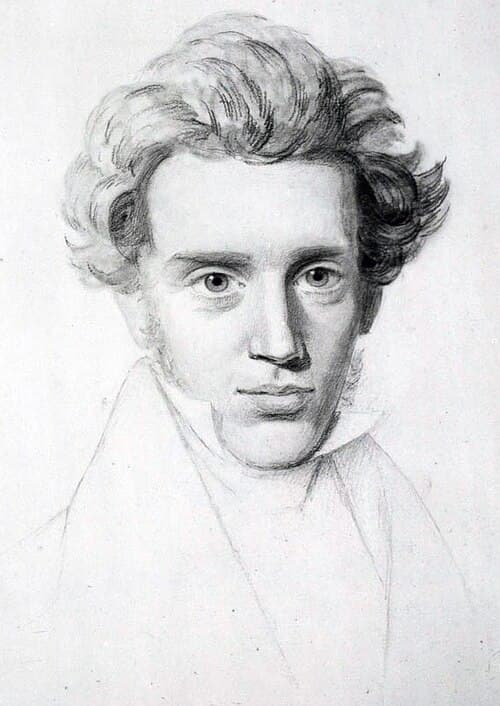
Søren Kierkegaard
Fear and Trembling...nce also that one whom God blesses He curses in the same breath? This is the spirit's interpretation of Mary, and she is not (as it shocks me to say, but shocks me still more to think that they have thoughtlessly and coquettishly interpreted her thus)–she is not a fine lady who sits in state and plays with an infant god. Nevertheless, when she says, "Behold the handmaid of the Lord"–then she is great, and I think it will not be found difficult to explain why she became the Mother of God.
She has no need of worldly admiration, any more than Abraham has need of tears, for she was not a heroine, and he was not a hero, but both of them became greater than such, not at all because they were exempted from distress and torment and paradox, but they became great through these. It is great when the poet, presenting his tragic hero before the admiration of men, dares to say, "Weep for him, for he deserves it." For it is great to deserve the tears of those who are worthy to shed tears. It is great that the poet dares to hold the crowd in check, dares to castigate men, requiring that every man examine himself whether he be worthy to weep…
For the waste-water of blubberers is a degradation of the holy.–But greater than all this it is that the knight of faith dares to say even to the noble man who would weep for him, "Weep not for me, but weep for thyself." One is deeply moved, one longs to be back in those beautiful times, a sweet yearning conducts one to the desired goal, to see Christ wandering in the promised land. One forgets the dread, the distress, the paradox. Was it so easy a matter not to be mistaken? Was it not d...
Continue reading →
2
⚖Pity's Strange Dialectic

Søren Kierkegaard
Fear and TremblingThe author expresses deep personal empathy for the character of Sarah, observing the spiritual cruelty of being an innocent object of pity.
...ring deed! What humility before the face of another personl What faith in God to believe that the next instant she would not hate the husband to whom she owed everything! Let Sarah be a man, and with that the demoniacal is close at hand. The proud and noble nature can endure everything, but one thing it cannot endure, it cannot endure pity. In that there is implied an indignity which can only be inflicted upon one by a higher power, for by oneself one can never become an object of pity.
If a man has sinned, he can bear the punishment for it without despairing; but without blame to be singled out from his mother's womb as a sacrifice to pity, as a sweet-smelling savor in its nostrils, that he cannot put up with. Pity has a strange dialectic, at one moment it requires guilt, the next moment it will not have it, and so it is that to be predestinated to pity is more and more dreadful the more the individual's misfortune is in the direction of the spiritual. But Sarah had no blame attaching to her, she is cast forth as a prey to every suffering and in addition to this has to endure the torture of pity–for even I who admire her…
Put a man in Sarah's place, let him know that in case he were to love a girl a spirit of hell would come and murder his loved one–it might well be possible that he would choose the demoniacal part, that he would shut himself up within himself and say in the way a demoniacal nature talks in secret, "Many thanks, I am no friend of courteous and prolix phrases, I do not absolutely need the pleasure of love, I can become a Blue Beard, finding my delight in seeing maidens perish during the n...
Continue reading →
2
⚖Repentance's Double Grip

Søren Kierkegaard
Fear and TremblingThe author uses the mythological figure of the merman to metaphorically explore the psychological tension between hidden guilt and the revelation of love.
...ce is more righteous and fair: there is only one protection, and that is innocence. We will now bestow upon the merman a human consciousness and suppose that the fact of his being a merman indicates a human pre- existence in the consequences of which his life is entangled. There is nothing to prevent him from becoming a hero, for the step he now takes is one of reconciliation. He is saved by Agnes, the seducer is crushed, he has bowed to the power of innocence, he can never seduce again.
But at the same instant two powers are striving for possession of him: repentance; and Agnes and repentance. If repentance alone takes possession of him, then he is hidden; if Agnes and repentance take possession of him, then he is revealed. Now in case repentance grips the merman and he remains concealed, he has clearly made Agnes unhappy, for Agnes loved him in all her innocence, she believed that at the instant when even to her he seemed changed, however well he hid it, he was telling the truth in saying that he only wanted to show her the beautiful calmness of the sea. However, with respect to passion the merman himself becomes still more…
The demoniacal element in repentance will now explain to him that this is precisely his punishment [for the faults of his pre-existent state], and that the more it tortures him the better. If he abandons himself to this demoniacal influence, he then perhaps makes still another attempt to save Agnes, in such a way as one can, in a certain sense, save a person by means of the evil. He knows that Agnes loves him. If he could wrest from Agnes this love, then in a way she is saved. But how? T...
Continue reading →
2
⚖Silence in Paradox

Søren Kierkegaard
Fear and TremblingThe author explains that Abraham's silence is a necessary component of his paradox, and that speaking at the last moment would have been a sign of spiritual weakness rather than strength.
...in a certain sense can understand Abraham in what he says, though without getting any closer to him than I have been in the foregoing discussion. In case no last rejoinder of Socrates had existed, I should have been able to think myself into him and formulate such a word; if I were unable to do it, a poet could, but no poet can catch up with Abraham. Before I go on to consider Abraham's last word more closely I would call attention to the difficulty Abraham had in saying anything at all.
The distress and anguish in the paradox consisted (as was set forth above) in silence–Abraham cannot speak.* So in view of this fact it is a contradiction to require him to speak, unless one would have him out of the paradox again, in such a sense that at the last moment he suspends it, whereby he ceases to be Abraham and annuls all that went before. So then if Abraham at the last moment were to say to Isaac, "To thee it applies," this would only have been a weakness. For if he could speak at all, he ought to have spoken long before, and the weakness in this case would consist in the fact that he did not possess the maturity of spirit and the…
Moreover, by such a speech he would fall out of the role of the paradox, and if he really wanted to speak to Isaac, he must transform his situation into a temptation (Anfechtung), for otherwise he could say nothing, and if he were to do that, then he is not even so much as a tragic hero. However, a last word of Abraham has been preserved, and in so far as I can understand the paradox I can also apprehend the total presence of Abraham in this word. First and foremost, he does not say an...
Continue reading →
2
⚖God's Elect Denied

Søren Kierkegaard
Fear and TremblingThe author reflects on the poetic irony of Abraham's election, describing the life of the chosen as one of delayed fulfillment and persistent expectation against all odds.
...tation. It is human to sorrow, human to sorrow with them that sorrow, but it is greater to believe, more blessed to contemplate the believer. There is no song of Lamentations by Abraham. He did not mournfully count the days while time passed, he did not look at Sarah with a suspicious glance, wondering whether she were growing old, he did not arrest the course of the sun, that Sarah might not grow old, and his expectation with her. He did not sing lullingly before Sarah his mournful lay.
Abraham became old, Sarah became a laughingstock in the land, and yet he was God's elect and inheritor of the promise that in his seed all the races of the world would be blessed. So were it not better if he had not been God's elect? What is it to be God's elect? It is to be denied in youth the wishes of youth, so as with great pains to get them fulfilled in old age. But Abraham believed and held fast the expectation.
If Abraham had wavered, he would have given it up. If he had said to God, "Then perhaps it is not after all Thy will that it should come to pass, so I will give up the wish. It was my only wish, it was my bliss. My soul is sincere, I hide no secret malice because Thou didst deny it to me"–he would not have been forgotten, he would have saved many by his example, yet he would not be the father of faith. For it is great to give up one's wish, but it is greater to hold it fast after having...
2