Faith Beyond Concepts
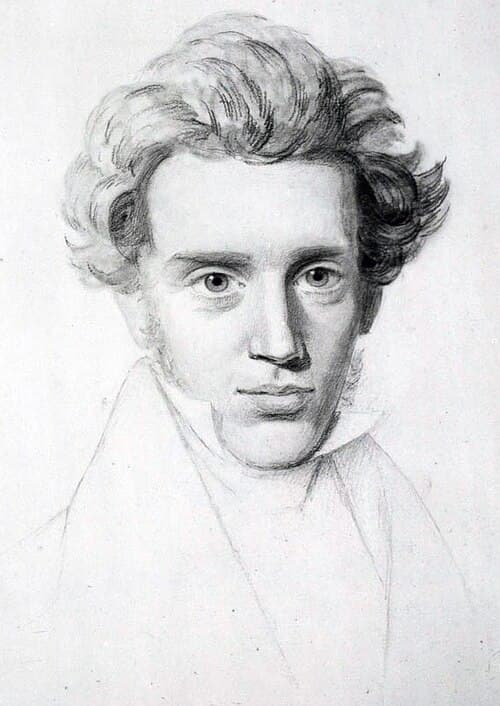
Søren Kierkegaard
Fear and Trembling

The author distances himself from formal philosophy and 'the System,' identifying instead as an amateur poet who believes faith cannot be fully captured by concepts.

...ows … except as he might succeed at the earliest opportunity in going further. Where these revered figures arrived, that is the point where everybody in our day begins to go further. The present writer is nothing of a philosopher, he has not understood the System, does not know whether it actually exists, whether it is completed; already he has enough for his weak head in the thought of what a prodigious head everybody in our day must have, since everybody has such a prodigious thought.
Even though one were capable of converting the whole content of faith into the form of a concept, it does not follow that one has adequately conceived faith and understands how one got into it, or how it got into one. The present writer is nothing of a philosopher; he is, poetice et eleganter, an amateur writer who neither writes the System nor promises of the System, who neither subscribes to the System nor ascribes anything to it.
He writes because for him it is a luxury which becomes the more agreeable and more evident, the fewer there are who buy and read what he writes. He can easily foresee his fate in an age when passion has been obliterated in favor of learning, in an age when an author who wants to have readers must take care to write in such a way that the book can easily be perused during the afternoon nap, and take care to fashion his outward deportment in likeness to the picture of that polite young gar...
2
The Solitary Knight
Søren Kierkegaard
Fear and Trembling

The author argues that the 'knight of faith' must act as a solitary individual outside of universal categories, meaning their path cannot be explained or validated by others.

...ing it for God's sake). Faith itself cannot be mediated into the universal, for it would thereby be destroyed. Faith is this paradox, and the individual absolutely cannot make himself intelligible to anybody. People imagine maybe that the individual can make himself intelligible to another individual in the same case. Such a notion would be unthinkable if in our time people did not in so many ways seek to creep slyly into greatness. The one knight of faith can render no aid to the other.
Either the individual becomes a knight of faith by assuming the burden of the paradox, or he never becomes one. In these regions partnership is unthinkable. Every more precise explication of what is to be understood by Isaac the individual can give only to himself. And even if one were able, generally speaking, to define ever so precisely what should be intended by Isaac (which moreover would be the most ludicrous self-contradiction, i.e. that the particular individual who definitely stands outside the universal is subsumed under universal categories precisely when he has to act as the individual who stands outside the universal), the…
Hence even if a man were cowardly and paltry enough to wish to become a knight of faith on the responsibility of an outsider, he will never become one; for only the individual becomes a knight of faith as the particular individual, and this is the greatness of this knighthood, as I can well understand without entering the order, since I lack courage; but this is also its terror, as I can comprehend even better. In Luke :, as everybody knows, there is a striking doctrine taught about the...
Continue reading →
2
The Terrible Individual
Søren Kierkegaard
Fear and Trembling

The author challenges the idea that existing as an individual is easy, suggesting it requires more strict self-supervision than living under universal rules.

...in the Church–not even his father and mother etc.–who fails to understand him. On the other hand, he is not a knight of faith, and he has also a different answer from that of Abraham: he does not say that it is a trial or a temptation in which he is tested. People commonly refrain from quoting such a text as this in Luke. They are afraid of giving men a free rein, are afraid that the worst will happen as soon as the individual takes it into his head to comport himself as the individual.
Moreover, they think that to exist as the individual is the easiest thing of all, and that therefore people have to be compelled to become the universal. I cannot share either this fear or this opinion, and both for the same reason. He who has learned that to exist as the individual is the most terrible thing of all will not be fearful of saying that it is great, but then too he will say this in such a way that his words will scarcely be a snare for the bewildered man, but rather will help him into the universal, even though his words do to some extent make room for the great. The man who does not dare to mention such texts will not dare to…
That there may be some who need compulsion, some who, if they were free-footed, would riot in selfish pleasures like unruly beasts, is doubtless true; but a man must prove precisely that he is not of this number by the fact that he knows how to speak with dread and trembling; and out of reverence for the great one is bound to speak, lest it be forgotten for fear of the ill effect, which surely will fail to eventuate when a man talks in such a way that one knows it for the great, knows it...
Continue reading →
4
Faith's Unshareable Burden
Søren Kierkegaard
Fear and Trembling

The author asserts that faith is an isolating paradox that cannot be mediated or shared between individuals, requiring each person to assume the burden alone.

...lly exclusive. Thus when we see a man do something which does not comport with the universal, we say that he scarcely can be doing it for God's sake, and by that we imply that he does it for his own sake. The paradox of faith has lost the intermediate term, i.e. the universal. On the one side it has the expression for the extremest egoism (doing the dreadful thing it does for one's own sake); on the other side the expression for the most absolute self-sacrifice (doing it for God's sake).
Faith itself cannot be mediated into the universal, for it would thereby be destroyed. Faith is this paradox, and the individual absolutely cannot make himself intelligible to anybody. People imagine maybe that the individual can make himself intelligible to another individual in the same case. Such a notion would be unthinkable if in our time people did not in so many ways seek to creep slyly into greatness. The one knight of faith can render no aid to the other. Either the individual becomes a knight of faith by assuming the burden of the paradox, or he never becomes one. In these regions partnership is unthinkable.
Every more precise explication of what is to be understood by Isaac the individual can give only to himself. And even if one were able, generally speaking, to define ever so precisely what should be intended by Isaac (which moreover would be the most ludicrous self-contradiction, i.e. that the particular individual who definitely stands outside the universal is subsumed under universal categories precisely when he has to act as the individual who stands outside the universal), the indivi...
2